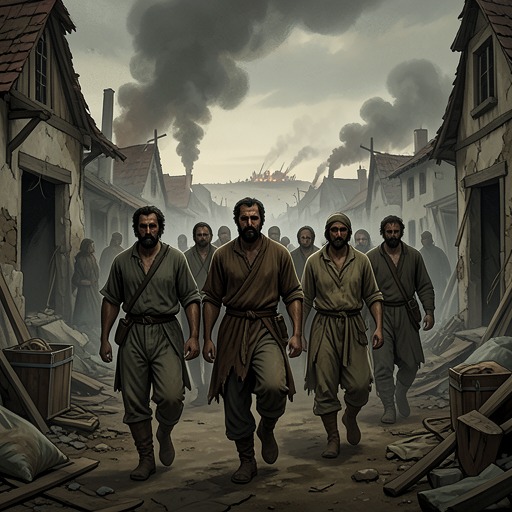
Xuande’s refusal to abandon the people
The Romance of the Three KingdomsXuande’s refusal to abandon the people is a defining principle of his leadership, tested most severely when Cao Cao’s advance drives him and his followers from Xinye and Fan. Faced with the choice between a faster, safer retreat and carrying the civilians who look to him for protection, Xuande chooses the people. His decision makes benevolence more than a claim to political virtue: it becomes a costly obligation that shapes where he can go, how quickly he can move, and what risks he accepts.
Principle and political setting
The novel places Xuande’s conduct against the collapse of the Han and the rise of rival powers. As the empire breaks apart, its leading commanders compete not only through armies but through claims about who can rule justly. Kong Ming identifies Cao Cao’s control of the emperor and the strength of his forces as reasons Xuande cannot simply confront him in the north; he urges Xuande to treat Sun Quan as a potential ally and to make his position in Jingzhou the basis of a larger strategy. Within that struggle, Xuande’s protection of ordinary people gives his political authority a practical, visible expression.
The principle is not presented as a guarantee of safety or military success. It repeatedly conflicts with the demands of campaigning: civilians slow movement, vulnerable settlements cannot be held, and pursuing forces gain opportunities to attack. Xuande’s conduct instead establishes what he will not count as an acceptable price of survival. Even when his officers see abandonment as the necessary military choice, he regards the people’s peril as inseparable from his own responsibility.
The exodus from Xinye and Fan
After Xuande rejects Cao Cao’s offer to surrender, he and Kong Ming conclude that Fan cannot be defended and that another move is unavoidable. Rather than order the inhabitants to fend for themselves, they ask the people what they wish to do. The people cry out that they want to accompany Xuande, turning the withdrawal into a mass exodus. The departure is marked by families helping one another: the young assist the elderly, parents carry children, and men care for women as the group sets out.
Xuande reads this suffering not as an incidental cost of war but as a consequence for which he is personally answerable. Overwhelmed by the distress, he says that it is his fault and attempts to throw himself into the river; his commanders intervene in time. The episode gives the principle its sharpest personal consequence. Xuande does not merely choose to remain responsible for the people: their hardship becomes a burden he turns against himself.
At Xiangyang, the crowd is refused entry by Liu Zong, whose fear of Cao Cao’s vengeance outweighs the plight of those outside the city. Amid the ensuing disorder, Kong Ming advises Xuande to give up the attempt to enter and head instead for Jiangling. By then, more than one hundred thousand people are travelling with him. Xuande stops to pray at Liu Biao’s tomb, then learns that Cao Cao is already at the river preparing to cross. His officers urge him to hasten to Jiangling, even if that means leaving the civilians behind. Xuande refuses, accepting that their presence will make progress slow and put his own life in serious danger.
Pursuit, danger, and continued responsibility
Cao Cao sends a force of five thousand to overtake Xuande, who is already more than a hundred miles ahead. While advancing with the people, Xuande sends Guan Yu to seek reinforcements from Liu Qi in Jiangxia. A sudden dust cloud blots out the sun, and Jian Yong, consulted as a reader of omens, warns that disaster awaits that night. He urges Xuande to flee and save himself by abandoning the civilians. Xuande again refuses; instead, the party takes defensive positions on a nearby hill and waits.
Cao Cao’s men attack before dawn. Xuande cannot hold them back and is nearly killed before Zhang Fei reaches him and helps him escape. As they flee, Wen Ping confronts them, but Xuande’s rebuke leaves Wen Ping ashamed, and he turns his men away. Zhang Fei continues to clear a path through the attackers until daylight. The escape does not preserve the large company that began the journey: Xuande sees only about a hundred of his men remaining and does not know where his family or the people have gone. He grieves for the lives suffering because they followed him, but the account does not resolve the immediate whereabouts of those separated in the attack.
Xuande’s response after the rout shows how thoroughly protection has become bound to his sense of responsibility. When Mi Fang claims that Zhao Zilong has joined the enemy, Xuande rejects the accusation, relying on their long friendship and Zhao Zilong’s proven steadfastness. The exchange takes place amid defeat and uncertainty: even then, Xuande’s concern is not simply how to escape, but what has happened to the people and companions who travelled with him, and whom he has reason to trust.
Leadership, risk, and narrative significance
The repeated refusals distinguish Xuande’s leadership from a purely tactical calculation. He does not mistake the danger: the route is slow, the pursuers are close, and the civilians make the retreat harder to manage. Yet he refuses the available shortcut of leaving them behind. The principle therefore has an immediate military cost while demonstrating the benevolence that helps define his claim to rule.
This conduct also connects private anguish to public legitimacy. When Kong Ming later argues that Xuande should become emperor, he points to his reputation for benevolence and to the peace his rule has brought to the regions under his control. The claim does not erase the losses and dangers of the retreat; it clarifies why the narrative makes Xuande’s choices among civilians politically meaningful. His authority rests, in part, on a refusal to treat ordinary people as expendable baggage. The episodes test that ideal under pressure, showing both its human cost and the basis on which Xuande’s followers and advisers understand his right to lead.