Xuzhou massacre
The Romance of the Three KingdomsThe Xuzhou massacre begins with a betrayal on the road and expands into a campaign of collective punishment. After Zhang Kai and his former Yellow Headband rebels kill Cao Cao’s family, Cao Cao blames Tao Qian and orders an invasion of Xuzhou, including the killing of the city’s inhabitants. The episode shows how private bereavement, mistaken responsibility, and a commander’s refusal to reconsider turn a family’s destruction into province-wide civilian devastation; Tao’s unsuccessful appeals and Xuande’s effort to intervene make that violence a test of political authority and public duty.
Causes and Background
Cao Cao’s family was travelling from the capital toward Yanzhou so they could join him there. The party comprised more than forty family members, around one hundred servants, and over one hundred wagons carrying their goods. Passing through Xuzhou, governed by Tao Qian, they were welcomed in the city. Tao then entrusted their escort to Zhang Kai, a former Yellow Headband rebel leader, and his men, assigning them to take the party to the provincial border.
A storm forced the travellers to shelter in an old temple. The family received quarters from the resident monks, while the soldiers lodged in the exposed corridors. Zhang Kai and his men, resentful of what they felt they had gained by surrendering, saw the Cao family’s wagons as a chance to enrich themselves. Zhang proposed killing the family and taking the goods; his lieutenants agreed. The attack was therefore not an order from Tao, but the decision of the escort he had appointed.
The Attack and Retaliation
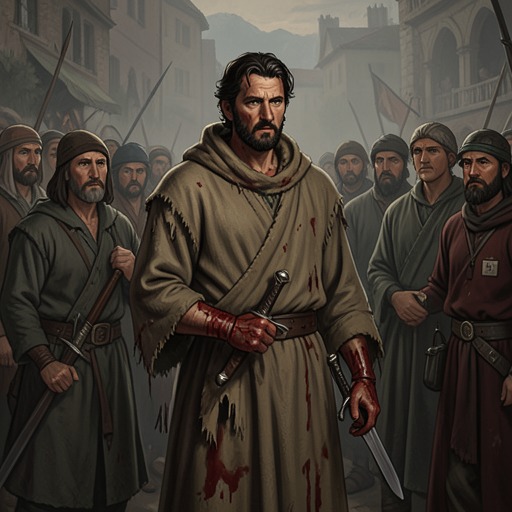
During the night, while the storm continued, Zhang Kai’s men killed the family members. The account describes people trying to hide or escape, including by climbing over the temple walls, but none survived. The rebels then burned the temple and fled to Huainan with the wagons. The family’s deaths and the loss of the party thus resulted directly from the escort’s betrayal, not from an attack ordered by Xuzhou’s governor.
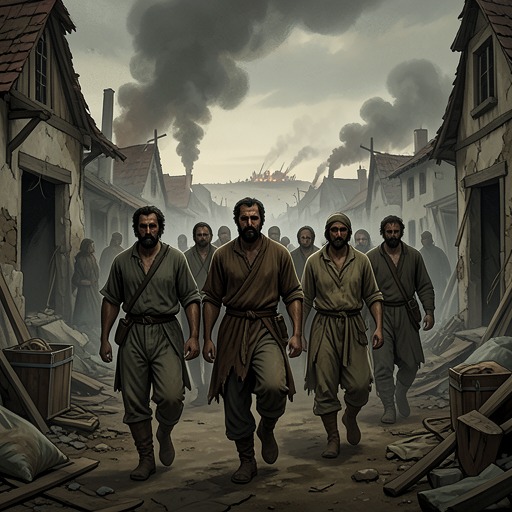
When Cao Cao learned what had happened, he collapsed in grief. He nevertheless attributed the killing to Tao Qian, swore revenge, and ordered an invasion of Xuzhou. His instructions were explicit: when the city fell, its people were to be killed. Ministers and courtiers tried to dissuade him, but he pressed ahead. The campaign brought massacres across the province; his forces also looted graves and desecrated the dead. The narrative’s cause-and-effect is stark: a crime committed by Zhang Kai’s men is converted into a pretext for punishing a much larger population that was not shown to be responsible.
Tao Qian’s Appeal and Xuande’s Intervention
Tao Qian rode out with his army to meet Cao Cao and tried to explain that Zhang Kai had betrayed them both. Cao Cao would not listen. Back in the city, Tao told his advisers that he considered himself responsible for the invasion and offered to surrender himself in the hope of preventing further violence. One adviser instead argued that the city’s defenses could withstand Cao Cao and proposed a plan to bring him down, although the account does not identify or describe that plan in this episode’s evidence.
Xuande’s intervention develops through a sequence of appeals and commitments. Responding to Kong Rong’s request for help, Xuande set out for Beihai with Zhang Fei, Guan Yu, and three thousand warriors. They broke the rebel siege of the city, after which Kong Rong asked Xuande to help Tao Qian resist Cao Cao. Xuande initially noted that he had no personal quarrel with Cao Cao, but Kong Rong persuaded him to assist the threatened province. Xuande gave his word, returned to his base to recruit more men, and then joined the others at Xuzhou.
Once there, Xuande proposed making one last appeal directly to Cao Cao. His letter acknowledged Cao Cao’s loss and argued that Tao Qian had no part in it. It urged Cao Cao to withdraw and called for supporters of the Han to unite against the wider threats to the court and empire rather than pursue private revenge. Cao Cao reacted with anger, executed the messenger, and ordered an attack on the city. The appeal therefore failed to change his judgment, and its messenger became another victim of the conflict.
Withdrawal and Political Significance
Cao Cao’s decision to leave did not follow from accepting Xuande’s explanation. At the moment he ordered the assault, a messenger reported that Lü Bu had attacked Yanzhou and seized most of Cao Cao’s province. Concerned that he might lose his own base, Cao Cao agreed to respond to Xuande’s letter and abandoned the siege. His withdrawal halted this immediate confrontation, but the account does not present it as a reconciliation or as recognition that Tao Qian was innocent.
The episode places the danger to ordinary people at the centre of political conflict: civilians suffer not only from Zhang Kai’s crime but also from the retaliatory orders issued by a powerful commander. Xuande’s appeal frames the choice differently, asking that Han loyalty and the defense of the empire take precedence over personal vengeance. This distinction becomes especially resonant against the novel’s broader setting of Han collapse, in which Cao Cao and Xuande emerge as rival leaders. Later, Kong Ming describes Cao Cao as powerful in part because he controls the emperor; the Xuzhou episode presents the human cost that accompanies such power without implying that political authority itself ensures justice. The novel’s wider blending of historical events with dramatic storytelling also gives the episode a concentrated moral shape: a failure to distinguish the guilty escort from the governor and the province turns grief into a campaign against civilians.