Yao–Shun abdication precedent
The Romance of the Three KingdomsThe Yao–Shun abdication precedent is a political model in which a ruler hands power to a successor outside his own hereditary line, and the transfer is presented as an act serving the realm rather than a seizure for private gain. In the novel, its language lends moral and historical authority to competing claims about the end of the Han: Cao Pi’s accession is staged as a voluntary handover, while Xuande’s succession is defended as a means of continuing the Han line.
The precedent and the crisis of the Han
The precedent enters a story shaped by repeated cycles of division and reunification. The Zhou empire fractured among competing kingdoms before Qin reunified the land; after Qin’s collapse, the Chu–Han struggle ended with Han rule. Later, an uprising again divided the empire, until Emperor Guang Wu restored unity. Under Emperor Xian, however, the Han realm breaks into three kingdoms, following a long decline in imperial authority and the takeover of the court by the Ten Imperial Attendants. Against this history, the question of who may rule is not merely a contest of armies: it is a contest over whether authority has been inherited, earned through virtue, or transferred by Heaven.
The precedent used to secure Cao Pi’s accession
When Cao Pi moves to replace Emperor Xian, his officials frame the proposed abdication as an honourable transfer modeled on the ancient rulers Yao and Shun. Hua Xin tells the emperor that the Han has run its course and asks him to hand the empire and its ancestral shrines to the King of Wei. He presents the act as one that would accord with Heaven and the people, and allow the former emperor to live in freedom. The historical example makes a politically compelled surrender sound like a ruler’s virtuous choice.
Emperor Xian resists this framing. He recalls that the Han founder overcame Qin and Chu and that the dynasty has passed down through the Liu family for four hundred years. His appeal to inherited continuity stands against the court’s argument that the dynasty has reached its natural end. When the emperor rejects astrological signs offered as proof that Heaven has transferred its mandate, Wang Lang warns him that dynasties and families must eventually fall. The precedent is thus part of a broader case that combines dynastic decline, claims about Heaven, and pressure from Cao Cao’s court.
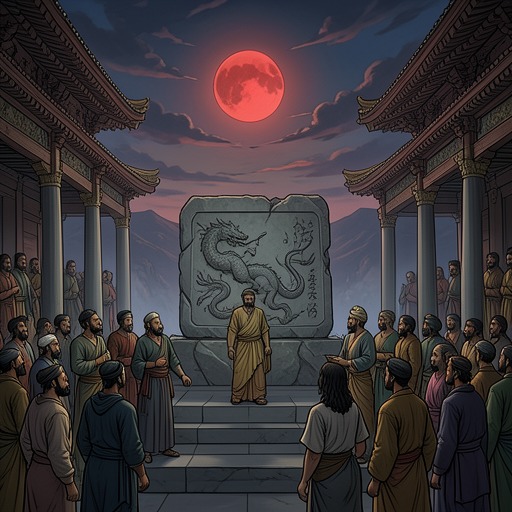
The abdication announcement, written in the emperor’s name, adopts the language of the precedent: it says that the Han fire has ended, fortune has moved to the Cao family, and the empire belongs to everyone rather than to one ruler. It describes the transfer to Cao Pi as following Yao’s example. Sima Yi advises Cao Pi to refuse at first and later to refuse again, extending the appearance of reluctance before maneuvering the emperor into ordering an Altar of Abdication. At the ceremony, Emperor Xian hands over the jade seal of authority before officials and soldiers, and Cao Pi accepts the throne as emperor of Wei. The staged sequence turns the precedent into a political procedure: the old ruler’s formal consent, the symbolic seal, and the public ceremony make a transfer achieved under pressure resemble a voluntary act of virtue.
The precedent and Xuande’s rival claim
The precedent’s political force is not confined to Cao Pi’s case. Kong Ming tells Xuande that Cao Cao has taken power while the true ruler is usurped, and urges Xuande to become emperor after his victories and the restoration of peace in the regions under his control. Xuande objects that, despite his descent from the House of Han, taking the throne would make him appear rebellious. Kong Ming answers that the realm needs a true emperor and presses him to accept the people’s hopes and Heaven’s will.
After Cao Pi establishes the Wei dynasty, Kong Ming proposes that Xuande be crowned as a new Han emperor. Xuande is horrified, calling the action rebellious and disloyal; Kong Ming counters that Cao Pi has already usurped the Han and that Xuande, as a descendant of the Liu house, has a duty to take back control. The two arguments draw on different accounts of legitimate succession. Cao Pi’s accession is presented as a transfer away from a failing dynasty, while Xuande’s is justified as continuation of the displaced Han line. The Yao–Shun model therefore supplies a vocabulary of legitimacy without resolving the conflict: each side’s claim depends on how the end of Han authority and the will of Heaven are interpreted.