Yellow Headband rebels
The Romance of the Three KingdomsThe Yellow Headband rebels are the mass uprising led by Zhang Jue and his brothers Zhang Bao and Zhang Liang, whose rise turns a crisis of imperial authority into open war. Their movement begins with healing, secret teachings, and a promise of a new age; once its plan to overthrow the dynasty is exposed, it erupts across the empire. The rebellion is defeated as a direct threat, but its appearance at the opening of the story sets the conditions for Xuande’s entrance and gives later struggles over rule a first, decisive precedent.
Origins and Beliefs
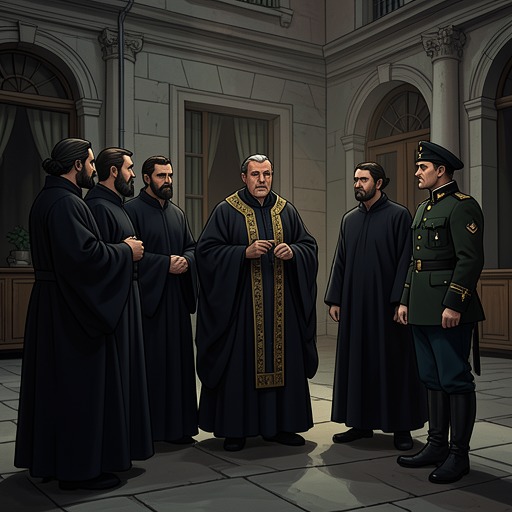
The movement takes shape amid signs of disorder at the imperial court. Omens unsettle Emperor Ling, but warnings from loyal ministers do not restore order: he withdraws into the palace while the Ten Imperial Attendants, led by Zhang Rang, take control. Rebellion spreads through the empire, and the Yellow Headband rebels arise from this widening political crisis.
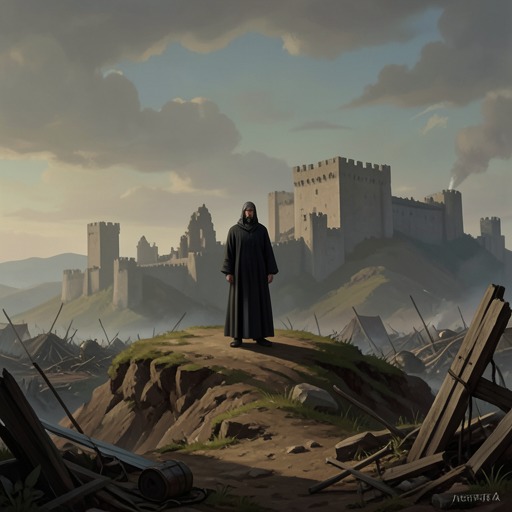
Zhang Jue’s authority begins with a supernatural encounter rather than a military appointment. After failing his imperial examination, he retreats to the mountains, where an old master leads him into a cave and gives him a three-volume divinely inspired book, The Peaceful Way for the Future. The master names Zhang Jue Heaven’s chosen messenger and charges him to spread its teachings, while warning that abandoning compassion will bring misfortune. When Zhang Jue asks the stranger’s identity, the master calls himself the Old Immortal from the sacred mountain of Hua Shan and vanishes.
Zhang Jue studies the texts and acquires arts that include summoning wind and rain. Known as the Peaceful Master of the Way, he gains a following when plague strikes: the amulets and spells he distributes are said to succeed, and his fame draws hundreds of thousands of adherents. A song circulating among the people declares that the Blue Heaven is dying and the Yellow Heaven arising, heralding a new cycle and promised good fortune. The movement’s appeal thus joins practical aid in sickness to a cosmic account of dynastic change.
From Conspiracy to Uprising
Zhang Jue gives himself the title Great and Esteemed Leader and decides that the moment has come to overthrow the dynasty. He orders yellow banners made, sets an auspicious date, and sends a trusted disciple to the capital, where the movement already has supporters within the palace. But the disciple betrays the plan: the court conspirators are arrested, and the rebels inside the palace are imprisoned.
The discovery of the plot turns preparation into emergency. Zhang Jue summons his troops, adopts the title Heaven’s Commander, and tells his followers that a great sage will soon appear and a new era begin. Hundreds of thousands respond from across the empire, wearing yellow cloth around their heads. The scale of the rising overwhelms the imperial troops, who scatter before its force. The yellow headcloths make the movement visible as a collective body, while its message casts revolt as the beginning of a promised transformation rather than merely a contest for office.
Xuande’s Entry into the War
The rebellion advances into the territory governed by Liu Yan, a distant member of the imperial family. Liu Yan is advised to issue a proclamation urgently recruiting volunteer soldiers, and the notice is posted in Zhuo County. Xuande sees it. The narrative presents him as generous, reserved, and modest, though not a scholar, and describes his unusual stature and features; the appeal for recruits gives those personal qualities their first public test.
Xuande joins with Guan Yu and Zhang Fei. After swearing allegiance, the three agree that Xuande will be regarded as elder brother, Guan Yu as second, and Zhang Fei as third. They share meat and wine in the Peach Orchard with roughly three hundred recruits, then gather weapons, horses, and armor. Their force grows to about five hundred and reports to Liu Yan. When an army of around fifty thousand Yellow Headband rebels attacks the Zhuo district a few days later, Xuande leads his men, with Guan Yu on his left and Zhang Fei on his right. Zhang Fei kills the enemy champion with his spear; Guan Yu cuts down the champion’s companion. The rebels flee, and many are captured. The uprising therefore supplies the opening occasion for the three companions’ first joint action and for Xuande’s emergence as a military leader.
Political Legacy
The rebels belong to the wider breakdown that precedes the Three Kingdoms. As the Han fragments and warlords carve kingdoms from its failing authority, the movement’s challenge to the court stands at the beginning of a longer crisis in which control of the emperor, inherited legitimacy, and claims of Heaven’s will become recurring grounds for political conflict. Later, Kong Ming argues that the Han has collapsed and its authority been usurped by evil ministers; he also invokes the Will of Heaven and the people when urging Xuande toward rule. The uprising’s own language of a dying Blue Heaven and a rising Yellow one makes that struggle between dynastic decline and a promised new order visible from the outset.
The movement’s influence is not limited to the opening campaign. In the later account of Zhang Lu’s Hanzhong regime, Zhang Lu is described as continuing a religious tradition associated with his grandfather, Zhang Ling, and father, Zhang Heng. That regime has its own healing practices, ritual petitions, communal provision of rice and meat, and system of libationers. This is a distinct organization, not a continuation of the Yellow Headband rebels, but its place in the book’s account of regional rule recalls how religious authority and care for the sick could acquire political force amid weak imperial control.
The rebellion also forms a contrast with later efforts to govern newly conquered peoples. During the southern campaign, Meng Huo’s forces resist the Shu army, and after repeated defeat and release he submits. Kong Ming appoints him ruler over lands conquered by the Shu kingdom, and the people rejoice. The two movements are not treated as the same political episode: the Yellow Headband rising seeks to overthrow the Han, whereas the later settlement incorporates a defeated population under a recognized local ruler. Together, these episodes frame a recurring problem in the story: whether popular allegiance will be mobilized against a failing center or secured through the terms of rule after conquest.