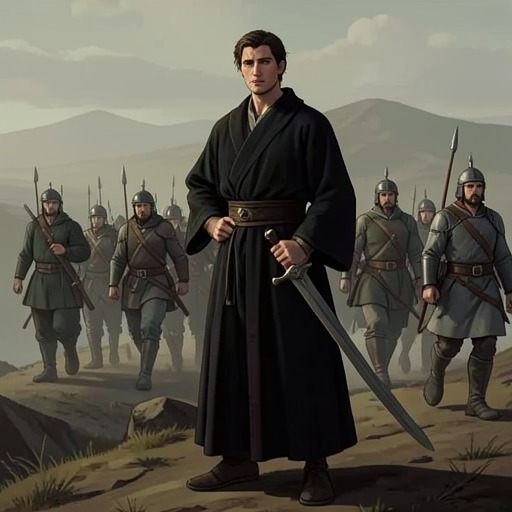
Yu Ji
The Romance of the Three KingdomsYu Ji is a Daoist healer whose encounter with Sun Ce turns a dispute over spiritual authority into a crisis that foreshadows the ruler’s death. Celebrated by the people and credited with summoning rain, Yu refuses to be intimidated by Sun Ce’s threats; after Sun Ce has him executed, Yu’s repeatedly appearing spirit overwhelms the ruler, whose wounds reopen and who dies after transferring power to Sun Quan. The episode makes Sun Ce’s rejection of supernatural claims inseparable from the consequences the narrative assigns to it.
Reputation and encounter with Sun Ce
Yu enters the episode through the response of others to his reputation. During a feast, Sun Ce learns that guests and attendants are leaving because Yu is in the marketplace. From a window, he sees a Daoist monk in a crane-feather cloak, leaning on a staff as people bow, burn incense, and worship. Sun Ce orders Yu brought before him, although his attendants warn that the monk is famous as a healer and urge him to treat Yu respectfully.
Yu tells Sun Ce that he is a poor Daoist monk. He says that in the reign of Emperor Shun he found a hundred-volume sacred book called Finding the Way of Peace for a Thousand Years, whose pages taught him to cure illness. He claims to have travelled and healed people without accepting rewards. Sun Ce instead associates Yu’s clothing and claims with the teachings of Zhang Jue and the Yellow Headband rebels, calls him a fraud, and threatens execution. The disagreement is not merely about whether Yu heals: Sun Ce treats popular reverence for a religious figure as a political danger, while his courtiers see Yu’s long record of service as grounds for restraint.
The rain trial and execution
Zhang Zhao speaks in Yu’s defence, and nearly all the court, including Sun Ce’s mother, asks that he be spared. Sun Ce nevertheless imprisons him while deciding what to do. When an adviser proposes testing Yu’s reputed ability to summon rain during a drought, Sun Ce agrees to the trial rather than release him.
Yu mounts an altar and promises three feet of rain by noon, while also saying that he believes he will die because his time has come. Sun Ce orders that Yu be burned if he fails. As the appointed hour approaches, the pyre is lit; then rain falls and quickly reaches the promised depth. Yu calls out, and the rain stops. The assembled people kneel in awe, but their response hardens Sun Ce’s hostility rather than persuading him. He dismisses the result as luck and orders Yu’s beheading. He then orders the body left in the marketplace as a warning.
The returning spirit and Sun Ce’s death
The next morning Yu’s body is gone, and Sun Ce sees Yu walking before the main hall. Sun Ce collapses. His mother urges him to repent, but he resists her appeal and remains determined to reject spiritual explanations. He eventually agrees to visit a local temple with her, burns incense but refuses to pray, and sees Yu appear in the smoke. Yu appears again at the gate. Sun Ce throws a sword at the spirit, but it strikes and kills the soldier who had beheaded Yu.
Yu continues to appear beside the temple. Sun Ce orders the building burned, yet sees the spirit among the flames; the repeated apparitions leave him frightened and haggard. When his mother tells him he looks unwell, Sun Ce looks in a mirror and sees Yu’s face reflected. He collapses, and the wounds from his earlier injuries reopen. The narrative makes these appearances the immediate culmination of the execution: what Sun Ce had called a trick returns in a form he cannot dismiss, and the physical consequences coincide with his recognition that he is dying.
Succession and narrative significance
As death approaches, Sun Ce summons Zhang Zhao and his younger brother Sun Quan and hands the seal of office to Sun Quan as his heir. He directs his mother and brother to consult Zhang Zhao on internal matters and Zhou Yu on external affairs; Zhou Yu is not present. Sun Ce then dies at twenty-six. Yu’s episode thus ends not with a change of allegiance or a public reconciliation, but with Sun Ce setting his affairs in order and transferring rule.
The account places a ruler’s political authority beside a religious figure’s authority over healing and signs. The rain trial offers a public test, but its outcome does not alter Sun Ce’s decision: the people’s belief intensifies his defiance, and execution is followed by apparitions, a fatal accident, and the return of his wounds. Elsewhere, the book also treats celestial and supernatural signs as part of arguments about rule. During the burial of Dong Zhuo, repeated storms destroy the coffin, and the narration presents the disasters as Heaven’s anger. In the account of the Han court’s transfer of authority to Cao Pi, astrologers invoke auspicious signs to claim that Heaven has passed the mandate to Wei, while a violent storm during Cao Pi’s worship of Heaven and Earth is read as a portent of displeasure. These episodes do not make Yu a participant in those political events; together, they show how the narrative repeatedly makes supernatural signs a test, and sometimes an indictment, of human claims to power.