Yuan Shao
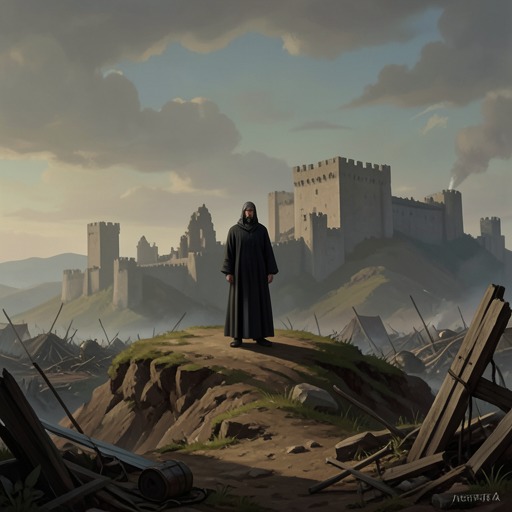
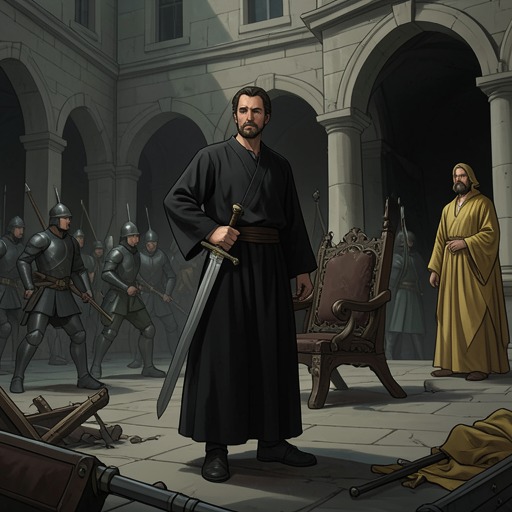
The Romance of the Three KingdomsYuan Shao is a major warlord whose rise helps define the fractured politics of the late Han. He joins Cao Cao’s call to oppose Dong Zhuo, is chosen to lead the coalition, and establishes himself in Jizhou through political maneuvering. His success brings military power, but his seizure of the province alienates Gongsun Zan and exposes the gap between the coalition’s public language of loyalty and the rival ambitions of its leaders.
Position in the Struggle for Power
The account places Yuan Shao among the three leading figures who emerge as the Han empire disintegrates. Cao Cao and Sun Quan are named alongside him as leaders who will each establish a kingdom from the failing empire. Yuan Shao’s role is therefore more than that of a coalition commander: he is one of the principal contenders in the larger contest to replace Han authority with regional power.
His standing is visible early in the campaign against Dong Zhuo. After Cao Cao circulates a proclamation calling for Dong Zhuo’s removal, Yuan Shao brings an army of thirty thousand to join him. Seventeen military leaders eventually rally to the cause. At their gathering, Yuan Shao is selected to command the expedition, while his brother Yuan Shu is assigned responsibility for supplies. The coalition’s shared pledge is framed as protecting the imperial family and its shrines, giving the campaign a language of public loyalty even as it assembles rival armies under one banner.
Coalition Leadership and Han Legitimacy
Yuan Shao’s leadership is presented as both political recognition and a claim to moral authority. Before the campaign proceeds, he makes sacrifices and vows before Heaven, Earth, and the ancestors that those assembled will protect the imperial house from Dong Zhuo’s actions. This solemn language contrasts with the fact that the coalition is made up of competing regional powers, each with its own army and interests.
The crisis around the succession had already shown Yuan Shao acting alongside Cao Cao. When the court faced uncertainty after Emperor Ling’s death, Cao Cao nominated Prince Bian as heir, and Yuan Shao joined the declaration. Yuan Shao then offered five thousand soldiers to storm the palace, place the prince on the throne, and eliminate the eunuchs. The episode establishes him as a forceful participant in court politics as well as a commander: his military resources could be deployed in support of a proposed succession and a stated restoration of order.
Seizure of Jizhou and Rupture with Gongsun Zan
Yuan Shao’s acquisition of Jizhou reveals a more opportunistic method of rule. He first encouraged Gongsun Zan to join him in attacking the province, then warned its governor, Han Fu, of the danger posed by Gongsun Zan and offered to help defend Jizhou. Although some of Han Fu’s advisers recognized the offer as a plan to take control, Han Fu accepted Yuan Shao’s assurances. Yuan Shao entered with his army and took over the province; two advisers who attempted to oppose him were killed by his guards. Han Fu received a grand-sounding but powerless title and was pushed aside, only later realizing how completely he had lost control.
The seizure transformed Yuan Shao’s relationship with Gongsun Zan. Enraged by what he regarded as treachery, Gongsun Zan confronted him at a bridge over the Pan River, with the two armies arrayed on opposite banks. Gongsun Zan accused Yuan Shao of betrayal and condemned the change from his former standing as leader of the uprising. Yuan Shao answered that Han Fu had surrendered because Yuan Shao was his superior, rejecting Gongsun Zan’s right to intervene. Their dispute became an armed clash: Yuan Shao ordered an attack, and Gongsun Zan’s forces were driven into retreat. The episode shows how the coalition’s shared opposition to Dong Zhuo gave way to conflict over territory and authority.
Reputation and Retrospective Significance
Yuan Shao’s later reputation is measured against Cao Cao’s rise. Kong Ming describes Cao Cao as initially weaker than Yuan Shao but successful through cunning, ultimately gaining a vast army and control of the emperor. The comparison makes Yuan Shao a benchmark for Cao Cao’s political and military ascent: the man once better positioned in the north has been overcome, and Cao Cao has converted that victory into control over the court and the allegiance of many nobles.
That contest also sits within a wider argument about Han legitimacy. When Kong Ming urges Xuande to accept the imperial title, he invokes Cao Cao’s seizure of power and the displacement of the rightful ruler. The later transfer of the throne from the Han to Cao Pi is presented through the language of Heaven’s signs, popular feeling, and the precedent of Yao’s abdication; the new Wei ruler’s advisers urge him to accept only after a formal sequence of refusals. Yuan Shao is not present in those later scenes, but his earlier coalition leadership and territorial ambition belong to the same political landscape: claims of loyalty to the Han coexist with the pursuit of power that eventually breaks the empire into competing kingdoms.