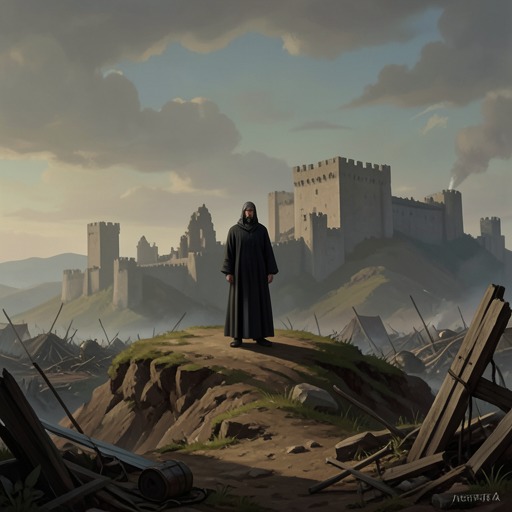
Zhang Jue
The Romance of the Three KingdomsZhang Jue is the central leader of the Yellow Headband rebellion, a movement whose rise exposes the Han dynasty’s weakening authority and whose defeat leaves the empire further open to competing powers. His story begins with a failed imperial examination and a chance encounter with a mysterious teacher; it ends with his death during a revolt that has already lost its original leader and direction.
Background and Revelation
After failing the imperial examination, Zhang Jue withdrew to the mountains seeking solace and healing. There he met an old man who led him into a cave and gave him a divinely inspired book in three volumes, The Peaceful Way for the Future. The teacher named him Heaven’s messenger, charged with spreading the teachings, and warned that he must practise compassion or suffer ill fortune. When Zhang Jue asked the old man’s identity, he answered that he was the Old Immortal from the sacred mountain of Hua Shan, then disappeared.
The encounter gives Zhang Jue’s later authority a supernatural foundation: his movement is presented not simply as a bid for power but as a mission he believes Heaven has entrusted to him. The warning about compassion also places a condition on that authority, foreshadowing the eventual failure of the rebellion without making its outcome a simple consequence of any one decision.
Teachings and the Rise of the Rebellion
Zhang Jue studied the book and acquired occult powers, including the ability to summon wind and rain. Known as the Peaceful Master of the Way, he gained a wide reputation when plague struck in the last year of Emperor Ling’s reign. The amulets and spells he distributed were reported to be successful, and his fame spread until hundreds of thousands of people followed him.
A song associated with the movement announced that the Blue Heaven was dying and the Yellow Heaven arising, marking the beginning of a new cycle and promising good fortune. The language turned widespread political and social unrest into a vision of a new order. Zhang Jue took the title Great and Esteemed Leader, made yellow banners, chose an auspicious date, and organized an uprising.
Exposure and Mass Uprising
Zhang Jue first tried to build support inside the palace. He sent a trusted disciple to the capital to contact an established supporter there, but the disciple betrayed the plan. The court conspirators were arrested and imprisoned, exposing the plot before the planned revolt could proceed as intended.
In desperation, Zhang Jue summoned his troops and called himself Heaven’s Commander. He told his followers that a great sage would soon appear and that a new era was near. Hundreds of thousands responded from across the empire, wearing yellow cloth around their heads. Their rising force scattered the imperial troops and transformed the failed palace conspiracy into an empire-wide rebellion.
Defeat and Narrative Significance
The rebellion did not survive its founder. Zhang Jue died, and his son was killed in battle. During the siege of Yangcheng, the news prompted Zhang Bao’s men to turn against him: one of them killed Zhang Bao and surrendered to the imperial forces with his leader’s head. The movement’s collapse thus followed both the loss of its original leader and a revolt within its own ranks.
Zhang Jue’s rebellion is set against a court weakened by omens, political withdrawal, and the dominance of the Ten Imperial Attendants. Later, Kong Ming describes the rot of the Han as beginning with Dong Zhuo and depicts a divided realm in which Cao Cao controls the emperor while other leaders contend for power. Zhang Jue’s uprising is an early, decisive expression of that larger breakdown: it challenges the dynasty in the name of a new heavenly cycle, but its defeat does not restore stable imperial rule. The movement’s promise of renewal instead belongs to a narrative of recurring disorder and contested political legitimacy.