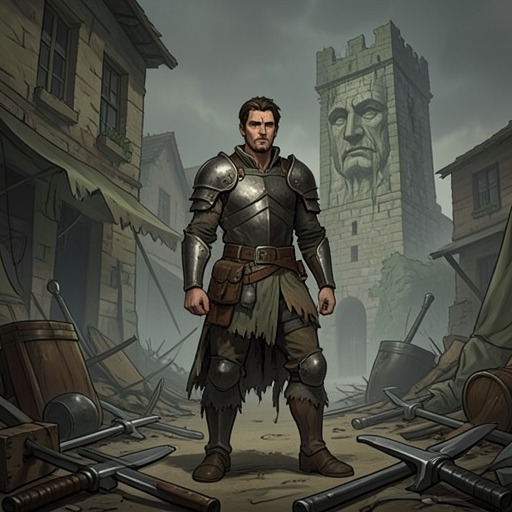
Zhang Liao
The Romance of the Three KingdomsZhang Liao’s role in the novel is defined by a striking combination: he is a dangerous and resourceful battlefield commander, yet his most consequential relationships are shaped by gratitude, loyalty, and the ability to restrain force. Xuande and Guan Yu save him from execution; later, serving Cao Cao, he rescues Cao Cao during the rout at Red Cliffs and leads a devastating attack at Hefei that nearly captures Sun Quan. The novel makes his martial reputation inseparable from the bonds that govern his choices.
Identity and Introduction
Zhang Liao first appears as a captured opponent brought before Cao Cao. The two recognize one another from their earlier encounter at Puyang, where Zhang Liao says he regrets not having killed Cao Cao. Cao Cao responds in anger, raising his sword against the prisoner. Xuande seizes Cao Cao’s sword arm, while Guan Yu kneels to plead for Zhang Liao’s life. Their intervention turns a moment of threatened execution into a demonstration of how they judge character: Xuande says Zhang Liao has a pure heart and that they need men like him.
Cao Cao then declares that he was joking, frees Zhang Liao himself, and wraps his cloak around him. The gesture marks a reversal from captor and prisoner to patron and supporter. From that day, Zhang Liao becomes one of Cao Cao’s most ardent adherents. The narrative thus introduces him through an encounter in which his future allegiance is not secured by defeat alone: it follows an act of mercy, and comes after Xuande and Guan Yu have recognized his worth.
The Three Conditions and Guan Yu’s Choice
Zhang Liao’s friendship with Guan Yu becomes important when Cao Cao seeks to bring Guan Yu into his service. Cao Cao admires him and wonders who might persuade him to switch sides. Zhang Liao offers to try because he is Guan Yu’s friend, but Cheng Yu warns that words alone will not suffice. His plan is to place Guan Yu in an apparently impossible position and then have Zhang Liao speak to him.
After Xiapi falls, Guan Yu is isolated on a hill and prepares to make a final attack rather than submit. Zhang Liao rides up alone. He reminds Guan Yu that Guan Yu once saved his life, explaining that he has come in the hope of saving Guan Yu in return. Guan Yu initially takes this to mean that Zhang Liao has brought reinforcements to join his struggle; Zhang Liao has to tell him that this is not the case. His appeal rests not on a promise of military aid but on the obligations Guan Yu already recognizes.
Zhang Liao identifies three errors in Guan Yu’s intended suicide. Guan Yu had vowed with his brothers to die together, but Xuande may still survive and need his help. Xuande’s wives have been entrusted to Guan Yu’s protection and would be left without it if he died. And the sworn purpose of protecting the Han dynasty, together with Guan Yu’s grounding in the Classics, makes an unnecessary death a failure of duty rather than an act of fidelity. The argument redirects Guan Yu from a solitary gesture of defiance toward obligations to his brothers, the household in his care, and the Han.
A later interruption echoes this intervention: when a third horseman charges in shouting for an attack to stop, the messenger is Zhang Liao. Across these scenes, his role is not only to persuade but to prevent decisions whose consequences would break existing ties or squander a larger purpose.
Commander in Cao Cao’s Service
Zhang Liao’s service to Cao Cao includes work that depends on judgment as much as direct force. At one point, Jia Xu studies Cao Cao’s apparent attention to a section of the city wall. The southeastern rampart is the weak point: its earthworks are crumbling and the wall consists largely of wooden stakes. But Cao Cao acts as if he has not noticed and piles materials on the northwest side to suggest that an attack will come there. This account emphasizes the importance of reading both a defended position and the signals deliberately offered to an opponent. Zhang Liao’s wider career likewise unfolds in a narrative where intelligence, feints, terrain, and the timing of an attack shape military outcomes.
Before the Battle of Guandu, Cao Cao’s army is only about a tenth the size of Yuan Shao’s. Xun You urges immediate action because Cao Cao’s veterans may be able to defeat a much larger force, but their supplies will not sustain a prolonged campaign. Zhang Liao’s later battlefield episodes belong to this recurring strategic world: numerical strength alone is not decisive, and a commander’s choices about timing and exposure can determine whether a smaller force survives or wins.
At Bowang, Kong Ming assigns Zhang Liao and other commanders to coordinated positions around the route of Cao Cao’s advancing army. Guan Yu is to wait in the hills and attack the rear and supply train once he sees flames; Zhang Fei is to watch for the same signal and strike at the army stores. Two commanders prepare fires on either side of the ravine, while Zhao Zilong leads the advance party and is instructed to feign retreat when he meets the enemy. Zhang Liao is not individually assigned a particular maneuver in this account, but the plan illustrates the coordinated use of concealed troops, fire, supply targets, and a deliberately staged withdrawal that forms the military setting for his career.
Red Cliffs and the Rescue of Cao Cao
After Cao Cao’s defeat at Red Cliffs, the retreat becomes a race through smoke, fire, and disorder. As Cao Cao searches for a way to escape, Huang Gai spots him and pursues in a skiff. Zhang Liao drives through in a small boat to reach Cao Cao, who leaps aboard; the opposing pursuer and rescuer race to land first. Zhang Liao’s arrow shot gives him the advantage. He hauls Cao Cao onto dry land, and the two mount horses and flee as the army around them falls into chaos.
Their escape remains precarious. Cao Cao and Zhang Liao have only a few men left, and they ride through a landscape made difficult to navigate by flames and smoke. When Cao Cao demands a way through, Zhang Liao points to the nearby forest as the only route. His actions combine immediate initiative with practical direction: first he gets Cao Cao out of the water and onto land, then he identifies where the small surviving party can go.
The flight brings them face to face with Guan Yu, who has been positioned to block the road. Guan Yu tells his troops to spread out and turns his horse away from Cao Cao, leaving a gap through which Cao Cao and his officers escape. He then faces the remaining men, but when his old friend Zhang Liao rides forward, Guan Yu relents and frees them as well. The escape is therefore not simply Zhang Liao’s rescue of his commander. The bond between Zhang Liao and Guan Yu helps bring about the release of Cao Cao’s remaining force, joining a military retreat to the personal history that began when Zhang Liao was himself spared.
Hefei and a Fearsome Reputation
At Hefei, Zhang Liao’s command turns a dispute over whether to remain behind the city walls or attack into a decisive offensive. Cao Cao’s message appears to support both options, but the defenders ultimately follow Zhang Liao’s decision to sally out and destroy the Xiaoshi bridge. The bridge becomes a key feature of the plan: its destruction will later leave Sun Quan facing a perilous crossing when Zhang Liao’s assault drives him back toward it.
Sun Quan’s initial attack succeeds, but Zhang Liao then strikes at him. Ling Tong, with about three hundred riders, cannot withstand the assault. He urges Sun Quan to cross the Xiaoshi bridge quickly, only for Sun Quan to find that its far end has already been destroyed. One of his men tells him to ride back and jump the gap. Sun Quan retreats thirty paces, turns, and drives his horse toward the broken bridge; it clears the gap and lands on the far bank. Zhang Liao’s attack has brought Sun Quan to the edge of capture, while the ruined crossing turns escape into a desperate calculation.
Ling Tong loses all three hundred of his men but survives. The slaughter across the battlefield is so severe that Zhang Liao’s name is used for many years afterward to frighten naughty children in Wu. The story measures the impact of his command not only by the immediate outcome but by the memory it leaves among his enemies: his reputation becomes a domestic threat, a name invoked long after the battle.
During a later encounter near Ruxu, the rivalry between Ling Tong and Gan Ning flares into a fight in front of Sun Quan. Sun Quan stops them and warns them not to underestimate Cao Cao’s strength. He sends Ling Tong with three thousand men to look for Cao Cao’s advance party. When they reach the barrier at Ruxu and encounter Cao Cao’s army, Ling Tong rides out and fights Zhang Liao for many rounds without either prevailing. Sun Quan then orders Ling Tong to return, the encounter having produced little beyond the inconclusive contest between the two commanders.
Zhang Liao also anticipates danger beyond the immediate engagement. When his own men question his orders to stay fully alert, he insists that a night attack is highly likely. The account highlights a commander who does not treat a momentary lull as proof of safety: readiness depends on judging what the enemy may attempt next. Together with the Hefei attack and the Ruxu encounter, this caution completes the portrait of Zhang Liao as both an aggressive battlefield leader and a vigilant one.