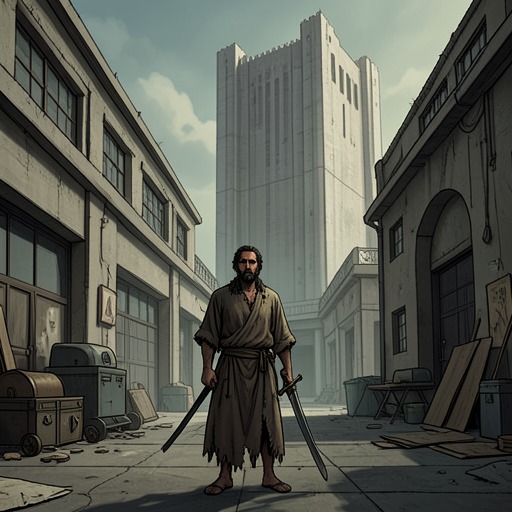
Zhang Lu
The Romance of the Three KingdomsZhang Lu is the ruler of Hanzhong whose political authority rests on a long-established religious community and whose final surrender brings the region under Cao Cao’s control. His story turns on a tension between resistance and restraint: he contemplates enlarging his domain and defying Cao Cao, yet when Hanzhong falls he protects its stores as the property of the Han dynasty and its people. Cao Cao honors that act, even as Zhang Lu’s own adviser Yang Song betrays him.
Identity and rule in Hanzhong
Zhang Lu governs a remote territory that has remained outside the imperial court’s immediate concern for thirty years. The court has accommodated his rule by giving him the official title of prefect and requiring the usual tax payments. His authority is therefore at once locally established and nominally incorporated into the Han order: Hanzhong governs itself in practice, while its ruler retains an imperial appointment.
The territory’s religious tradition predates Zhang Lu. His grandfather, Zhang Ling, is described as a Daoist master who meditated in the western Riverlands of Shu and wrote a book that persuaded ordinary people he possessed magical or divine powers. Zhang Heng, Zhang Lu’s father, continued the tradition, and Zhang Lu in turn inherited its leadership. The account connects the movement’s growth to a five-bushel rice donation required of those who wished to study the Dao, a practice that earned Zhang Heng the nickname Rice Thief.
Religious community and public order
Zhang Lu gives himself the title supreme ruler, while his followers are known as ghost fighters. The community assigns religious offices rather than maintaining ordinary officials: local leaders are called libationers, and those responsible for large forces are lead healing libationers. Its stated ethical center is sincerity, with lying and deception forbidden.
The community’s response to illness combines reflection, confession, prayer, and prescribed offerings. A sick person is brought to the Place of Silence to reflect on the sins believed to have caused the illness and to articulate them. A superintendent of libations oversees prayers, accompanied by a written confession copied three times. One copy is placed on a hill for Heaven, one buried for Earth, and one cast into water for the officials of the Underworld. If the patient recovers, the person donates five bushels of rice in thanksgiving.
This system also has a material, communal dimension. Public places provide poor people with free rice and meat and somewhere to cook. People may take what they honestly need, but excess is believed to invite punishment from Heaven. Offenders receive three pardons before punishment. The account thus presents the religious community not only through ritual and titles but also through provisions for need, limits on taking, and a rule-governed form of discipline.
Ambition and the threat from Cao Cao
News that Cao Cao has defeated the western army and is beginning to extend his power alarms Zhang Lu. He predicts that, after Ma Teng’s death and Ma Chao’s retreat, Cao Cao will next move against Hanzhong. To get ahead of that danger, Zhang Lu considers proclaiming himself prince of Hanning and leading a resistance.
His adviser Yan Pu urges a more expansive plan. He points to more than one hundred thousand households, substantial wealth and grain, and natural defenses on all four sides. Refugees have arrived in large numbers after Ma Chao’s defeat; Yan Pu also judges Liu Zhang, governor of Yizhou, weak. Rather than merely declaring resistance from Hanzhong, he recommends taking the forty-one departments of the Western Riverlands and declaring independence there. Zhang Lu is persuaded enough to commission his brother Zhang Wei to summon the army.
Ma Chao’s arrival further strengthens Zhang Lu’s confidence. After his family is killed and he escapes west, Ma Chao offers his services in Hanzhong, and Zhang Lu receives him. The new recruit encourages Zhang Lu to plan a seizure of Yizhou and a defiance of Cao Cao. Zhang Lu even considers making Ma Chao his son-in-law, but Yang Bo opposes the match, arguing that Ma Chao’s actions have resulted in the deaths of his entire family and are therefore a bad omen. Ma Chao responds by vowing revenge on Yang Bo, who in turn vows to get rid of him. The intended alliance thus brings private antagonism into Zhang Lu’s circle at the very moment his political ambitions are growing.
Surrender and aftermath
As Cao Cao’s forces overwhelm the city, Zhang Lu orders the grain warehouses and treasury sealed and protected. He regards them as belonging not to himself but to the Han dynasty and its people. That decision distinguishes the care of public stores from the defense of his own power, and Cao Cao is impressed when he learns that they have been preserved.
Cao Cao sends a message asking Zhang Lu to surrender. Zhang Lu is willing, but his brother resists. Yang Song offers to help Cao Cao secure the city, then deceives Zhang Lu: he persuades him to leave the city to attack Cao Cao’s troops and refuses him entry when he returns. Shut out and unable to regain the city, Zhang Lu has no choice but to surrender. Cao Cao receives him with praise and honor, while the whole Hanzhong region passes into Cao Cao’s hands and those who surrendered are given new posts. Yang Song, despite his betrayal of Zhang Lu, is publicly executed by Cao Cao.
Zhang Lu’s outcome contrasts with the expansionist course he had considered. His religious administration and plans for resistance give way to submission, but his final act of safeguarding the stores preserves a measure of public duty even in defeat. The account’s judgment of his surrender is also set apart from its treatment of Yang Song: Zhang Lu is honored by the victor, while the adviser who engineered his exclusion is punished. In a larger contest over who may legitimately claim rule, Zhang Lu’s reference to the Han people and dynasty becomes an action rather than merely a political title or declaration.