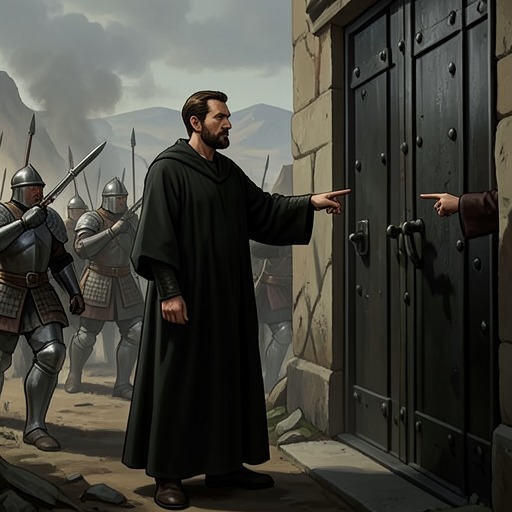
Zhang Zhao
The Romance of the Three KingdomsZhang Zhao is a senior adviser at Sun Quan’s court whose counsel repeatedly tests the boundary between political opportunity and reckless war. He argues for caution when Sun Quan faces pressure to align with Cao Cao or to take Jingzhou from Xuande; during Kong Ming’s visit, he also challenges the case for alliance. Across these episodes, Zhang Zhao serves as a practical counterweight to expansionist impulses, even when his advice does not settle the ruler’s decision.
Position and Political Judgment
Zhang Zhao appears as a prominent member of Sun Quan’s court, able to speak directly on major questions of policy. His influence is evident when a Daoist priest is brought before Sun Ce on suspicion of sorcery: Zhang Zhao immediately defends the prisoner, arguing that a man who has been active for decades without attracting complaint should not simply be killed. Sun Ce rejects the appeal to leniency and imprisons the priest, but the intervention establishes Zhang Zhao as a court adviser prepared to oppose a ruler’s punitive impulse.
After Sun Ce’s death, Zhang Zhao’s standing becomes explicit. Sun Ce summons him and his younger brother, Sun Quan, then hands Sun Quan the seal of office as his heir. He tells his mother and brother to consult Zhang Zhao on internal affairs, assigning him a central role in managing the new ruler’s domestic government. Zhou Yu, who is absent from the deathbed scene, is entrusted with external affairs. The division distinguishes Zhang Zhao’s place in the regime: he is a trusted adviser on internal matters and a senior voice in the court’s deliberations.
The Alliance Debate
When Cao Cao sends Sun Quan a letter framed as an imperial command to join an attack on Xuande, Zhang Zhao strongly supports accepting the offer. Sun Quan remains uncertain, however, and asks Lu Su’s opinion in private; Lu Su counsels against the alliance and reveals that Kong Ming has returned with him. The dispute brings Zhang Zhao’s political judgment into direct conflict with Lu Su’s and, soon after, with Kong Ming’s argument for joining Xuande.
Kong Ming is brought before roughly twenty of Sun Quan’s advisers, with Zhang Zhao leading the questioning. Zhang Zhao challenges why Xuande, despite having secured Kong Ming’s services, has lost the lands around Jingzhou and Xiangyang. When Kong Ming answers carefully, Zhang Zhao dismisses him as an irrelevant hermit and contrasts his arrival with Xuande’s former reputation as a hero, now in flight and unable to protect his territory. The exchange makes the debate more than a discussion of military balance: Zhang Zhao attacks the credibility of Kong Ming’s strategic value by pointing to the reversals Xuande has suffered.
Kong Ming nevertheless argues that Cao Cao’s troops are tired from long travel, inexperienced in naval warfare, and poorly motivated because they were conscripted. He says Xuande’s forces, together with Sun Quan’s, could weaken Cao Cao and establish a balance among the south, Jingzhou, and the north. Sun Quan is persuaded, but Zhang Zhao and the other advisers react with alarm and argue furiously that the alliance would be disastrous. Sun Quan is again unable to decide, showing that the debate has not ended with Kong Ming’s success in persuading him: Zhang Zhao remains a forceful advocate of caution in the court.
Warnings Against Opportunism
After Zhou Yu survives his latest crisis and writes to Sun Quan seeking revenge on Xuande, Zhang Zhao again urges restraint. He points out that the union of Sun Quan’s and Xuande’s armies is the only thing keeping Cao Cao at bay. His warning treats the alliance not simply as a temporary convenience but as a barrier against a stronger northern enemy; breaking it to satisfy Zhou Yu’s hostility could undo the military position that has kept Cao Cao in check.
When Sun Quan considers attacking Jingzhou while Xuande is away, the queen mother’s objection—that an attack would put her daughter, Xuande’s wife, at risk—forces him to apologize. Zhang Zhao then proposes another way to exploit the situation: he recommends sending a trusted man with a forged message claiming that the queen mother is dying, so that Xuande’s wife will leave Jingzhou with her son. Sun Quan accepts the plan. Here Zhang Zhao’s caution does not mean refusing political maneuver altogether. He redirects the proposed seizure of Jingzhou into a scheme aimed at extracting Xuande’s wife and heir, whose absence, he believes, could induce Xuande to surrender the territory.
After a later Wu victory, Sun Quan and his advisers again consider taking Jingzhou while Xuande is away. Zhang Zhao opposes an immediate attack, saying that it is not the time for war and proposing instead a plan that would make Xuande return Jingzhou and be humbled. When Xuande subsequently takes control of Shu, Sun Quan once more thinks of seizing the disputed territory. Zhang Zhao intervenes with the same judgment that peace, not another war, is needed at that moment. Across these reversals, his repeated function is to resist treating every change in the balance of power as an invitation to fight.
Counsel, Risk, and Its Limits
Zhang Zhao’s opposition to Cao Cao’s offer also returns when Sun Quan receives a later proposal from Cao Cao’s side that would grant Wu the south in exchange for moving against Jingzhou. Zhang Zhao distrusts the offer, noting that Cao Cao’s forces are faltering and that there is even discussion of abandoning the capital. He interprets the proposal as a device intended to divert Wu from attacking Cao Cao and enlist it in an attack on Xuande instead. Before Sun Quan can answer, Lü Meng reports that Guan Yu is campaigning against Fancheng and that Jingzhou may now be vulnerable. Sun Quan chooses to authorize an attack. The moment underlines the limit of Zhang Zhao’s influence: his warnings can define the risks, but urgent military opportunity can still prevail over them.
In the novel’s political landscape, Zhang Zhao is neither a figure of unbroken opposition to war nor simply a spokesman for inaction. He can defend an accused priest against Sun Ce’s immediate anger, challenge Kong Ming’s account of Xuande’s prospects, and devise a deceptive operation against Xuande’s household. What holds these different interventions together is attention to consequence: the dangers of antagonizing Cao Cao, the costs of renewed conflict, the value of an alliance, and the leverage of family ties. Sun Quan’s repeated uncertainty gives Zhang Zhao’s counsel room to matter, while the episodes in which it is rejected show that advice alone cannot control the direction of Wu’s policy.