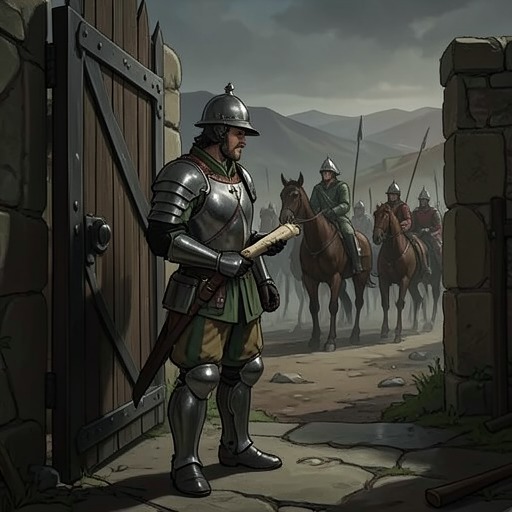
Zhong Hui’s revolt and Jiang Wei’s death
The Romance of the Three KingdomsZhong Hui’s revolt and Jiang Wei’s death form the final, doomed effort to turn the fall of Shu Han into an opening for its restoration. Jiang Wei helps Zhong Hui rise against Sima Zhao, but his counsel drives the plot toward a coup whose secrecy cannot survive its own machinery of betrayal: the imprisoned Wei officers are warned, their allies mobilize, and the revolt collapses in Chengdu. Zhong Hui dies in the fighting; Jiang Wei, concluding that Heaven has determined the outcome, ends his life, and his family perishes as well.
The opening against Deng Ai
Following Shu Han’s surrender, Zhong Hui turns against Deng Ai, whose position he wants to undermine. He consults Jiang Wei, who advises him to send Wei Guan to arrest Deng Ai: if Deng Ai kills the envoy, Zhong Hui would have an apparent justification for attacking him. The plan works. Deng Ai’s officers accept Wei Guan’s warning that they could face punishment themselves, and Wei Guan arrests Deng Ai and his son. Zhong Hui and Jiang Wei then arrive, and Zhong Hui takes Deng Ai’s troops into his own command.
The arrest removes one obstacle, but it does not secure Zhong Hui’s position. Jiang Wei cautions him that a leader who thinks he has reached the summit may be near the start of his fall, and suggests retirement or a retreat to Emei Mountain. Zhong Hui, not yet forty, refuses to withdraw. His ambition now stretches beyond the removal of Deng Ai: he begins considering how to expand his power, while Jiang Wei secretly writes to the second ruler in hopes of restoring the Han.
From secret design to open revolt
A message from Sima Zhao changes the balance. Sima Zhao says he is coming from Chang’an because Zhong Hui may need more troops to defeat Deng Ai. Zhong Hui recognizes the implication: the stated offer of assistance masks distrust, since he already commands enough men to act independently. He begins planning to secure his control of Shu, following the precedent of Xuande, who had made Shu a base of power.
Jiang Wei proposes a more ambitious pretext. The queen mother has recently died, he suggests; Zhong Hui could claim that she sent him a letter authorizing vengeance for the emperor’s death and a campaign against Sima Zhao. The supposed authorization would furnish a reason to move north. Zhong Hui welcomes the proposal and invites Jiang Wei to lead the vanguard and share in the gains. Jiang Wei appears concerned that Wei officers may resist, but Zhong Hui has already chosen a way to compel them: during the lantern festival, he will summon them to a banquet and kill anyone who refuses to pledge obedience.
At the banquet, Zhong Hui announces that he possesses the queen mother’s secret letter and demands that the officers join his campaign. The assembled men pledge themselves, but he does not trust their promises. He has them imprisoned and tells Jiang Wei that he has already arranged to kill them, with a pit dug and clubs prepared. Jiang Wei encourages the plan further, urging Zhong Hui not to trust the prisoners. The conspiracy has moved from a fabricated claim of legitimacy to a scheme for eliminating the very officers whose support it has publicly demanded.
Exposure and collapse
The plot is compromised by Qiu Jian, a junior officer whom Zhong Hui has left at liberty. Having served Hu Lie, one of the imprisoned commanders, Qiu Jian warns him. Hu Lie passes the warning to his son Hu Yuan, who gathers other officers still free and organizes an attack for the eighteenth day of the month. The revolt’s secret timetable is now matched by a counter-plan outside the prison.
On the night of the seventeenth, Zhong Hui dreams that a great number of snakes are attacking him. He asks Jiang Wei to interpret the dream, and Jiang Wei reassures him by calling the creatures dragons and the omen favorable. The next morning, Zhong Hui orders Jiang Wei to execute the imprisoned Wei officers. As Jiang Wei begins, he suffers a heart attack and collapses. When he comes around, the counterattack has already broken into the prison amid disorder and fires. Jiang Wei calls for the officers to be killed, but the attempt to carry out the executions has lost its moment. Soldiers enter, and the revolt disintegrates. Zhong Hui fights back but is brought down and killed.
Jiang Wei’s final choice
Jiang Wei suffers another heart attack as he rushes into the fighting. He declares the effort a failure and submits to what he calls the Will of Heaven, then takes his own life. He is fifty-nine. His entire family perishes that day, making the revolt’s defeat not merely a political reversal but the destruction of the family line around its central strategist.
Wei Guan restores order, but the consequences of the revolt continue beyond Zhong Hui’s and Jiang Wei’s deaths. Deng Ai and his son are freed by their supporters. Wei Guan, fearing for his own safety, allows an officer with a personal reason to kill them to set out with five hundred men. Deng Ai believes the approaching force has come to support him and goes to meet it without protection; he and his son are killed. The failed uprising thus leaves a trail of retaliatory violence, and its attempted restoration of the Han ends with the deaths of its plotters and the elimination of the rival commander whose arrest began the crisis.
Political and narrative significance
The revolt turns on the gap between political claims and actual allegiance. Zhong Hui invokes a letter from the dead queen mother to justify a campaign against Sima Zhao, but the authority he claims cannot keep his officers loyal: they pledge obedience under threat, while a trusted subordinate quietly warns the prisoners’ allies. The conspiracy’s demand for public vows and its secret plan to kill those who make them expose the fragility of rule founded on coercion and deception.
Jiang Wei’s role is deliberately double-edged. He helps Zhong Hui gain control and supplies the ideas that carry the conspiracy toward open revolt, while privately hoping to restore the Han. Yet he also recognizes the danger of ambition, warns Zhong Hui of a fall from power, and ultimately calls the failed outcome Heaven’s will. His death closes the last effort in this episode to use the Wei-Shu power struggle as a route back to the Han. The ending is starkly circular: plans are made in the name of restoration, but the political order that has replaced Shu remains, while the men who tried to overturn it and the families caught in its aftermath are destroyed.