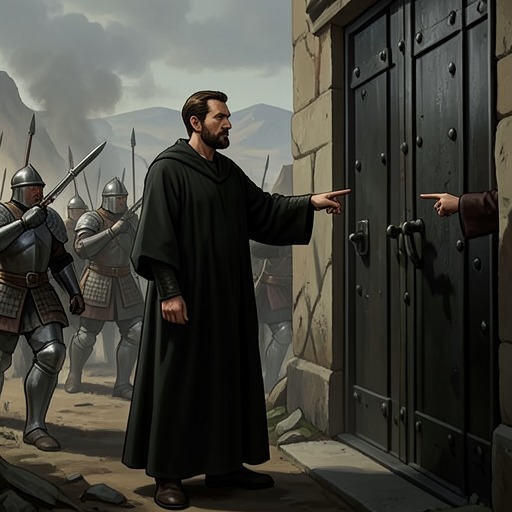
Zhuge Ke
The Romance of the Three KingdomsZhuge Ke is the ambitious son of Zhuge Jin who takes control of Eastern Wu’s court after Sun Quan’s death. His rapid concentration of power, unsuccessful northern campaigns, and eventual assassination at a court banquet mark a sharp turn in the fortunes of the Sun family’s government. His end also shows how military failure, court rivalry, and political violence reinforce one another in the later history of Wu.
Position and Rise to Power
Zhuge Ke enters the account as the son of Zhuge Jin, a prominent figure who has died by the time Sun Quan’s reign ends. Zhuge Ke then holds power and enthrones Sun Liang, the heir apparent, as emperor. Rather than serving only as a caretaker for the young ruler, he takes control of the court and the country, establishing himself as the dominant political figure.
The account characterizes him as foolish and ambitious, and associates his rule with extravagance and the killing of opponents. His command over the state thus rests not simply on his position beside the new emperor but on his ability to suppress resistance. That concentration of authority brings fear to the country while creating resentment among members of the Sun family, who become the agents of his removal.
War with Wei and Political Failure
Sun Quan’s death prompts Sima Shi to consider an invasion of Wu. Despite advice that the campaign would be unwise, Sima Shi marches south, and Zhuge Ke leads Wu’s response at the border. Wu’s schemes inflict heavy losses on the Wei army and force it to retreat. This defensive success encourages Zhuge Ke to seek retaliation by invading Wei himself.
His larger campaign fails. Zhuge Ke dismisses signs interpreted as ill omens and proposes a joint war to the ruler of Shu and Jiang Wei. The Wu army captures no territory. At Xincheng, its governor outmaneuvers the besiegers, and Zhuge Ke is wounded by an arrow. Summer heat, low morale, poor leadership, desertion, and illness further weaken the force until it withdraws. The contrast is consequential: a successful defense against Wei does not translate into the ability to sustain an offensive, and the defeat damages Zhuge Ke’s standing at court.
Court Opposition and Assassination
After the failed campaign, Zhuge Ke withdraws to his home and feigns illness. His retreat does not quiet opposition; resentment has already grown over his abuse of power. Sun Jun petitions the emperor for permission to execute him, and the plot is organized around a banquet invitation. The emperor, who has long wanted Zhuge Ke removed, is part of the plan.
Strange occurrences intensify the foreboding surrounding the plot. Zhuge Ke finds a man in mourning clothes in his house and executes both the stranger and guards who deny seeing anyone enter. Later, he sees the same figures in a vision and collapses in terror. He also finds that the water used by his attendants continues to smell of blood despite repeated changes. When the day of the banquet arrives, these signs weigh on him: he turns back before reaching it, but two officials persuade him to continue.
At the banquet, Sun Jun announces that the emperor has ordered a traitor’s execution and kills Zhuge Ke with a single stroke. Zhuge Ke’s brother Zhang Yue attempts to defend himself and is also killed. Their bodies are wrapped in reed mats and discarded in an unmarked paupers’ burial place outside the city. The political assassination is therefore followed by deliberate public dishonor, not an official burial befitting a former ruler of the court.
Family and Aftermath
The violence extends to Zhuge Ke’s household. At home, his wife receives a maid who claims to be Zhuge Ke and identifies Sun Jun as his murderer. The account presents this as a supernatural visitation, linking the aftermath of the banquet killing to the narrative’s recurring use of ghosts and ominous signs. Recognizing the danger to herself and her family, she gathers them together, but soldiers soon arrive and kill them all in the market square.
Zhuge Ke’s death in autumn AD 253 transfers power to Sun Jun. His fall thus completes a political reversal: the man who had controlled Wu through the young emperor and silenced opponents is himself removed by a rival operating through the court. The killing of his family makes clear that the struggle is not confined to officeholding; the victorious faction eliminates the household as well as its former political master.