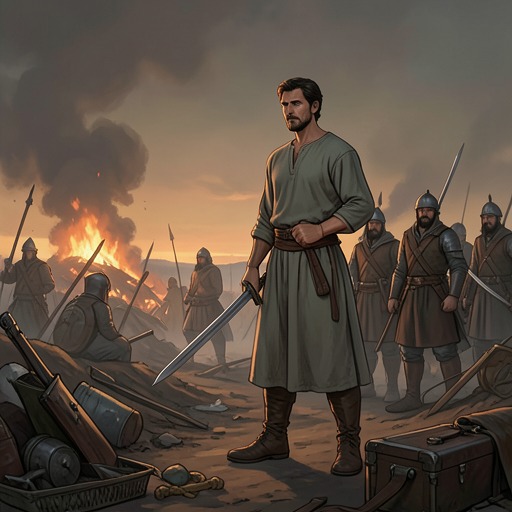
Zhuge Zhan
The Romance of the Three KingdomsZhuge Zhan, the son of Kong Ming, becomes the last prominent defender of Shu as Deng Ai’s surprise invasion advances toward Chengdu. His arc turns on a sharp reversal: a man who had once stayed away from a corrupt court rises to command its troops, refuses an offer from the enemy, and dies fighting beside his son at Mianzhu.
Identity and Return to Public Life
Zhuge Zhan had despaired of corruption at the Shu court and, pleading illness, remained away from it. When Deng Ai’s unexpected advance reached Jiangyou and reports of the danger could no longer be dismissed, the ruler summoned him to take command of the troops at Chengdu. His reappearance is therefore not a gradual rise through the court but an abrupt return under the pressure of imminent invasion.
The emergency also exposes the cost of the court’s earlier failure to respond. The ruler had been alarmed by reports but was reassured by Huang Hao that they were false; by the time the scale of Deng Ai’s advance was clear, Shu needed a commander who had previously withdrawn from its politics. Zhuge Zhan’s summons marks the moment when private disillusionment gives way to public responsibility.
Command and Resistance
As commander, Zhuge Zhan organizes resistance against Deng Ai’s forces. The Wei army’s attempts to break through are repeatedly thwarted, and Shu wins a series of battles. One defense is strengthened by the appearance of Kong Ming riding in his famous carriage: the sight unnerves the Wei troops, who flee and are killed in large numbers by Shu forces. The episode places Zhuge Zhan’s command within a legacy that remains militarily and symbolically powerful even after his father’s death.
Deng Ai then tries a different approach, sending a flattering letter intended to win Zhuge Zhan over. Zhuge Zhan tears it apart and has the messenger executed. His answer is conveyed through action rather than negotiation: he will not change sides, even as the Wei advance continues.
Mianzhu and Death
Deng Ai eventually turns retreat and ambush tactics into a crushing defeat for Shu. The Wei army presses on to besiege Mianzhu, and Zhuge Zhan sends an appeal for assistance to Wu. Sun Xiu agrees to send reinforcements, but assembling them takes time. Zhuge Zhan must decide what to do without knowing whether help will arrive before the city falls.
He chooses a last attempt to break out and fight Deng Ai, with Zhuge Shang and the army beside him. The decision ends disastrously: Zhuge Zhan and Zhuge Shang are killed, and Mianzhu falls the following day. Deng Ai, moved by the courage of father and son, gives them honourable burial. Their deaths do not save Shu, but they close Zhuge Zhan’s story in open resistance rather than in the political retreat with which it began.
Narrative Role and Significance
Zhuge Zhan’s brief appearance concentrates the final contrast between a failing court and the duty of defending the state. He had withdrawn because of corruption, yet answers the summons when the invasion makes withdrawal untenable. His refusal of Deng Ai’s letter and his final charge show fidelity through concrete choices, not through a speech about loyalty.
His death also makes the fall of Shu a generational loss. The son of Kong Ming dies with Zhuge Shang at Mianzhu, while Deng Ai’s respectful burial acknowledges the courage of the defeated even as the city falls. The narrative moves directly from that defeat toward Chengdu, leaving Zhuge Zhan’s last stand as a final resistance before the end of Shu’s rule.