Zuo Ci
The Romance of the Three KingdomsZuo Ci enters the story as an old Daoist whose miracles unsettle Cao Cao’s confidence in command. His transformations, impossible escapes, and apparent immunity to hunger or violence make him more than a court magician: he is a figure whose powers repeatedly elude the state’s efforts to seize and control him.
Identity and Introduction
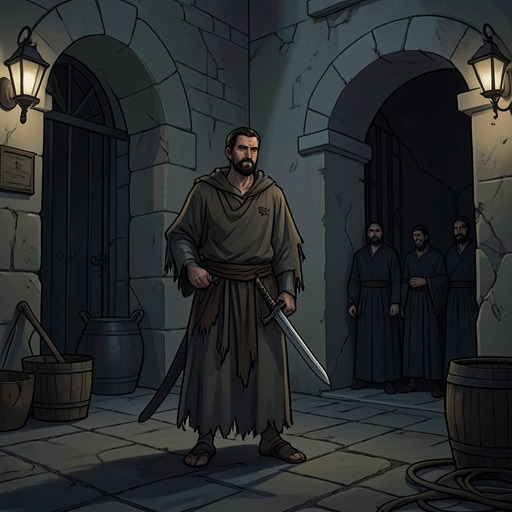
Zuo Ci first appears to the porters carrying forty loads of oranges from Sun Quan to Cao Cao. At the foot of a hill, the party encounters an old man who is half blind and lame, dressed in worn, unusual clothes. He offers help, lifts one of the loads, and carries it some distance. When he leaves, the porters find their loads have grown much lighter. He identifies himself as Zuo Ci, gives his Daoist name as Master Blackhorn, and says he comes from the same village as Cao Cao, whom he calls the king of Wei. Then he disappears.
The meeting’s modest beginning sets the pattern for his appearances: Zuo Ci seems to enter an ordinary situation on its own terms, but its familiar rules soon fail. At Cao Cao’s palace, an orange is empty when the ruler peels it. The porter recounts the encounter, and Zuo Ci arrives at that very moment. Asked what dark magic has emptied the fruit, he cuts open an orange that is full and ripe; the oranges Cao Cao opens, by contrast, are all dry and hollow. Zuo Ci does not explain the discrepancy. Instead, he asks for food and drink, consumes enormous quantities, and shows no ill effect.
Daoist Knowledge and Cao Cao’s Offer
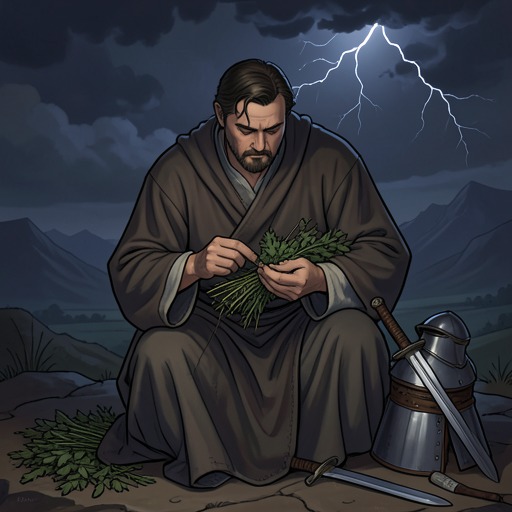
When Cao Cao presses him about his abilities, Zuo Ci recounts his studies on Emei Mountain in Shu. One day, he heard his name called from within a stone wall. Finding no one when he examined it, he witnessed the wall split apart after a clap of thunder. Inside lay three scrolls, the Supreme Revelations of the Heavenly Texts: one for Heaven, one for Earth, and one for humanity. Their teachings include riding the clouds and winds, passing through mountains, and changing shape.
Zuo Ci invites Cao Cao to join him on Emei Mountain and become his student, promising to give him all three scrolls. Cao Cao says he would welcome such a retreat, but worries about whom he could trust to run the court. Zuo Ci proposes Xuande, noting that he belongs to the imperial family, and warns that otherwise he may have to send a magic sword to cut off Cao Cao’s head. Cao Cao interprets the proposal as proof that Zuo Ci is allied with Xuande and orders him arrested.
Arrest, Banquet, and Escape
The arrest order exposes the limits of Cao Cao’s authority. A dozen guards rush to seize Zuo Ci, but cannot move him; he appears to be asleep. Even after they manage to take him to a cell, his chains fall away, and seven days without food or drink leave him unharmed. Cao Cao is left unable to decide what to do with his prisoner.
Later that day, as Cao Cao hosts a banquet, Zuo Ci suddenly appears wearing wooden clogs. He observes that the table is overflowing, then offers to fetch what is missing. His reappearance turns captivity into another brief, ineffective assertion of control: the court can confine him only until he chooses to be elsewhere.
The Banquet’s Transformations
At the banquet, Zuo Ci makes absence itself part of the spectacle. He claims he can supply what the overflowing table lacks and produces rare fish from a bronze basin, then purple-sprout ginger from a golden bowl. When Cao Cao challenges the ginger’s origin, Zuo Ci answers the test with the exact ingredient; inside the bowl, Cao Cao also discovers a book titled The New Treatise of Meng De. Its contents strike him as entirely true. The sequence mingles practical abundance, impossible provenance, and uncanny foreknowledge, while giving Cao Cao no firm way to distinguish a gift from a demonstration of power.
Zuo Ci next fills a jade cup with the finest wine and promises that drinking it will make Cao Cao live a thousand years. Suspicious, Cao Cao insists that Zuo Ci drink first. The Daoist divides the wine in the cup with a jade hairpin and drinks one half, but Cao Cao refuses the other. In disgust, Zuo Ci throws the cup to the floor: it becomes a white turtle dove and flies around the hall. He disappears, leaving the promised elixir unaccepted and the court with another transformation it cannot command.
Pursuit, Multiplication, and Apparent Defeat
Cao Cao treats Zuo Ci’s departure from the banquet not as an end to the encounter but as a security threat. He orders Xu Chu and three hundred soldiers to pursue and capture him. They find Zuo Ci strolling just ahead, yet cannot catch up however fast they run. When he climbs into the hills, he appears amid a flock of sheep; Xu Chu shoots at him, but Zuo Ci vanishes. In fury, Xu Chu slaughters the sheep, leaving their young shepherd in tears. Then one severed sheep’s head speaks, instructing the boy to put the heads back; another voice promises to restore the flock. Zuo Ci appears and brings the sheep back to life, then disappears again with a twitch of his gown. The episode turns the pursuit’s violence into an absurd reversal: the soldiers can kill the animals, but their violence cannot secure the magician they seek.
The shepherd’s master reports what happened, and Cao Cao has Zuo Ci’s likeness drawn and circulated throughout the country with orders for his arrest. Three days later, hundreds of men who look exactly like Zuo Ci are herded into the capital. Their sheer number throws the city into chaos. Cao Cao orders that they be splashed with pig and sheep’s blood and taken outside the walls, where five hundred soldiers, led by Cao Cao himself, cut off every one of their heads. The mass execution is an escalation from failed capture to an attempt to eliminate every possible likeness; it still cannot establish which, if any, is the original.
The Immortal Beyond the State
From each severed head a thin black mist rises, spirals into the sky, and merges into Zuo Ci. Seated on a summoned white crane, he claps his hands and declares, “The rats of the earth follow the golden tiger, but one day the evil one will be no more.” Cao Cao orders his archers to fire, but a strong wind scatters everything. The executed men rise, clutching their severed heads, and rush toward Cao Cao and his men; the officials cower in terror and faint. The scene completes the reversal of the execution: what was meant to make the capital secure instead releases a final, overwhelming display of power.
The episode ends with a verse contrasting the capacity of a powerful man to overthrow a country with the still greater powers of a Daoist immortal. Zuo Ci’s role is not to seize Cao Cao’s authority or replace it with a rival government, but to make its reach look inadequate. Guards cannot move him, chains cannot hold him, deprivation cannot weaken him, soldiers cannot overtake him, and decapitation cannot prevent him from reappearing. Against Cao Cao’s repeated attempts to classify, command, and destroy him, Zuo Ci remains elusive; the story leaves the ruler’s force intact in scale but powerless to master the supernatural figure before him.