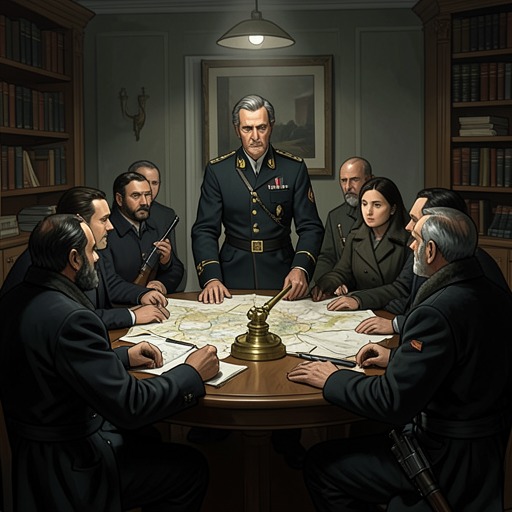
Checquy Raid on the Grafter Base
The RookThe Checquy Raid on the Grafter Base is the London operation Myfanwy directs from Reading after a threat from a Grafter leader exposes a renewed danger inside England. Unable to lead the strike herself, she entrusts it to Chevalier Eckhart and the Barghests; the later debriefing reveals both the scale of the resistance and the presence of traitors among the assault team.
Causes and Preparation
Myfanwy contacts Eckhart as soon as she identifies the threat as a Grafter matter. One of the Grafter leaders is in England, she tells him, and has faxed a threat whose source has been traced to London. Since she is stuck in Reading, she asks Eckhart to oversee the strike team rather than attempting to command it in person.
The target has been confirmed as a private residence. That confirmation matters: Myfanwy asks Carruthers whether the trace might lead to a misleading site, recalling previous investigative misdirections, but he assures her it does not. She then contacts the London Barghests and learns that team two is still occupied with operations in Reading, while team one is on standby at the Rookery.
Myfanwy activates team one and puts it under Eckhart’s command. Because the target is in a residential area, she emphasizes discretion. She also warns Eckhart that only the two of them have been cleared of Grafter implants and that she suspects at least one other member of the Court is a traitor. Keeping the operation from the rest of the Court is therefore part of its security, not an incidental restriction: a leak could alert the Grafters to the strike.
The Assault
Eckhart accepts command and tells Myfanwy that the strike team is ready. She considers the possibility that some Barghests may themselves be traitors, but judges that they cannot take him. Eckhart’s later account confirms that this concern was well founded: two members of the Barghests turned against their comrades during the raid. Their Grafter enhancements did not protect them from the team’s response.
The assault reaches a chamber where giant sacs and cocoons hang from the ceiling. Pods burst open and Grafter warriors emerge, forcing the Barghests to fight them off while Eckhart engages Graaf Gerd de Leeuwen. Their duel pits metal against bone. The account establishes that the home base was not merely a residence marked by the fax trace: it also held a prepared force capable of joining the fight as the operation unfolded.
Eckhart describes the encounter with the Grafter leader as a direct fight. The leader grows blades of bone from his arms; Eckhart ultimately kills him. In his report, Eckhart recounts using a chain taken from the ceiling as a weapon. The clinical manner of the account contrasts with the violent scale of the struggle, which Myfanwy listens to openmouthed.
Command, Betrayal, and Aftermath
The raid’s command structure links Myfanwy, directing operations remotely, to Eckhart, leading the assault, and the Barghests, who carry it out. Myfanwy’s choice of Eckhart is accompanied by an explicit security judgment: she trusts him to lead even under the possibility that the team contains traitors. The later revelation that two Barghests were compromised makes that trust a calculated risk rather than a general confidence in the organization.
After the action, the events are revisited in a bureaucratic debriefing that lasts almost as long as the events themselves. Eckhart’s account records the fight, the emergence of the warriors, the Barghests’ resistance, the betrayal within their ranks, and his duel with Graaf Gerd de Leeuwen. The Court agrees to hold a full debriefing the following day, after everyone has slept.
The operation resolves the immediate confrontation at the Grafter base but does not erase the larger danger that shaped it. Myfanwy had already concluded that the Court could not safely be told about the strike, because an undiscovered traitor might warn the Grafters. The presence of two traitors among the Barghests confirms the reach of the infiltration even within the force sent to attack the enemy. The raid thus exposes the difficulty of distinguishing an external assault from an internal security crisis: the Checquy can strike at the Grafters, but cannot assume that every member of its own response is trustworthy.