Checquy Rank System
The RookThe Checquy Rank System organizes a secret organization whose work depends on both supernatural abilities and conventional expertise. Its formal distinctions divide members into a ruling Court, powered Pawns, and non-powered Retainers, while the Rooks occupy a distinctive executive role. Yet rank does not map neatly onto authority: Retainers can supervise Pawns, and the system’s history of military command has given way to an administrative structure responsible for domestic affairs. The hierarchy is therefore both a chain of command and a means of classifying, recruiting, and managing people as institutional resources.
The Court and the basis of rank
The Court is the Checquy’s ruling circle, but membership is restricted to powered individuals. Non-powered employees may be exceptionally capable and may hold significant operational authority, yet they cannot enter the Court. The organization comprises hundreds of people: some possess abilities beyond the ordinary population, while others are recruited as the best of their respective professions. The distinction between those groups has formal consequences even where it does not determine day-to-day authority.
The distinction between a Pawn and a Retainer is stated simply: a powered person outside the Court is a Pawn, while a non-powered person is a Retainer. That shorthand conceals a more flexible structure. A Pawn is not automatically senior to a Retainer; both may serve as supervisors or section heads, and a Retainer may lead Pawns just as a Pawn may lead Retainers. Prejudice nevertheless persists. When a position comes down to a choice between the two, Pawns will generally be preferred, even though Retainers are more numerous.
The Court’s exclusivity is thus not the same as a complete monopoly on practical authority. Retainers provide essential work in administration, intelligence, security, and medicine, and the organization employs them in nearly every area that does not require powers. The hierarchy distinguishes eligibility for the ruling circle from the ability to direct work, preserving a formal status boundary alongside considerable operational overlap.
Recruitment, training, and institutional ties
The Checquy acquires powered members through varied means and has long held authority to claim citizens for its service. Children may be released by parents who are coerced or deceived, sometimes in exchange for substantial payments; adults may be drawn in with offers of wealth, power, and national service. Membership is then secured through ancient oaths and modern contracts, reinforced by official and unofficial secrecy laws. The resulting ties make departure exceptionally difficult.
The Estate turns recruitment into a sustained program of classification and preparation. Pupils study subjects ranging from classics and chemistry to rifle handling, alongside instruction in observation, language, judo, computing, and other skills. Their abilities are also subjected to monthly medical testing. The Checquy seeks to identify the sources of supernatural powers even when its investigations cannot explain them: one pupil’s ability was associated with atmospheric phenomena in Iceland in a way that remained obscure, while another described sensing the emotional states of left-handed people around the world. The data is gathered and retained in the hope that later workers may understand what present investigators cannot.
Medical examination makes the institution’s attention to its recruits concrete. At the Estate, the narrator underwent extensive physical and psychological assessment, including scans, interviews, and the collection of bodily samples; the staff also recorded allergies and phobias and assigned therapy. The testing was not a one-time intake procedure but part of the school’s regular practice. In this system, training and rank sit alongside the collection of information: pupils are developed as future personnel while their bodies and abilities are documented for institutional use.
Retainers, too, are recruited through a wide professional network. The Checquy draws on government, military, clergy, universities, and the private sector, with university agents watching for capable and discreet candidates. Their work sustains the organization’s administrative and specialist functions, while their own membership is bound by contracts, religious and fealty oaths, secrecy laws, and threats. Personal staff assigned to Court members include secretaries, drivers, and bodyguards; their purple clothing marks a centuries-old livery. The system thus gives visible signs to some staff roles while relying on layered obligations to bind both powered and non-powered personnel.
The changing office of the Rooks
The Rooks illustrate how the rank system changes while retaining its inherited titles. For the first centuries of the Checquy, they were its martial leaders, responsible for military action and traditionally drawn from the nobility. Their expected expertise centered on tactics and strategy. In the old hierarchy, Pawns were the organization’s blade and Rooks its hilt: the Pawns carried out force, while the Rooks directed it.
That arrangement did not prevent the organization from treating Rooks as instruments. In 1702, they led a four-pronged assault on Brigadoon that destroyed its buildings; some inhabitants were killed, and others were transported to Wales and compelled to work in lead mines, where they died in captivity. The history of the office therefore includes both command authority and the subordination of its holders to the institution’s purposes. The Rook was a leader, but leadership could still mean being deployed as a weapon.
A major redistribution of power in 1788 transformed the position. The Rooks ceased to be the Checquy’s generals and became responsible for domestic affairs: they now act as executive guardians of the United Kingdom, handling unusual events within the British Isles. They may still authorize or exercise force, but it can be delegated; fieldwork is no longer the defining duty of the office. Rooks coordinate domestic Pawn teams, assign their tasks, manage the Rookery, and work with one another and the Court to organize the Checquy’s activity. The change recasts the Rook from battlefield commander into administrator of a national system, without removing the office’s capacity to direct violence.
Authority in practice and crisis
The career of Myfanwy Alice Thomas demonstrates how someone can rise within this structure without following its most visible model of advancement. The Checquy initially imagined that her ability to control another person’s physical systems might make her an effective spy. She disliked aggression, became violently ill on planes, and was shy, so field espionage proved a poor fit. Rather than discard a valuable recruit, the organization placed her in internal operations, where her administrative skill and ability with numbers became the basis of her career.
After ten years in administration, Myfanwy became a member of the Court and the youngest person then serving in it. The next-youngest member had needed sixteen years of dangerous fieldwork to reach the same circle. Her advancement makes bureaucracy an alternative route to the top, while exposing the gap between the institution’s expectations of a powered operative and the work she proved able to do. She rarely used her power; her expertise in administration was itself enough to make her an exceptional asset.
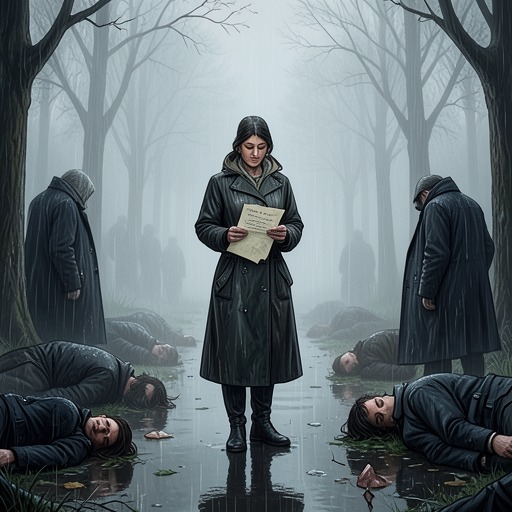
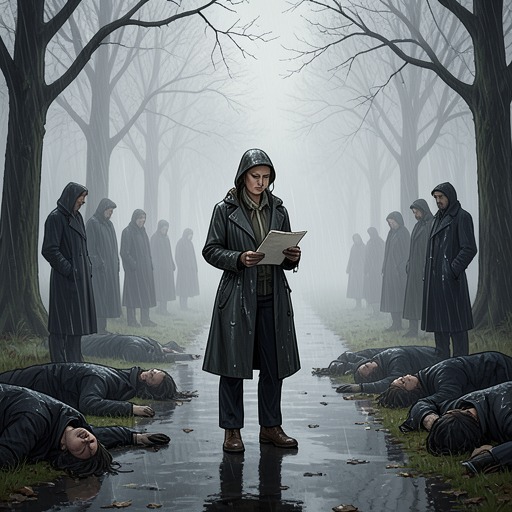
Court authority also has defined limits and formal procedures. During the crisis involving Harper Callahan, Myfanwy invokes a prescribed declaration to summon the Estate ward to serve the public. The wording is archaic, but it transfers responsibility for the operation onto the authorizing Rook. Only Rooks, Bishops, and the Lord and Lady of the Checquy can authorize the use on British soil of an agent classified as a Force of Physical Obliteration. Such deployment requires informing the Prime Minister, the Minister of Defense, the country’s ruler, and every member of the Court. The scene shows rank operating not merely as title but as a legal capacity to make consequential decisions, with notification requirements surrounding the exceptional use of force.
Hierarchy as governance
The rank system is embedded in a wider apparatus for identifying threats and directing responses. Information arrives through civil-service channels, and analysts sift through reports, figures, and files for patterns that may signal supernatural activity. The Panic Lines connect the Checquy to high-ranking national and local officials, who receive discreet briefings designed to alert them without fully explaining the phenomena. Their calls, along with information supplied by people placed in key organizations, feed the Checquy’s work while its name remains absent from outside paperwork and its computer network stays separate from external systems.
That arrangement links occupational specialization to secrecy. Pawns contribute powers, Retainers bring professional expertise, and Court members exercise leadership within a structure designed to gather information without making the organization publicly visible. During the Grafter infiltration crisis, the Checquy responds by ordering intrusive examinations for every member to search for implants. The proposed screening uses random groups of observers to watch examinations, requires agreement among Checquy doctors and a randomly selected civilian practitioner, and sends results to thirty-five doctors around the world. Court members are to be screened first. The plan shows how suspected betrayal activates the organization’s capacity to inspect its own personnel, but also how rank, professional oversight, and distributed verification are made to work together.
The system’s central tension is that it presents authority as service while treating people as subjects of recruitment, training, observation, and binding obligations. Myfanwy takes pride in protecting ordinary people through an institution that must remain unknown to them, yet the organization’s means of securing personnel include the power to claim citizens and rules that make departure difficult. The Checquy Rank System accordingly joins public protection to private control: its titles allocate responsibility, its divisions organize specialized labor, and its procedures make the organization’s exceptional authority usable in the name of the country it serves.