Checquy–Grafters Merger Negotiations
The RookThe Checquy–Grafters Merger Negotiations turn a secret approach by Ernst von Suchtlen into the prospect of joining two long-hostile organizations. Myfanwy recognizes that von Suchtlen has come to discuss alliance, not surrender: open war would be devastating, hard to conceal, and contrary to the Checquy’s mandate. The proposed merger is therefore both a practical answer to the prospect of conflict and a test of whether trust can be built between institutions with a history of violence and concealment.
Causes and Terms of the Approach
Myfanwy makes the stakes explicit to von Suchtlen. The Checquy would never surrender, even with traitors inside its Court; resistance might win a war, but England would not be the same afterward. An international battle would also make secrecy difficult to maintain. She connects this danger to the Checquy’s defining obligation, expressed as “To protect, in secrecy.” Her reading of von Suchtlen’s purpose follows from that impasse: he does not want either to fight the Checquy or to remain hidden from it, and he understands that the Checquy would not permit him to live freely given his history. Myfanwy concludes that he has come to negotiate an alliance between their organizations.
The secrecy surrounding the meeting is itself part of the negotiation’s circumstances. Myfanwy points out that von Suchtlen has concealed his presence not only from the Checquy but from his own partner. His secret approach suggests a willingness to act without Gerd’s knowledge, but it also leaves open the question of whom he represents and how much authority he can exercise. The distinction Myfanwy draws between surrender and alliance matters: the proposal is not that the defeated party submit, but that former opponents attempt to become partners.
A Proposed Merger Meets the Facts
The Belgian explains that he has been growing in seclusion for months while his cousin believes him to be in his quarters. He expected to use that absence to settle merger details with Myfanwy, then present the result to Gerd as a fait accompli. If Gerd resisted, he believed the combined forces of the Wetenschappelijk Broederschap van Natuurkundigen and His Majesty’s Hidden Soldiers of the Checquy could subdue him and his supporters. His plan assumes both that Gerd is alive and that the Belgian can return to him with an agreement already secured.
Myfanwy corrects those assumptions. She tells him that the experimental heart technology has taken months, not weeks, to grow, and that the project meant to occupy Gerd has failed. After giving the Belgian a concise account of Gerd’s recent actions, she tells him that his cousin is dead, killed in the assault. The news stops the proposed plan at its premise: there is no living Gerd to confront with a fait accompli. The Belgian repeats the word “Dead,” slumps back, and then acknowledges that Gerd might have struggled to adjust to the new situation. For Myfanwy, the moment also means that the man in front of her is grieving a relative while discussing the fate of two organizations; she judges that formal sympathy from her would seem plainly insincere.
Myfanwy makes clear that she cannot authorize the merger herself. Any agreement must be presented to the entire Checquy Court, and the Croatoan must also be involved. The proposal therefore cannot be settled in a private room by two representatives, however useful or urgent their conversation may be. Its legitimacy depends on bringing in the institutions whose security and interests the arrangement would affect.
The Croatoan and the Hidden Diversion
The question of American involvement exposes another complication. Myfanwy asks why Grafter agents were operating in the United States and tells von Suchtlen that a Grafter operative was captured in Los Angeles. Von Suchtlen says that Gerd appears to have enacted a contingency gambit: if the Checquy discovered the Grafters’ presence in Britain, an expendable operative would be allowed to turn up in the United States. The intended effect was to distract the Croatoan and prevent it from sending reinforcements to the Checquy.
Von Suchtlen says the plan was not his and describes Gerd as improvising. Myfanwy is not convinced. She suspects that Gerd took an operation intended as a last resort and used it as a first strike, a choice that would obstruct the compromise now under discussion. The episode makes the proposed alliance more than a question of shared force: the Checquy must account for an operation designed to manipulate the Croatoan, while Myfanwy insists that the Croatoan be included in any negotiations. The merger’s possible partners are already entangled in the consequences of the Grafters’ deception.
Negotiation, Trust, and an Unfinished Agreement
After insisting that formal negotiations must wait until all relevant parties are gathered, Myfanwy remains willing to hear von Suchtlen’s proposed terms. The conversation shifts briefly from institutional crisis to hospitality: she asks whether he is hungry, explains that the kitchens are closed and the office coffee machine is broken, and offers to make coffee at her residence. Von Suchtlen asks for a cup. The ordinary request does not settle anything, but it marks a move from accusation and disclosure toward continued conversation.
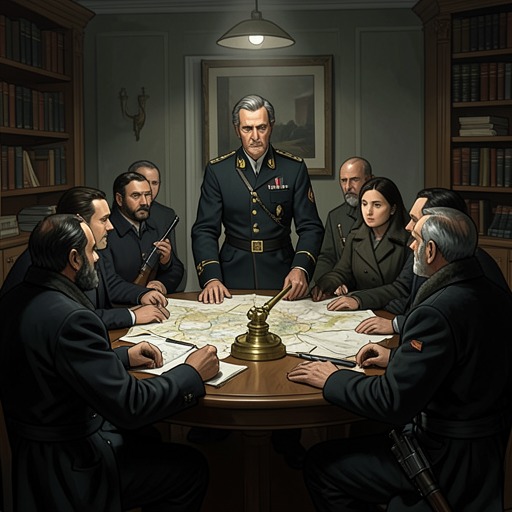
Three days later, the talks have widened. The American Bishop Shantay has arrived in England with a Rook of Comanche descent and a cohort of lawyers to help negotiate the merger’s terms. This is no longer simply Myfanwy and von Suchtlen’s private understanding; it has become an interorganizational process with American participation and legal support. The physical cost of the Checquy’s recent violence remains visible in Myfanwy’s eyes, which she explains to Bronwyn by saying, “Airbag.”
Myfanwy expects the details to take months. Lawyers will argue; each side will resist some terms out of pride or distrust; compromises will be necessary. She nevertheless believes the process will succeed. Her confidence is not based on uncomplicated reconciliation: she intends to bind the Grafters with contracts, oaths, and promises of full disclosure, and sees them as both friends and enemies. The proposed merger thus rests on the same tension that brought the parties to the table—cooperation is necessary, but trust remains incomplete.
Consequences and Prospective Reorganization
Myfanwy considers the merger alongside changes within the Checquy itself. She expects new appointments to the Rook, Chev, and Bishop positions and wants more non-powered people and more women on the Court. Lady Farrier has hinted that she wants Myfanwy to become the new Bishop, a possibility Myfanwy regards as surprising even as she begins to entertain it. These anticipated changes show that the negotiations are taking place amid a broader rethinking of the organization’s leadership and composition, although the account does not present them as completed outcomes.
The practical case for cooperation extends beyond the immediate threat of war. Myfanwy expects the usual strange incidents around the world to continue and believes the Grafters’ help could improve the Checquy’s ability to deal with them. The merger is therefore left as a negotiated future, not a finished treaty: its terms remain to be worked out with the Court and the Croatoan, and its promised advantage depends on making former enemies accountable to one another. The immediate outcome is less a union than a framework for continued talks, built around the conviction that a concealed partnership may prevent a destructive war and better equip the Checquy for the work ahead.