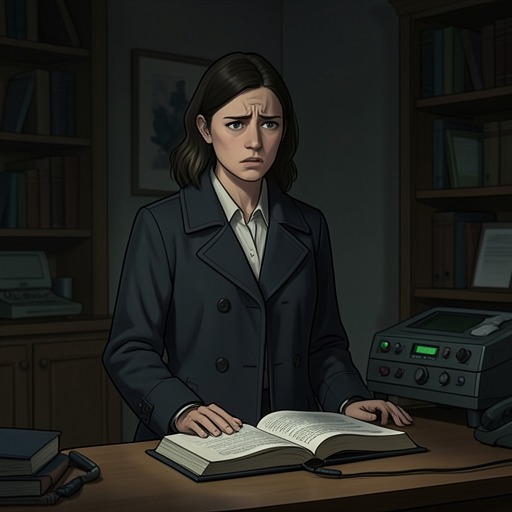
Fate, prophecy, and free will
The RookFate, prophecy, and free will are placed in tension through the former Myfanwy Thomas’s expectation of imminent obliteration and the letters she leaves for her successor. A prophecy makes catastrophe feel certain, yet it cannot explain its cause or name its agent. Myfanwy’s response is neither simple acceptance nor an escape from duty: she investigates while continuing to serve as Rook of the Checquy, and writes to a future person whose choices she cannot control. The letters turn a fixed-seeming future into a question of what can still be chosen within it.
Prophecy and the pressure of certainty
The former Myfanwy’s sense of the future is anchored in predictions she cannot dismiss. Lisa’s prophecy has warned that she will be betrayed, and a boy at the Estate has whispered warnings that she may be unable to prevent what is coming. A duck has given her, at most, a month. She jokes darkly about impending obliteration, then admits that she has not attained calm or accepted her end. The authority she reluctantly grants the duck is at once comic and frightening: the prediction is absurd in its source, but not thereby harmless to the person living under it.
That knowledge produces a particularly sharp anxiety because it predicts disaster without providing an explanation. Myfanwy expects to lose her memories and fears that she may die without learning why someone wanted to kill her. Her private research has uncovered vendettas and misappropriated funds, along with intimate facts about colleagues, but she cannot tell which, if any, connect to the threat. Prophecy supplies an approaching deadline while leaving its meaning incomplete. The uncertainty is not whether she has been warned, but whether any discovery or action can turn warning into understanding.
Investigation, duty, and the attempt to evade fate
Myfanwy initially treats prophecy as something that might be outmaneuvered. She hopes that finding an answer, or learning in time not to say or do something, will allow her to sidestep Lisa’s prediction and prove the boy’s warnings wrong. This is not passive fatalism: she searches for causes and considers whether a change in her own conduct might alter the outcome. Yet her attempt to protect herself is constrained by the office she holds. She does not dare stop working, fearing that unexplained withdrawal would invite questions and that those questions could themselves become the catalyst for her death.
The result is a double labor. Myfanwy keeps up her duties as Rook while conducting private searches, trying to cover every base until the effort nearly breaks her. The work does not yield the answer she wants. She never returns to Camp Caius, never discovers who is behind the threat, and cannot tell her successor who will attack or kill her. She apologizes for being unable to provide all the answers and calls this her last letter. The failure is concrete: duty consumes time that investigation also requires, while the prophecy’s deadline continues to close.
Letters as a limited exercise of choice
In a later letter, Myfanwy distinguishes the certainty of what is coming from the question of whether anyone has free will. She says the future is not a matter of faith or fatalism for her, but knowledge; she can imagine that this makes free will impossible. Still, writing the letters allows her to regard herself as making choices. The distinction is modest but consequential. She cannot claim to choose the predicted event away, yet she can choose what to do with the remaining time and what to leave behind.
Her preparations include practical care: after an uneventful day spent on ordinary duties, she visits the Rookery infirmary during lunch for a checkup because she wants to leave her successor a relatively fit body. She also leaves information and guidance through dozens of letters. These acts do not prove that the prophecy has been defeated. They establish a narrower domain of agency, in which the former Myfanwy can prepare for another person even while she believes her own future has already been decided.
The successor’s freedom and the meaning of inheritance
The recipient is not simply a continuation whom Myfanwy can direct. She knows the future woman might choose the other option, use the other key, and build a life of her own. Myfanwy recognizes that this choice could make much of her work and correspondence unnecessary, but leaves them available rather than treating inheritance as an obligation. Her preparations offer a route into the former life; they do not erase the possibility of refusal.
That freedom shapes the emotional language of the letters. Myfanwy does not yet know what kind of person the recipient will be, and allows that she might keep the name Myfanwy Thomas or choose another and forget her predecessor. Nevertheless, she comes to care deeply for her. She calls the unknown recipient her identical sister, her daughter, and her family, joining several possible relations in a bond created before they can meet. Her closing wish is not that the successor fulfill a plan, but that she be happy, whatever life she chooses.
An unresolved future, answered by care
The letters leave the central threat unresolved: the former Myfanwy does not identify her betrayer, explain the motive, or disclose who will attack her. Their candor preserves that uncertainty instead of turning prophecy into a fully solved riddle. The reader sees both the limits of preparation and what preparation can still accomplish: it cannot guarantee survival or knowledge, but it can furnish the successor with a body, information, and the option of another life.
This is the concept’s central reversal. Prophecy narrows the former Myfanwy’s imagined future, but it does not determine every act within it; she continues to investigate, performs her duties, tends to the body that will be inherited, and writes to someone who may reject her legacy. Nor does her successor’s freedom cancel the care invested in the letters. Fate remains a pressure rather than a complete account of human action, and free will appears not as mastery over outcomes but as the capacity to choose what one offers another person under the shadow of an outcome one cannot change.