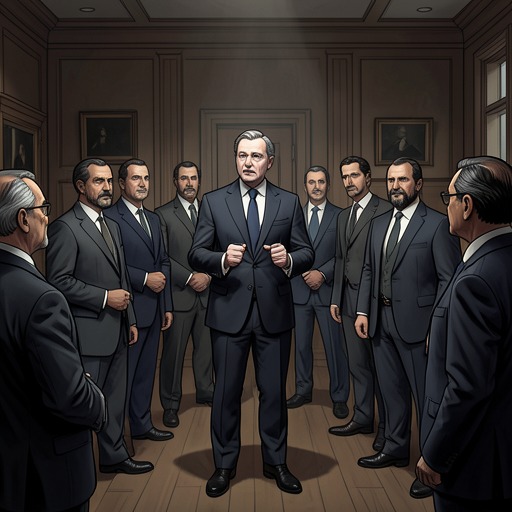
Gallows Keep
The RookGallows Keep is a remote Scottish castle repurposed by the Checquy as a prison for dangerous people it cannot kill outright. The facility’s outwardly archaic appearance conceals modern security, while its history and continuing use of executions make it a place where confinement is only the first measure of the organization’s judgment. It becomes especially important after Rook Gestalt is exposed as a traitor: Myfanwy visits the imprisoned body there, and later draws on what she learned at Gallows Keep when confronting Conrad Grantchester.
Origins and Setting
The Checquy’s purple binder describes Gallows Keep as the ancestral manor of an obscure Scottish noble family. After the family angered the king and was stripped of its land and property, the estate was handed to the Checquy. The organization left it unused for decades before deciding that it ought to make use of the royal gift. The castle’s remote location and dour appearance suit that purpose: it is far from ordinary public life and offers a forbidding setting for the custody of the Checquy’s undesirables.
The entry’s wry assessment is that an island on another planet would be a still more perfect place to store them. Gallows Keep is the less fantastical, but serviceable, alternative. That joke makes the practical purpose of the place plain: it is designed around removing people from reach, not rehabilitating or integrating them into the world outside.
Prison and Checquy Custody
Gallows Keep is not presented as an ordinary long-term prison. It is a temporary holding facility for people the Checquy has not yet decided are beyond redemption. The distinction leaves the institution’s threat deliberately unresolved: detention may precede a decision about the captive’s fate, and the organization retains extraordinary power over what follows. The binder says the Checquy uses the facility for enemies it cannot kill, even as it describes the eventual possibility of determining that a subject cannot be redeemed.
The name preserves a more openly lethal history. Before the present facility was established, human-shaped enemies were commonly held at the end of a rope. Executions have not disappeared: the binder lists hangings, beheadings, staking, burning, and other methods as measures the Checquy may use when it decides they are necessary. The grim catalogue places the castle’s administrative role beside the violence that continues to shadow it; custody is not a guarantee of survival.
Architecture and Security
From outside, Gallows Keep appears almost medieval, as though its inhabitants were preparing for an old-fashioned siege. Inside, however, it is equipped with sophisticated security cameras and lead manacles. The contrast between ancient fortress and modern surveillance captures the Checquy’s method: an isolated castle supplies the enclosure, while contemporary equipment makes that enclosure operational.
The security is visible in the restraint of Gestalt’s body. When Myfanwy enters the room where he is held, he is confined in stocks fixed to the wall with thick iron bars, with his hands and head secured through openings. A wire sphere surrounds his head. The precautions reflect the danger the Checquy associates with Gestalt, whose other bodies remain active beyond the prison, and turn the room into a concrete expression of the problem posed by a prisoner whose consciousness is not confined to one body.
Gestalt’s Imprisonment and Myfanwy’s Visits
After Gestalt is exposed as a traitor, Myfanwy goes to Gallows Keep to question him. Her bodyguards wait outside the glass-door room, able to see what is happening; she has chosen to enter without them. The meeting begins with controlled mockery: she comments on Gestalt’s appearance and the elaborate apparatus holding him. His response points to the limits of the Checquy’s precautions: he has other bodies elsewhere. The prison can restrain the body in its room, but not straightforwardly contain the shared identity distributed among all four.
That visit has consequences beyond the interview. Later, when Conrad Grantchester questions how Myfanwy learned of his divided loyalties, she says that she found out more than Gestalt had supposedly told him. Grantchester had heard that Gestalt claimed not to have revealed anything useful, but Myfanwy’s account of the Gallows Keep conversation makes him react with visible displeasure. The prison thus becomes a site where information changes hands and where the Checquy’s attempt to isolate a traitor does not prevent him from affecting events outside his cell.
A Threat That Reaches Beyond the Prison
Gallows Keep also shapes Myfanwy’s calculation of danger when she considers exposing a person who could destroy her life. She thinks of the terrors awaiting someone the Checquy cannot trust and of the penalties that might be inflicted on an infiltrator. The thought makes the prison more than a distant institution: it is an available consequence in her mind as she weighs whether to act.
The Gestalt siblings later express their fear that their other bodies might be subjected to the castle’s torturers. In fact, Teddy and Robert have not yet been harmed; they are restrained and blindfolded in soundproof rooms while Alrich and the scientists and torturers consider how to exploit Gestalt’s shared consciousness to question all four bodies at once. Myfanwy declines to participate in that plan. The contrast between the siblings’ fear and the other bodies’ actual condition shows how Gallows Keep’s reputation itself exerts pressure, even before the threatened treatment occurs. The castle stands for the Checquy’s power to confine, punish, and make uncertainty part of captivity.