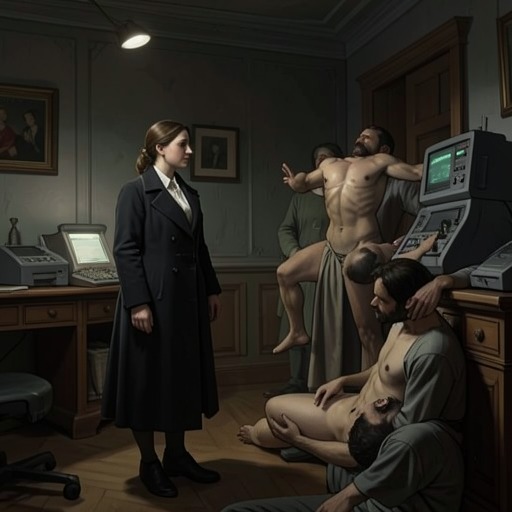
Gestalt’s Child Is Born and Adopted by the Grantchesters
The RookGestalt’s child is born through a reproductive arrangement in which Gestalt’s multiple bodies constitute both parents, then enters the Grantchester household through adoption. The revelation joins a seemingly ordinary family portrait to the disturbing biological logic of Gestalt’s shared identity—and makes the child’s future a question of both parentage and survival.
Discovery of the Child’s Parentage
Myfanwy pieces together the secret while reviewing both official and personal correspondence. Among the files is the announcement Conrad and his wife sent when they adopted their baby. The family portrait accompanying it looks familiar: Myfanwy recognizes Eliza not merely as Mrs. Grantchester, but as the woman she had encountered indirectly during her interview with Gestalt, when she saw through all of Gestalt’s eyes.
That perception gives Myfanwy a route from image to evidence. She identifies a fifth, smaller body belonging to Gestalt, which had been in Eliza’s company. She then connects Eliza’s long-service leave and return shortly before the adoption with further details: Eliza has a scar across her stomach and has lately become withdrawn. Myfanwy concludes that the adopted baby is Gestalt’s child and confronts Conrad with the allegation.
Adoption and the Grantchester Household
The Grantchesters’ adoption announcement and portrait provide the visible record of the child’s new family. To an outside observer, the photograph places the baby within an ordinary domestic unit; to Myfanwy, it conceals a much stranger relationship, one she can infer only by joining documentary evidence to her unusual access to Gestalt’s perception.
The adoption also gives the child a place within the Grantchester family while leaving its biological origins undisclosed. Myfanwy’s discovery does not rest on a single confession: it emerges from the correspondence, the portrait, Eliza’s absence and return, and the physical and behavioral clues she has gathered. Conrad acknowledges the methodical quality of her detective work without, at that point, confirming the accusation.
Gestalt’s Account of Reproduction
The decisive confirmation comes later from Gestalt, who is found bleeding and weeping on the floor. Gestalt explains that no new bodies can be obtained by ordinary means: for a child to become part of Gestalt, both parents must be Gestalt’s bodies. The body capable of carrying a child is now dead, Gestalt says, so no further child can be born and Gestalt will die.
This revelation recasts the baby’s birth as the product of a single identity distributed across bodies that occupy the roles of both parents. Myfanwy understands that the child is not merely associated with Gestalt’s mind: Gestalt’s account means one mind formed both parents and the child. She recoils at what this implies, recognizing that Gestalt might otherwise have become immortal and multiplied into an army.
Consequences and Significance
The child’s birth marks both a continuation and a limit for Gestalt. The baby carries Gestalt’s identity into a household that has adopted it without the concealed parentage being openly established, while the death of the sole body able to bear a child closes off the possibility of reproducing that identity again. Gestalt’s fear of death gives the discovery an immediate consequence beyond the question of the child’s origin.
Myfanwy decides that the baby must be brought in so the Court can determine what should happen to it. She also recognizes that Gestalt does not know about her amnesia. With Gestalt still on the floor and Conrad’s family portraits before her, she picks up Norman’s gun and calls for help. The event therefore ends not with a resolution of the child’s fate, but with the secret exposed, Gestalt’s reproductive future apparently ended, and the child placed before the Checquy’s authority.