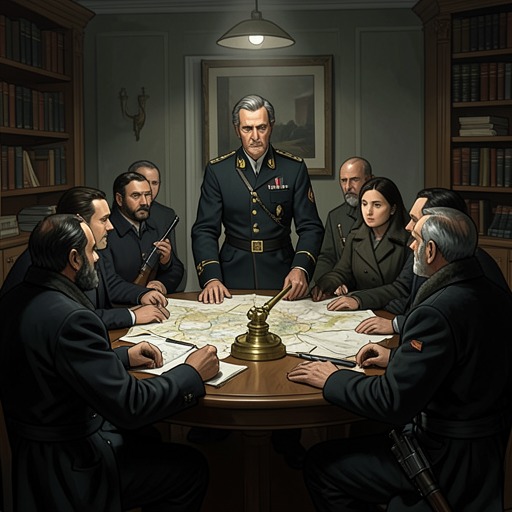
Grafters Issue Myfanwy an Ultimatum and Threaten Bronwyn
The RookDe Leeuwen’s ultimatum is the first direct personal crisis in the Grafters’ renewed approach to Rook Thomas: he demands that she produce Ernst von Suchtlen, then threatens Myfanwy and her sister, Bronwyn, when she says she does not know where he is. The encounter shifts from a supposedly limited request to an explicit attempt at coercion. Myfanwy responds with defiance, and the deadline is temporarily reset; beneath the exchange lies the much older conflict born of the Grafters’ invasion of the Isle of Wight and the Checquy’s destruction of their project.
Causes and Historical Background
The demand has roots in the Grafters’ disastrous invasion of England in 1677. The Checquy fought the invaders on the Isle of Wight for three weeks, losing hundreds of civilians and many soldiers. The fighting ended when John Perry, the surviving Rook, linked his mind to the Grafter general’s and killed them both. The subsequent settlement required the Belgian ruler to dissolve the Grafters: their funding and experiments were terminated, their estates confiscated, and the organization was dismantled under Checquy supervision. De Leeuwen’s resentment is therefore not merely a response to Myfanwy’s refusal. He remembers the invasion and the destruction that followed as a personal and collective injury.
Centuries later, the Grafters have survived and resumed covert activity, but de Leeuwen says he has lost track of his partner. Ernst disappeared from their factory months earlier after leaving instructions to continue the strategy in England and conceal his absence. De Leeuwen says he did not discover the disappearance until weeks before meeting Myfanwy. A record of mail sent to Myfanwy Thomas then led him to suspect that she knew where Ernst was. He also says he sent an agent to find Ernst and that the Checquy captured and tortured that agent. Myfanwy, however, has no knowledge of the Grafters’ renewed presence or of Ernst’s whereabouts.
The First Meeting and the Three-Day Threat
De Leeuwen arranges to meet Myfanwy when she is unattended. He appears in a tank installed in a limousine and explains that a new skin is being grown for him, but that he did not want to wait to meet her. He initially presents his assurance that neither he nor his people will harm her or her friends as a courtesy, without conditions, because she possesses something he wants. His manner changes when Myfanwy tells him that the Checquy does not have Ernst.
The demand becomes explicit: de Leeuwen wants Myfanwy to produce Ernst, whom he identifies as the other leader of the Wetenschappelijk Broederschap van Natuurkundigen. He treats her denial as a pretense rather than accepting that she may genuinely be uninformed. When she cannot supply an answer, he threatens to unleash a catastrophe against her people within three days. Myfanwy leaves the meeting without giving him what he wants; the encounter ends with the threat unresolved and the deadline running.
The Threat Expands to Bronwyn
De Leeuwen later contacts Myfanwy again and reinstates the original three-day offer after, he says, receiving advice that he may have acted rashly. Myfanwy challenges the terms of the deadline and reminds him that she had already said the Checquy did not possess Ernst. She explains that she will do what she can to help, but that his failure to notice his partner’s disappearance is not her responsibility. She also points out that, as the Court’s most junior member, she is not necessarily the person best placed to address the broader matter.
De Leeuwen refuses to let her refer the issue to other Court members. He says Ernst’s message to Myfanwy, the general of the Grafters’ greatest enemy, is why she was contacted, and asserts that he would otherwise have no reason to believe she knew Ernst’s location. He then makes the danger personal by threatening Myfanwy’s sister, Bronwyn, alongside a grotesque vision of an attack on Britain’s government and population. His earlier assurance that his people would leave Myfanwy’s friends untouched is thus contradicted by his own escalation. Myfanwy recognizes the reversal and reminds him that he had promised they would not be touched or investigated; he dismisses her appeal as naivety.
Myfanwy’s Counterthreat and the Reset Deadline
Myfanwy answers the threat to Bronwyn with a counterthreat: if de Leeuwen moves against her sister, she will have his country bombed and use her bodily-control power against him. The exchange marks a sharp change in leverage. De Leeuwen had tried to make Myfanwy’s ignorance look like deliberate obstruction; she now makes clear that a threat to her family will provoke retaliation rather than compliance. She tells him to call again in three days and says that, if Bronwyn suffers even slight discomfort, he will receive his partner in the form of matched luggage. She ends the call, then turns to Ingrid and admits that she needs a drink.
The episode establishes both the immediate stakes and the limits of de Leeuwen’s pressure. He does not obtain Ernst’s location, and Myfanwy does not accept responsibility for a disappearance she did not know about. Yet the renewed deadline leaves the confrontation open: her sister’s safety is now part of the dispute, while Myfanwy’s promise to retaliate makes clear that the Grafters cannot threaten her family without risking a direct conflict.
Significance in the Wider Conflict
The ultimatum initially presents the Grafters’ return as a demand backed by the possibility of violence. Later, de Leeuwen explains that the renewed strategy was not intended as a conventional invasion. He describes the apparent threat as a feint: the Grafters wanted to pressure the Checquy while concealing their existence from the wider world, which had become too interconnected for a country’s conquest to remain secret. The ultimatum is therefore part of a contest over secrecy and political survival, not simply a search for a missing leader.
That history complicates the confrontation without excusing its threats. De Leeuwen later says that the Grafters’ original response to the Checquy’s destruction was to hide and inflict pain, but that he came to forgive the Checquy and regard it as a capable governing body with noble aims despite its flaws. He describes infiltration and the cultivation of collaborators as ways of persuading the Checquy that joining forces would serve both organizations. Myfanwy, in turn, identifies the danger of a war that neither side could keep secret and argues that the Checquy’s mandate is to protect in secrecy. The ultimatum thus foreshadows a possible transition from inherited enmity and coercive pressure to negotiations over alliance, while showing how little trust exists when those negotiations begin.