Myfanwy Alice Thomas
The RookMyfanwy Alice Thomas is the name attached to a life that its original occupant deliberately prepared for a successor. After losing her memories, the new Myfanwy inherits the body, name, responsibilities, and dangers of the former Checquy officer, but not her autobiographical knowledge. The letters left behind turn that rupture into a practical and emotional problem: she must use another woman’s instructions to survive, then decide what it means to inhabit the life they describe. Her eventual reunion with Bronwyn marks the decisive shift from inheritance toward belonging.
Identity and the Inherited Life
The former occupant identifies the body as Myfanwy Alice Thomas and explains that the successor will use its name. Even pronunciation becomes part of the inheritance: the writer specifies “Miff-un-ee,” with a silent w and a hard f, and compares the sound to Tiffany. This intimate correction makes the name something the successor can learn and speak, even when the memories that once gave it personal meaning are absent.
The distinction between body and biography is present from the first letter. A scar on the inner left thigh comes from falling out of a tree at nine; a filling in an upper tooth comes from avoiding the dentist. These details belong to the body the new Myfanwy wears, but they are initially offered as facts about someone else’s past. The previous occupant even anticipates that her successor may care little about that history. The body is continuous; the person’s access to its story is not.
The new Myfanwy’s first questions make that separation explicit. After waking in a hotel room, she wonders who Myfanwy Thomas is, whether she is married or employed, and whether she has family or friends. She considers a dream in which she heard the name and wondered whether a rook was a bird, but dismisses its implications with the wry observation that she has no feathers. Her missing memories leave ordinary biographical questions unanswered, while her injured knees and aching chest remind her that she has entered this mystery through a vulnerable physical body.
Letters, Danger, and the Power in Her Body
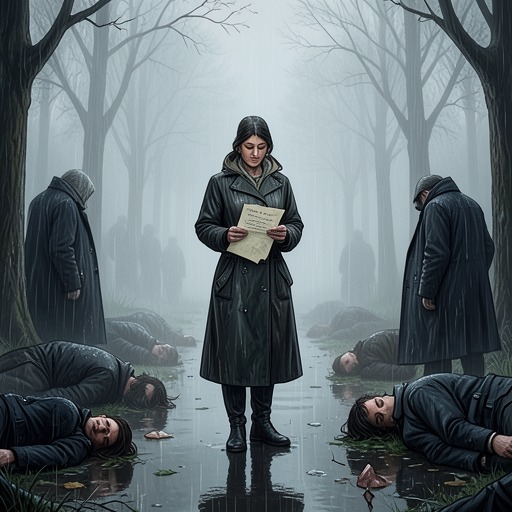
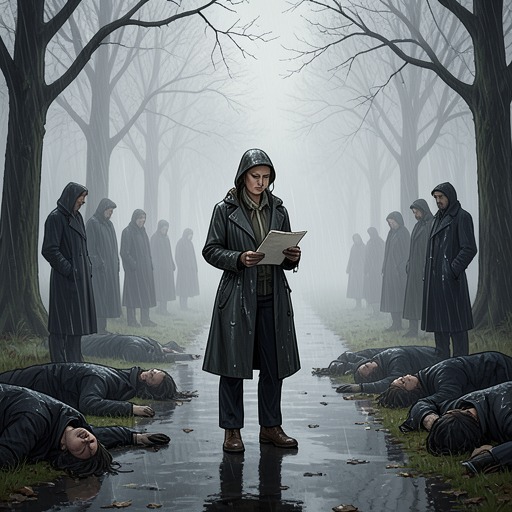
The previous occupant’s letters are not simply a record of a lost life; they are a survival system prepared for an unknown reader. The first identifies an immediate danger—fatal allergy to bee stings—and directs the successor to epinephrine injectors kept in a purse, car, and jackets. It also warns that the inherited body comes with problems and responsibilities. Practical knowledge arrives before a full explanation of identity, setting the terms of Myfanwy’s new life: she must act on information she cannot yet place in a personal past.
A second letter interprets the choice that brought her there. The writer assumes that, under severe stress, Myfanwy touched someone and disrupted their bodily control, perhaps paralyzing or blinding them or depriving them of speech. That assumption points to a power that can emerge without deliberate intent and whose effects can be severe. The former occupant describes its first manifestation as a door opening inside her, something impossible to ignore, and connects its unconscious release to intense pain. The new Myfanwy is therefore not only navigating amnesia; she is discovering a dangerous capacity through the consequences of having used it.
The writer’s account of her own first manifestation gives that power a bodily history. At nine, after falling from a tree and impaling her leg on a sharp branch, she was driven to a hospital in a tracksuit. A doctor brushed her bare skin and lost control of his legs; when another hospital worker touched her, the worker lost her sight. The incident explains both the scar and the power, but it does not give the successor a memory of having experienced it. Instead, the letter supplies a history that Myfanwy must treat as inherited evidence.
The letters also offer concrete means of preserving an independent path. In the wallet, the former occupant has arranged identification and bank cards in the name of Anne Ryan, along with the PIN 230500, and advises the successor to withdraw money and use that identity at a hotel. After Myfanwy chooses the letter rather than the alternative box, another note directs her to take both suitcases to a flat whose address is not connected to the former occupant officially. The driver takes a deliberately circuitous route, with abrupt changes of direction intended to prevent pursuit. At the flat, the successor sees the place where the writer sat on the other side of the couch and finds the arrangement companionable despite the absence of a companion. Objects, directions, and a prepared room make communication possible across the break in memory, while also making clear that danger has not disappeared.
A New Name in an Established Institution
Myfanwy’s assumption of the name becomes public when a man dressed in purple opens the car door and greets her as Rook Thomas. She answers awkwardly, still adjusting to a role that others recognize more readily than she can. The address carries institutional weight: the car is taking her to the Rookery, and the greeting places her within the Checquy’s hierarchy before she has fully made sense of the person who held that position.
Her education in that world is mediated by the former occupant’s files and instructions. After spending much of the previous day sleeping and reading dossiers, she wakes at five on Monday morning afraid she is late. The report under which she fell asleep concerns the Checquy’s diplomatic relationship with the Great Barrier Reef. Her instinctive concern about time and preparation exists alongside the strangeness of reading an official record about a life she cannot remember living. Institutional knowledge can be recovered through documents; the personal familiarity that might make it feel like her own has to be built.
That gap remains consequential well into the later crisis. After hearing accounts of violence, betrayal, and events involving Grantchester and the Grafters, Myfanwy decides not to disclose her amnesia to the Court. She carefully limits her account, feigns light-headedness to avoid a full explanation, and stays deliberately vague about Norman’s capabilities. Bruises around her eyes draw attention, but the others are preoccupied by the revelations and do not connect them to the earlier memory loss. Her concealment preserves control over private information while leaving an important vulnerability undisclosed, even as the remaining Court members and the surrounding organization face revelations of their own.
Bronwyn and the Making of Belonging
The claim that Bronwyn Thomas is Myfanwy’s sister first meets her not as a remembered fact but as a shock. Myfanwy recognizes her own features in Bronwyn’s face, though Bronwyn is taller, with long, highlighted blond hair, and Myfanwy feels an immediate connection that has no clear autobiographical source. Even the violent spectacle of Gestalt strangling Dr. Crisp had not struck her as forcibly as this revelation. For a moment, the world’s sounds seem to disappear; the sister-shaped relationship becomes more compelling than explanation.
The embrace that follows turns recognition into bodily experience. As Myfanwy and Bronwyn hold one another, weeping and laughing, Myfanwy’s power flares. She senses their genetic ties and recognizes her own patterns mirrored in her sister. She draws back to study Bronwyn at arm’s length, then pulls her close again. The relation is at once a fact of kinship and an encounter she experiences through her body before she can recover a shared past.
That encounter changes how she understands the life she has inherited. Other parts of Thomas’s existence have seemed like something left to her, but Bronwyn feels like hers as much as the former occupant’s: this is the sister of this body, and the body is hers too. In this recognition, Myfanwy finally relaxes into herself. When Bronwyn tells her their parents are dead, the news lands differently from the files she has read. It is no longer only information about the family of the woman whose body she inherited; it is grief about her own parents, accompanied by a piercing regret. The reunion gives kinship emotional force, and that force helps make the inherited past personal.
Memory, Selfhood, and the Unfinished Inheritance
Myfanwy’s identity develops through a tension between what she can know and what she can feel. At first, she calls the former occupant Thomas, distinguishing that person from the self who now looks out through the same face. Repeating “I’m Myfanwy” makes the name gradually more convincing, but it does not restore the lost biography. Files supply facts; the letters interpret abilities and dangers; bodily sensation and relationship supply forms of recognition that documents cannot provide.
The narrative thus treats identity neither as a name alone nor as a complete store of memories. The same body bears the scars of the former life and the power that life developed, while the new Myfanwy must decide how those continuities belong to her. Her bond with Bronwyn does not erase the distinction between successor and predecessor; it changes its meaning. What began as another woman’s body, history, and institutional role becomes a life Myfanwy can claim through present experience, action, and connection. Her decision to keep her amnesia from the Court shows that this process remains incomplete: she can belong to the role and to her family while still withholding a central fact about herself.