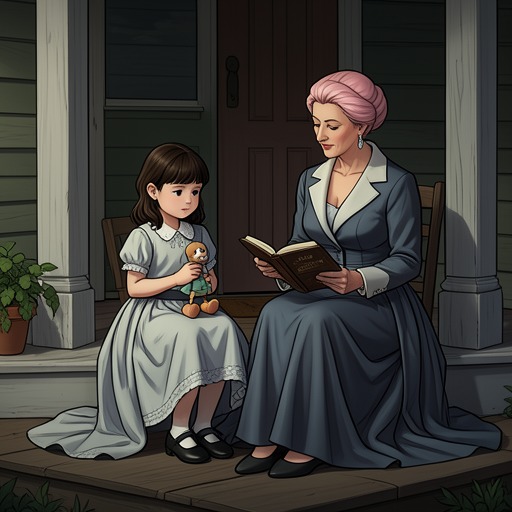
Myfanwy Thomas and Lady Linda Farrier
The RookLady Linda Farrier and Myfanwy Thomas are connected by an intimate, uncanny history that precedes their waking acquaintance and survives a devastating break in Myfanwy’s memory. Their relationship moves from dream companionship to the Checquy’s enforced separation of a child from her family, then returns in altered form when Farrier recognizes that the woman before her occupies Myfanwy’s body but is no longer the person she knew. Its defining tension is between personal familiarity and institutional power: Farrier can be a patient listener in dreams, yet also one of the officials who takes Myfanwy away.
A familiar face before their first meeting
As a child, Myfanwy dreamed of Farrier repeatedly for two months. In those dreams, they sat together in a room with a black-and-white-tile floor while food appeared on the tables. Farrier patiently drew details from her: she listened not only to Myfanwy’s account of her hospital visit, which particularly interested her, but also to descriptions of possessions and ordinary daily minutiae. Myfanwy later remembered the older woman’s attention as a rare kind of companionship. At nine, she had found someone who seemed genuinely fascinated by what she had to say, and that patience made her adore Farrier.
The dreams gave the relationship an unusual order. Myfanwy felt attached to Farrier before she could explain why the woman seemed familiar, and before they had met in the waking world. Their intimacy was made through conversation and repeated visits rather than through family ties or ordinary shared life. When the two eventually faced one another in person, the recognition belonged first to Myfanwy: Farrier ignored the child, while Myfanwy’s attention fixed on the woman from her dreams.
The Checquy’s claim on Myfanwy
Three months after Myfanwy’s hospital visit, an obscure government branch wrote to her father. He and Myfanwy were then driven to an old stone building in the City, where Lady Farrier and Sir Henry Wattleman met them in a book-lined drawing room. Over tea and biscuits, the two officials explained that the Checquy could legally take Myfanwy from her family and place her in its care. Myfanwy, nine and a half, scarcely followed the explanation. She was preoccupied by Farrier, whose appearance seemed to match the woman she had encountered night after night.
The difference between the dream relationship and the waking encounter became stark as Myfanwy’s father objected, then accepted that he would leave without his daughter. Farrier calmly repeated the law and offered no mercy in her voice. Sir Henry showed more visible pity toward the father, even patting him on the shoulder, but neither official comforted the weeping child. Myfanwy could not recall her final words with her father; she remembered wiping his tears from her cheek while staring at Farrier, astonished that the woman from her dreams was real.
That moment did not erase Myfanwy’s love for her family. She later recalled adoring her little sister and older brother and dissolving into tears in the days that followed. But the shock of recognizing Farrier temporarily eclipsed the departure. When Myfanwy began to sob, Farrier continued to sip tea and eat crumpets until the child composed herself. The restraint contrasts with the patient attention of their dreams: the same woman who had listened closely to a child’s stories did not respond to the child’s distress when the Checquy’s authority was being enforced.
Recognition after the loss of memory
Years later, following Myfanwy’s amnesia, Farrier returned in another dream. The scene recalled the earlier dream meetings: Myfanwy sat with an elderly woman in Victorian clothes in a hot, fern-filled room with a black-and-white-tile floor. Farrier thanked her for having disposed of a threat to Farrier and her family, acknowledging a debt and offering, reluctantly, to return the favor if she ever could. The exchange suggests that the women’s history included a consequential service by Myfanwy, though Farrier made clear that she could not actively help her in the dream or in the waking world without endangering them both.
Farrier’s gratitude gave way to alarm when she sensed that Myfanwy’s mind had changed. She recognized an impossible combination: the person before her was not Rook Thomas as Farrier knew her, and yet she was. Myfanwy explained that the former Myfanwy had lost her memory and described herself as the one who had awakened in that body. Farrier understood the bodily continuity but reacted to the psychological discontinuity: to her, the new consciousness was not simply the old relationship resumed.
The exchange turns their earlier familiarity into a test of identity. In childhood, Myfanwy recognized Farrier through the persistence of a dream; after the amnesia, Farrier recognized Myfanwy’s body while finding her mind altered beyond easy comprehension. The relationship therefore carries two opposed forms of recognition: a child’s remembered attachment surviving into a first waking meeting, and an old acquaintance’s knowledge confronting a person who looks like Myfanwy but cannot claim her memories.
Separation and the unfinished bond
Farrier’s conduct is not reducible to either intimacy or authority. In the recurring dreams, she patiently heard the details of Myfanwy’s life; in the waking world, she helped enact the Checquy’s legal claim and remained unmoved as Myfanwy cried. Later, when the amnesiac Myfanwy asked whether Farrier did not owe her a debt, Farrier insisted that the woman before her was not Thomas. The distinction is severe, but it follows from the same question raised by their reunion: whether a shared body and name are enough to preserve a relationship when memory and personality have changed.
The bond remains unfinished rather than restored. Farrier cannot safely offer active assistance, while Myfanwy’s new self reaches toward a debt and history she only partly possesses. Earlier, the child had experienced Farrier’s sudden absence from her dreams as abandonment; after the Checquy took her away, the first night at the Estate passed without the familiar dream visits. Across both interruptions, Farrier’s absence marks the limits of a connection that had once felt dependable. Their story makes those limits concrete: affection may begin in private attention, but it is repeatedly crossed by institutional power, danger, and the uncertainty of who Myfanwy has become.