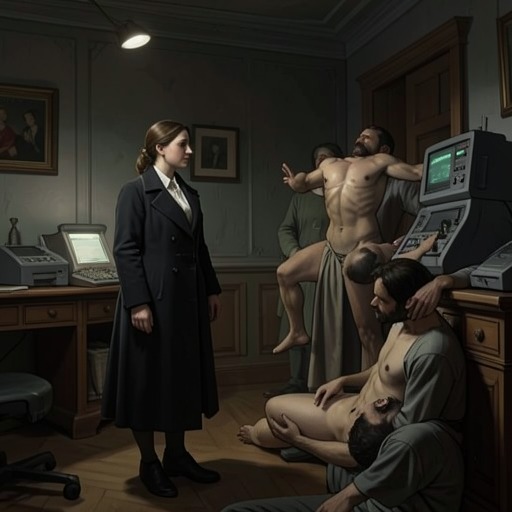
Myfanwy Thomas and Rook Gestalt
The RookMyfanwy Thomas and Rook Gestalt are the two Rooks responsible for coordinating the Checquy’s domestic work, but their professional partnership is established in an atmosphere of uncertainty rather than trust. Newly amnesiac and still learning the structure of her office, Myfanwy must work closely with a colleague whose unusual shared consciousness makes him powerful in the field—and whose possible involvement in the attack on her remains an open concern.
Identity and Professional Connection
Myfanwy first learns that Gestalt is her counterpart when Ingrid Woodhouse tells her that the Monday-morning meeting with the other Rook has been postponed: all of Gestalt’s bodies are away on assignments and will not return for several hours. The news leaves Myfanwy piecing together the chess-like hierarchy of her new position. She understands that she is one of two Rooks, but the reference to all of Gestalt’s bodies raises a further question: her counterpart is not a single person in the ordinary sense.
The work they share is substantial. Myfanwy is expected to master the domestic Checquy’s operations and politics, coordinate the country’s Pawn teams, assign them to tasks, and oversee the Rookery in close cooperation with Gestalt. The role makes him an unavoidable colleague: she cannot simply keep her distance from the person she may need to suspect.
Gestalt’s Methods and Reputation
Gestalt has held the rank of Rook for five years and has worked with Myfanwy’s predecessor on many operations. The predecessor met with Gestalt every Monday, Wednesday, and Friday at nine in the morning. Because Gestalt’s consciousness is distributed across multiple bodies, at least two of them are generally present in the field to oversee an operation. The four bodies also mean that at least one may be around the office, an arrangement that can complicate ordinary administration as well as making Gestalt’s presence difficult to ignore.
The distinction between the two Rooks is not simply organizational. Rooks had once acted as the Checquy’s generals, but a major redistribution of power in 1788 made them administrative guardians of the United Kingdom. They oversee responses to strange events within the British Isles and can delegate violence rather than routinely conducting it themselves. Myfanwy’s predecessor preferred office work; Gestalt, by contrast, enjoys fieldwork and is described as effective at coordinating operations on-site. The account also emphasizes his toughness, making his preference for direct involvement consequential rather than merely personal.
First Encounters and Uneasy Familiarity
When Ingrid announces Gestalt’s visit, Myfanwy reacts with apprehension. She is trying to inhabit an identity she cannot remember, and her first response to the name is faltering. She gathers herself to receive her counterpart, then greets two identical blond men with conspicuous enthusiasm, calling them the Rooks Gestalt and inviting both to sit. The deliberate cheerfulness is part of her effort to perform the authority expected of her even as she lacks the personal history that would make such a meeting comfortable.
The office encounter quickly reveals how Gestalt’s distributed awareness reaches beyond routine administration. While Myfanwy discusses the schedule with the two bodies present, they announce in unison that they are about to enter the headquarters of the antler cult and offer a running commentary. They describe the operation’s preparations: a Pawn checks the door, the team identifies armed people on the other side, and orders are given for the entry. As the twins speak, their voices shift into those of their sister, Eliza, who is directing the assault from elsewhere; their arms make small corresponding movements. The scene gives Myfanwy a practical demonstration of Gestalt’s shared consciousness: the bodies in her office can relay and physically echo a distant operation as it unfolds.
The simultaneous display of office conversation and field action unsettles the meeting’s ordinary rhythm. The twins struggle to return their attention to the remaining administrative matters, and the unfinished agenda is deferred. Myfanwy, meanwhile, notices how absorbed and satisfied they are by the operation and by their sister’s skill. Their account of the raid is not abstract briefing: it makes the violence Gestalt can coordinate present in the room, intensifying her awareness that she could be vulnerable to him.
Suspicion and the Limits of Trust
Myfanwy’s fear has a specific cause. Her predecessor’s letters warn that if Gestalt is the person who wants her dead, she will need to be very careful. The warning does not establish that Gestalt ordered the attack; it identifies him as a possibility whose power makes the possibility dangerous. Myfanwy therefore approaches their first working contact while carrying knowledge of a threat she cannot yet explain or verify.
After the operation commentary, she checks herself: she cannot meet every member of the Court and automatically assume that each is the traitor. Gestalt may not have ordered the attack at all, and the tension of the meeting may have been spent fearing him without cause. But suspicion does not resolve the central question of who gave the order. Myfanwy ends the encounter with more awareness of Gestalt’s capabilities, not proof of his guilt, and with the intention of learning what her predecessor knew. Their relationship is thus defined by a double demand: she must cooperate with Gestalt to run the domestic Checquy, while withholding trust until she can distinguish a real threat from the uncertainties of her lost memory.