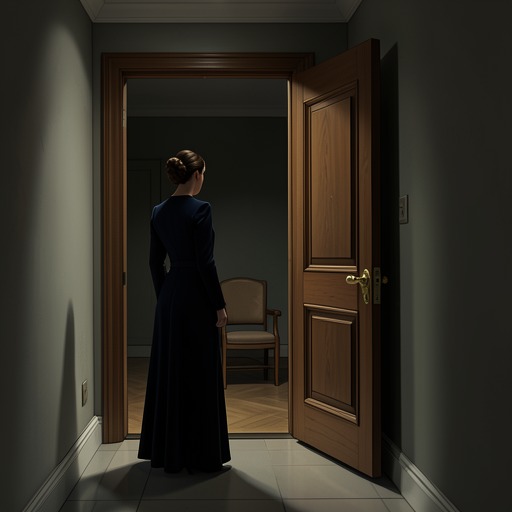
Myfanwy Thomas and the Checquy Group
The RookMyfanwy Thomas and the Checquy Group are joined by a defining contradiction: the organization gives her work she loves and a role in protecting the public, but it also claims authority over exceptional people, limits their freedom, and makes departure perilous. Myfanwy becomes one of its most senior administrators rather than the field operative first imagined for her, and her loyalty is tested when she learns that a member of the Court may be trying to kill her.
Recruitment and the discovery of her role
The Checquy Group recruits Myfanwy because she can affect another person’s physical systems through touch. Her ability can deprive someone of a sense, cause paralysis, or produce other bodily effects; mastering it takes years. The organization initially imagines her as an unusually powerful spy who might intervene directly in the field. That expectation does not suit her: she is shy, not aggressive, and becomes violently ill on planes.
Rather than dismissing her, the Court retains her as an in-house operative. Myfanwy proves exceptionally capable in administration and numeracy, and she uses her power only rarely. Her advancement comes through bureaucratic work rather than dangerous field operations: after ten years in administration, she enters the Court, becoming its youngest current member. The next-youngest member had reached the Court after sixteen years of highly dangerous fieldwork. Her career therefore unsettles any simple equation between supernatural ability, combat, and authority; the organization’s governing circle depends on her less-used gifts as well as on her administrative judgment.
Loyalty, protection, and institutional power
Myfanwy’s pride in the Checquy is genuine. She understands its work as the protection of ordinary people from threats they cannot know about, and she believes that even an office-based role contributes to that defense. This sense of purpose makes the possibility of betrayal inside the Court especially destabilizing: a predicted attack on her would imply not just a personal danger but a danger to the organization’s core and, through it, to the people it is meant to protect.
Her account of the Checquy also makes clear that its protection rests on extensive institutional power. It has operated for centuries, presenting itself as a secret instrument of the nation rather than of any single ruler. It recruits people with abilities through varied means and has long possessed authority to claim citizens. Its members are bound by ancient oaths, modern contracts, and government secrecy laws. Myfanwy knows that leaving would not be a simple resignation: she tells her successor that she prepared a contingency involving altered personnel records and a computer virus, to be activated through a terminal at Waterloo Station. The plan would impair the Checquy’s ordinary work and temporarily weaken national defenses, making escape a form of treason. She is relieved that her successor chose to remain, but the relief sits beside the starkness of the choice the institution imposes.
The organization also divides authority by ability. Its hundreds of members include both people with extraordinary powers and highly accomplished non-powered staff; Myfanwy explicitly refuses to regard the latter as inferior. Yet tradition and policy exclude non-powered members from the Court, the ruling body. Her own place within that hierarchy is secure because she has both a power and an unusual administrative record, even though her professional worth is not measured by frequent use of that power.
Office, authority, and the Rookery
As a Rook, Myfanwy is one of the senior officials responsible for the Rookery and the Checquy’s domestic operations. The office carries broad access and authority: she can enter the building’s restricted areas, use its secret passages, and direct the people working under her. The passages are documented in an electronic organizer kept in her desk and in schematics in her binder; their locks respond to her fingerprints, palmprints, or an access code supplied by her predecessor. These practical details make her position tangible: she inherits not only a title but an infrastructure of access, command, and institutional knowledge.
The Rooks’ function has changed over time. In 1702, they led the assault on Brigadoon as weapons of the old Checquy leadership. A redistribution of power in 1788 instead made them administrators of domestic affairs, responsible for responding to supernatural incidents within the British Isles. They still exercise violence, but increasingly through delegated teams. Myfanwy’s principal duties are to master the domestic forces’ operations and politics, coordinate and assign the country’s Pawn teams, manage the Rookery, and work closely with Rook Gestalt. She also meets with the other Court members to coordinate the organization’s wider movements. The contrast between the Rooks’ violent history and Myfanwy’s preference for office work places her within an institution whose administrative face is inseparable from its capacity for force.
Memory, inherited identity, and continued service
After losing her memories, Myfanwy initially has no clear sense of who the name Myfanwy Thomas identifies. The former occupant of her body becomes, in her thinking, Thomas: someone whose past and institutional life she has inherited but does not yet experience as her own. The letters left by that former self supply crucial context, including an explanation of the Checquy, Myfanwy’s ability, and the obligations attached to her office. The new Myfanwy must therefore make decisions about continued service before she has recovered the autobiographical history that once made those decisions familiar.
Her decision to stay does not erase that divide. She inherits the Checquy role, its responsibilities, and the danger of its internal politics, while gradually establishing a present-tense identity within them. Her relationship to the organization is consequently both continuity and choice: the position is already hers in law and practice, but the person who occupies it must decide whether its mission can become her own.
The inherited conflict and the prospect of alliance
The Checquy’s history with the Grafters shows why its secrecy and security culture are so entrenched. In 1677, Grafter creations landed on the Isle of Wight and began a supernatural war on British soil. The Checquy sent Pawns under the direct command of the Rooks; the fighting lasted three weeks, caused hundreds of civilian deaths, and cost many Checquy soldiers. When the invasion ended, the Checquy secured a treaty under which the Belgian ruler agreed to dissolve the Grafters, withdraw their funding, end their experiments, and confiscate their estates. The Checquy believed the threat had been extinguished.
Centuries later, Graaf Ernst von Suchtlen explains that the Grafters’ later maneuvers were not designed to conquer England. They were intended to demonstrate leverage against a secretive organization in a world where an open invasion could not remain hidden and where neither side could afford to expose the supernatural world. Myfanwy recognizes that a war between the organizations would be difficult to conceal and would violate the Checquy’s mandate, which she states as protection in secrecy. She interprets von Suchtlen’s presence as evidence that he has come to negotiate an alliance rather than surrender.
Von Suchtlen’s account complicates the Checquy’s inherited picture of its adversary. He recalls the destruction of Grafter homes and the deaths of his associates, but says that time led him to forgive the Checquy and regard its aims as noble despite its human failings. He claims that he fostered collaborators and continued infiltration to persuade the Checquy that union was in its interests, not simply to harm it. The relationship between Myfanwy and the organization thus reaches beyond her personal career: in her dealings with the Grafters, she must defend the Checquy’s secrecy while considering whether its survival may depend on changing the boundaries of the institution she has chosen to serve.