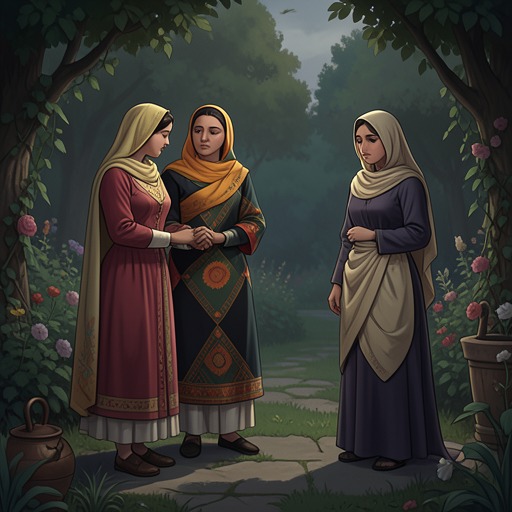
Myfanwy Thomas—Bronwyn
The RookThe relationship between Myfanwy Thomas and Bronwyn is both a family reunion and a turning point in Myfanwy’s struggle to understand who she is after losing her memories. Bronwyn identifies herself as Myfanwy’s younger sister; in the embrace that follows, Myfanwy feels their genetic connection through her powers and recognizes the relationship as belonging to her, not merely to the person whose life she inherited. Their meeting gives the amnesiac Myfanwy a personal bond that survives the gap in her recollection and changes how she inhabits her own identity.
Estrangement and the Reunion
Myfanwy meets Bronwyn without a remembered history to guide her. She is stunned by the claim of sisterhood and by the resemblance between them: Bronwyn has features like her own, with a taller frame and long, highlighted blond hair. The recognition is not a recovered memory. Rather, Myfanwy feels an immediate but uncertain sense of connection, as though Bronwyn fits a sister-shaped absence in her life.
Bronwyn is twenty-five and says she was three when Myfanwy went away, so she has no real memory of her older sister either. She had come to the address hoping to make contact, then followed Myfanwy after recognizing a resemblance to their mother. When Myfanwy’s name did not appear in the directory of the building she entered, Bronwyn waited nearby; she eventually saw Myfanwy across the street. The reunion therefore begins with recognition from appearance and a deliberate, hesitant search, rather than shared recollection.
The sisters also approach the past from different sides of the same silence. When Myfanwy cautiously asks what their parents told Bronwyn and their brother Jonathan, Bronwyn explains that the parents refused to discuss Myfanwy. Their father especially insisted that she was gone and that the others should forget her and carry on. Bronwyn recalls arguments and a family atmosphere of anger, silence, and shame around the subject. Myfanwy, who cannot remember those years, feels obscurely guilty for a rupture whose history she does not know.
Family History and Unshared Memory
Myfanwy explains her absence by saying she had a serious medical problem and that her chances of surviving had been slim. She describes being on drugs and in closed wards, presenting this as the explanation for the lost years. The account is an invention made in the moment, not a memory she has recovered. That distinction matters to the relationship: Bronwyn is offering the family history Myfanwy lacks, while Myfanwy must decide what she can tell without access to her own past.
Bronwyn says their parents died eight years earlier in a car accident caused by a drunk driver. Jonathan, who is thirty-three and works as a banker, became Bronwyn’s legal guardian. After moving to London to live with him, Bronwyn struggled through a new school, finished with difficulty, spent a couple of years in various unsatisfying jobs, and then began studying after Jonathan urged her to move forward. She recalls the family belief that the Thomases do better when they have a mission. The detail gives the sisters a shared family inheritance in words and habits, even though their memories of one another do not match.
The news of their parents’ deaths changes for Myfanwy as Bronwyn speaks. She had already read the deaths in files, but hearing them from her sister makes them emotionally immediate: these were not simply the parents of a body or a life she had taken over. They were her parents too, and she feels piercing regret. Bronwyn and Jonathan had believed Myfanwy might still be alive; after their parents died, they searched through the papers and found documents that supported that hope. Their family history thus contains not only imposed silence but also a continuing effort to establish what happened to the absent sister.
Recognition Through the Body
Bronwyn tells Myfanwy that she wants her to know she is glad to have found her and wants her as a sister, despite neither of them remembering their shared childhood. She acknowledges the painful imbalance: for Bronwyn, the revelations would be intense even if they concerned a friend, and they are more charged because Myfanwy is her sister. She also imagines that Myfanwy might feel the family did not care, since it had allowed her to disappear. The offer does not require Myfanwy to produce memories or to feel an obligation; it makes room for a relationship they can choose in the present.
Myfanwy answers that she wants the same, and they move toward each other, laughing and weeping as they embrace. The encounter has a physical dimension beyond ordinary recognition. Myfanwy feels her powers flare, as if fuel had been poured on a fire, and senses their genetic ties: Bronwyn’s patterns mirror her own to an extent. She pulls back to examine her sister at arm’s length, then draws her close again. In this sequence, the body supplies a form of kinship knowledge that autobiographical memory cannot.
The distinction between inheritance and belonging resolves in Myfanwy’s response to the embrace. Much of the life surrounding her seems to belong to Thomas, the former self whose history she has inherited. Bronwyn, however, is the sister of the body Myfanwy now inhabits, and Myfanwy claims that body as hers as well. She comes to feel that Bronwyn and their connection belong to her personally, not only to the lost woman whose identity she has taken up. The reunion is therefore not a restoration of remembered childhood; it is a new relationship that helps Myfanwy settle into a self she can call her own.
What the Relationship Makes Possible
The sisters’ bond begins amid missing memories, a family’s refusal to speak, and Myfanwy’s uncertainty about whether the life attached to her name is truly hers. It does not erase those gaps: Myfanwy still lacks the history Bronwyn is trying to share, and she has concealed the uncertainty behind a fabricated medical explanation. But Bronwyn’s willingness to accept a relationship without demanding proof through shared recollection gives Myfanwy a different basis for connection. Their recognition is made through resemblance, conversation, and touch, then affirmed by mutual choice.
For Myfanwy, the reunion marks a change from treating her past as someone else’s accumulation to claiming a present-tense tie within it. Family here is neither a complete record nor a recovered memory. It is a sister who sought her out, an account of parents and a brother she did not know, and an embrace in which the body’s connection becomes emotionally legible. Bronwyn does not restore the former Myfanwy; she helps the amnesiac Myfanwy find a place in the Thomas family as herself.