Myfanwy Thomas’s Amnesia and Park Attack
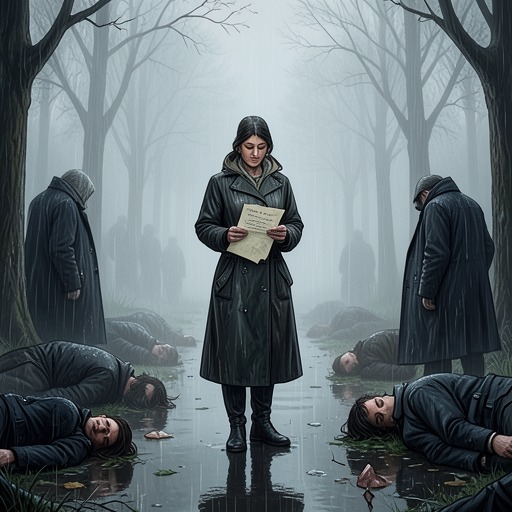
The RookMyfanwy Thomas’s amnesia and park attack sever memory from identity at the very moment an attack makes survival urgent. The woman who wakes in the rain cannot remember who she is, yet a letter and a prescription label identify her as Myfanwy Thomas; around her lie motionless attackers in latex gloves. The scene is at once a violent attempt to remove her and the fulfillment of a warning left by her former self, who knew she would lose her memory and suspected that someone she should trust had arranged the attack.
The warning and its limits
The attack reaches the reader through two linked perspectives: the amnesiac Myfanwy’s immediate experience and a letter written by the Myfanwy who expects to lose her memory. The latter says that, over the preceding year, several strangers approached her with claims of precognition. Some described occasional flashes; others could not explain their visions or hunches. Their reports convinced her that the amnesia and the scene in the park were coming, though she insists she cannot see the future herself. Her knowledge is therefore specific but secondhand: she knows the shape of the crisis, not its cause or the identity of the person behind it.
The letter makes that uncertainty central rather than incidental. Its writer knows that Myfanwy will lose her memory, that she or her future self will be attacked and fight back, and that the attackers will wear latex gloves. She considers the gloves important, but the amnesiac recipient does not yet understand why. More consequentially, the letter says that the attack means someone the writer should be able to trust has decided she must be removed. She cannot say exactly who is responsible, why they want her gone, or whether the reason lies in something she has not yet done. The prediction thus offers a direction for suspicion without resolving the mystery.
Waking in the park
The amnesiac Myfanwy finds two letters in her jacket’s inside pocket. One is addressed simply to the person who will find it; the other bears only the number 2. Their presence makes the jacket an improvised archive, but the rain is already dissolving the writing. Nearby, a lamppost offers dim light as she searches her pockets for clues to her name and circumstances. A prescription label supplies the name Myfanwy Thomas, while the soggy cardboard box holding the medicine and the firm plastic of an epi-pen show that the name belongs to someone with a serious practical vulnerability: Myfanwy carries emergency medication for a bee-sting allergy.
The name does not restore a self. She recognizes that she has learned what she is called without recovering the person who once answered to it. In the letter’s terms, the former Myfanwy cannot know whether the amnesiac woman is made of parts of her or is a wholly new person; the scene dramatizes that question rather than answering it. The loss is made physical by cold, pain, soaked clothing, and the storm, while the first-person thoughts of the letter writer and the third-person account of the woman in the park remain distinct. Knowledge has survived where memory has not, but it belongs to another version of the same life.
The park itself supplies the attack’s stark evidence. Willows hang over a clearing where the lawn has become mud, and the bodies scattered across it are all motionless and wearing latex gloves. The amnesiac woman steps carefully over them as she leaves. The letter had predicted that she would come to surrounded by dead people and that she would fight and win; the scene confirms that forecast through its aftermath, without giving her a remembered account of the fight. Her escape is therefore a fact she can act on, not a memory she can claim.
Escape and immediate precautions
The warning changes the way the newly amnesiac Myfanwy moves through the world. Remembering that the letter cautioned her, she scans the trees for further attackers as she leaves the park. She emerges into a residential street lined with dark Victorian-style houses, then heads toward the distant neon glow of a business district, hugging herself and pushing her hands into her armpits to stop them shaking. The shift from the enclosed clearing to an ordinary street does not make her feel safe: she is still cold, exposed, and alert to the possibility of pursuit.
After visiting an ATM and making a phone call from a battered phone box, she takes a cab to a five-star hotel. She checks repeatedly for following cars and asks the driver to make two U-turns. Nothing suspicious happens, but her caution is concrete, not merely a response to a vague fear: she has just found bodies, read a warning of an attack, and learned that a trusted person may be involved. To the driver, she offers a stalker-boyfriend explanation. The account does not establish a stalker; the explanation functions as a cover for her movements while she tries to reach temporary shelter.
The attack’s significance
The latex gloves join the letter’s foreknowledge to the evidence left in the park. They are not a decorative detail: the former Myfanwy stresses that they matter, even as the person who most needs that explanation has no memory with which to understand it. This gap creates suspense through unequal knowledge. The reader can recognize the gloves as a clue and the dead attackers as confirmation of the prediction, while the amnesiac Myfanwy must treat both as unexplained facts and follow the letter’s warning without knowing its full grounds.
The event also defines the danger as an internal betrayal rather than an attack by an identified outside enemy. The former Myfanwy is sure only that the assailant is someone she should be able to trust; she does not know who, why, or whether the supposed offense has even occurred yet. Her effort to prepare a future self therefore becomes both an act of care and an admission of how little can be controlled. She has placed copies of her letters in her coats and jackets so that one might reach the recipient when needed, and the rain-soaked park is where that contingency succeeds. The attack leaves Myfanwy with a name, a warning, emergency medicine, and no memory of the person who assembled them: survival begins with evidence instead of recollection.