Myfanwy Thomas’s letters to her successor
The RookMyfanwy Thomas’s letters to her successor are the former Myfanwy’s carefully prepared correspondence with the woman expected to wake without her memories and take over her life. Written under the address “Dear You,” they serve at once as a practical briefing, a record of a life nearing its predicted end, and an act of kinship toward someone who does not yet exist. Their central tension is that the writer prepares the successor to become Myfanwy Thomas while insisting that she remains free to become someone else.
A private channel across the loss of memory
The letters are designed for a recipient whose identity and whereabouts the writer cannot know with certainty. She assumes the successor has reached an apartment she prepared as a secret hideaway, despite the surveillance surrounding her, and imagines the empty couch as a place where the two versions of herself can almost keep company. The correspondence therefore bridges not simply a gap in information but a division in time: one woman writes from within the life the other will inherit, while the future reader must decide what, if anything, to inherit along with it.
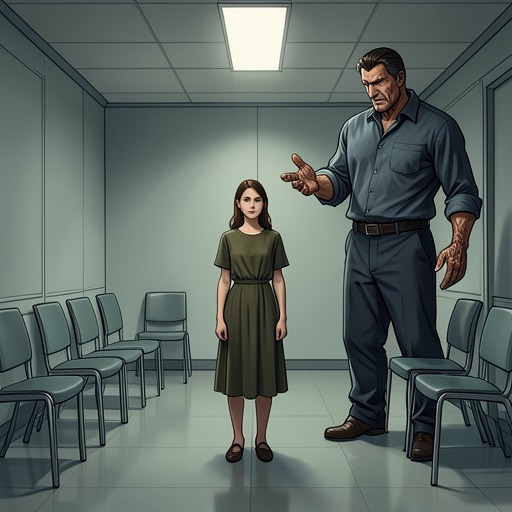
The first urgent subject is the successor’s unusual power. The writer assumes that she has touched someone and disrupted that person’s control of their own body, reasoning that this explains why she chose a particular box. She warns that the ability can be triggered unconsciously by severe pain and hopes the experience has not caused internal injury. To make the warning intelligible, she recounts her own first manifestation at nine: after falling from a tree and driving a sharp branch into her leg, she was taken to hospital in a tracksuit. When a doctor touched her bare skin, he lost control of his legs; a second person who touched her lost her sight. The letter turns a frightening, bodily episode into usable knowledge for someone who may otherwise experience the same power without understanding it.
That instruction also reveals the limits of what the writer can know. She makes an assumption about what happened to the successor, admits that she cannot supply every answer, and chooses not to follow every speculative possibility. The letters are not an omniscient manual: they are a hand-built guide written under pressure, with uncertainty marked rather than concealed.
A life under threat
The correspondence gives the amnesiac reader a way to approach questions that the empty memory cannot answer for itself. On waking, the successor wonders who Myfanwy Thomas was, whether she had a spouse, work, family, or friends, and even whether the dream of being a rook should mean anything. Her uncertainty is physical as well as biographical: she is injured, her knees are scabbed, and her chest hurts when she breathes deeply. The former Myfanwy’s letters answer that disorientation in installments, placing immediate survival and explanation before a complete account of the writer’s identity and work.
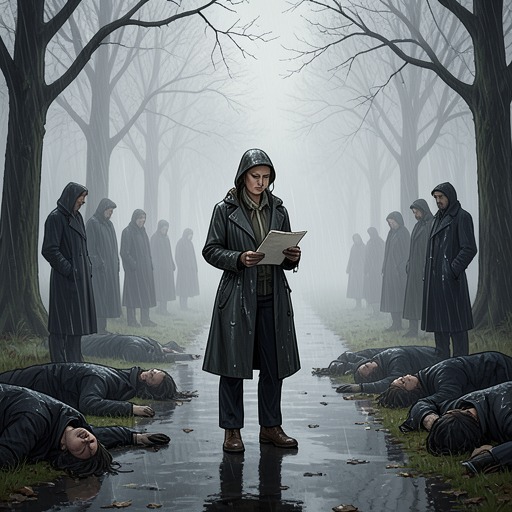
The letters are written against an approaching danger that the author cannot solve in time. She is haunted by a prophecy that her life will end in the rain and believes that a duck has given her at most a month. She continues her duties as Rook while conducting private searches, fearing that abandoning work would provoke questions and hasten the very danger she is trying to avoid. Yet she never makes it back to Camp Caius or discovers who is behind the threat. Her final letter is therefore not a triumphant explanation of the conspiracy: it openly apologizes for the answers she cannot provide and tells the successor that she cannot identify her enemies.
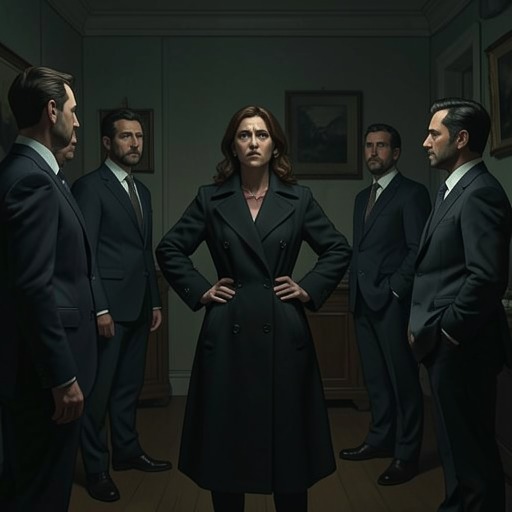
The danger becomes more painful because the writer has reason to suspect betrayal inside the Checquy. At a holiday gathering, she watches colleagues trade polite conversation while believing that one of them is planning to destroy her by taking her memories. The scene sharpens her sense of the organization’s contradiction: its members are trained and used as assets and warriors, yet are told that they can trust one another as a team. She compares the gathering’s sociability to a pleasant fiction and recognizes that its apparent comradeship cannot protect her from a colleague’s hidden intention. The letters carry that knowledge forward, though they cannot name the betrayer.
From inherited body to chosen family
The successor’s relationship to the former Myfanwy’s life changes as she encounters evidence that is more than documentary. When Bronwyn identifies herself as Myfanwy’s sister, the amnesiac woman recognizes her own features in Bronwyn’s face and feels an immediate, bodily sense of connection. Their embrace intensifies Myfanwy’s powers: she senses their genetic ties and recognizes her own patterns mirrored in her sister. That reunion gives emotional substance to the family history that a file alone could not make real.
After Bronwyn tells her that their parents are dead, the information lands differently from the fact Myfanwy had already read in the records. The parents cease to be merely the parents of a body she has inherited; she experiences them as her own, and feels regret. This distinction illuminates the work the letters ask the successor to do. Inheriting facts, an office, and a body does not automatically produce belonging; relationships can make the inherited life feel personally hers.
The former Myfanwy’s last letter makes that kinship explicit without demanding sameness. She imagines the successor choosing another key, leaving to build a separate life, and perhaps choosing a new name instead of Myfanwy Thomas. Although such a choice would make the writer’s preparations largely unnecessary, she says she would not blame her. She calls the future woman her sister and daughter, and her family, even while acknowledging that the recipient does not yet exist. The language moves beyond a transfer of identity: the writer’s attachment survives the possibility that the successor will refuse the identity being offered.
The handover remains unfinished
The letters create suspense by placing the writer’s account close to the event she fears but leaving its outcome uncertain. In the last message, written at home on a snowy night, she describes a fire, her rabbit at her feet, and her exhaustion after an ordinary day. She has gone to the Rookery infirmary for a checkup because she wants to leave the successor a relatively fit body. Domestic quiet and practical preparation sit beside the knowledge that her time is running out; even a routine day carries the weight of a life being readied for someone else.
That final note frames the handover as both material and ethical. The writer can leave a body, letters, and preparations, but she cannot dictate what kind of person the reader will be or which life she will choose. She hopes that, whatever the successor decides, she will be happy. Because the letters are written in the narrowing interval before the predicted end, their intimate directness carries an uncertainty no later explanation can remove: the author can offer guidance and affection, but cannot know whether her intended recipient will follow it. Their deepest legacy is thus not a command to continue the former Myfanwy’s life, but permission to make it her own—or to leave it behind.