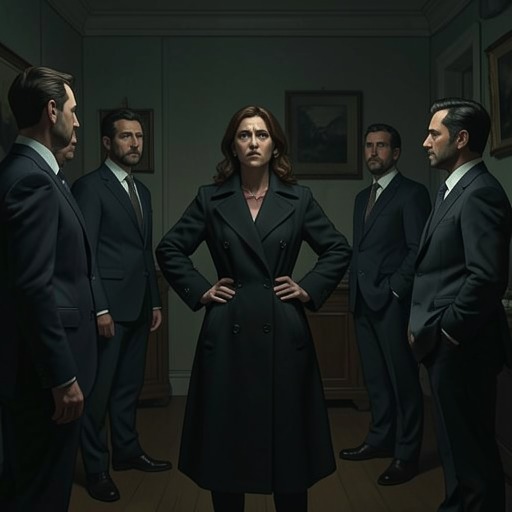
Myfanwy infiltrates Camp Caius
The RookMyfanwy’s infiltration of Camp Caius turns an accounting irregularity into evidence of a concealed, unauthorized power within the Checquy: a second estate training children into a small army, at terrible cost to its students. The break-in gives her concrete proof of the diverted funds and the school’s operations, while leaving its founder and any Court sponsor unidentified.
Discovery of the Second Estate
Myfanwy begins with money. Tracing an irregularity through financial records, she discovers that funds missing from the Checquy budget have been redirected over a period of years. The sums are modest relative to the organization’s total budget, but they have purchased land in southern Wales, paid for buildings, and financed the creation of a small army of superpowered children. The conclusion is startling: the Checquy has not one training estate but a second, hidden one.
The discovery matters because the Estate is more than a school. Myfanwy understands it as the core of the Checquy’s institutional strength: operatives become formidable not only through supernatural abilities, but because they are taken in young and rigorously trained. A second institution applying that model is therefore a weapon in its own right. Whoever controls it possesses a resource of immense value, and its construction has taken place without authorization.
Myfanwy’s investigation also clarifies what the money trail can and cannot establish. She has found the destination of the funds, but the records do not immediately disclose who arranged the operation. Because she does not trust anyone else with the inquiry, she decides to inspect the compound herself rather than hand the lead to another person.
Infiltration and the Compound
The school’s security makes the decision seem possible, though not safe. Students tell Myfanwy that guards periodically arrive on conspicuous four-wheelers with lights, giving anyone nearby time to hide. She judges the arrangements inferior to those at the legitimate Estate: the woods could conceal an intruder, and a village lies close by. This installation appears underfunded, and secrecy, rather than a formidable perimeter, is its principal defense.
That night Myfanwy wears black clothing, a ski mask, and gloves cut to expose only the tips of her fingers. She is frightened as she enters the woods, where darkness and every small sound unsettle her. Following a gully keeps her oriented, although she walks directly into the fence. The lack of razor wire lets her proceed; the mundane weakness of the barrier contrasts with the extraordinary secret it protects.
Once inside, she finds a compound divided among buildings labeled Living Quarters, Instruction, Physical Plant, Admin, and Medical. The students and grounds appear to be monitored, while the buildings offer the prospect of records that might explain the operation. Myfanwy chooses Admin, in keeping with her instinct to look for paperwork, and gets into an office through the sort of lock-picking skills she learned during Checquy training. She changes from her woolen gloves to latex ones to avoid leaving fingerprints and locks the door behind her.
Records, Students, and the Cost of Training
Memoranda identify the installation as Camp Caius. Its filing cabinets yield information chiefly about finances and students, while suggesting that other records may be held in archives or elsewhere. The earliest financial statements Myfanwy finds date back twenty years. Matching the account numbers she has memorized confirms that the diverted Checquy money has been paying for the camp.
The expense reports show where substantial portions of that money go: training fees and surgical facilities. Camp Caius pays its teachers more than the legitimate Estate pays its staff, and its surgeons receive even more. Myfanwy writes down the names of instructors and doctors, turning her discovery into a set of leads that may help identify who runs the program. The money has not merely built a remote school; it has purchased specialized instruction and medical capacity.
The student files expose the human cost concealed behind those expenses. Camp Caius keeps its students longer than the Estate does: they remain until the age of twenty-three, after which graduates are forwarded to a place called Albion. Myfanwy finds no clear indication of where Albion is. Nor does the number of graduates match the school’s apparent population. It has produced only about fifteen graduates in five years, despite having fourteen students at the time of her investigation.
The explanation is death. Quite a few students have died, more often than not, with some killed in training exercises and most dying under the knife. The records transform the idea of a school into something more sinister: its small graduating class is not evidence of limited recruitment alone, but the result of a program that consumes many of the children it trains. The substantial payments to surgeons take on a darker significance beside these files.
The Unidentified Founder and the Escape
The records still fail to name a member of the Court. Myfanwy considers such an absence implausible: in her assessment, only the eight Court members have the necessary combination of control, access to finances, and authority over the procurement of children to establish an operation on this scale. Yet page after page contains no reference to any of them. Reports are forwarded to the Founder, whose identity and position are left unexplained. The paperwork confirms the conspiracy’s machinery while withholding the person or people at its center.
Myfanwy tries to secure information about the current students by copying the first page of each file. She has just returned the folders to their drawers when someone tries the office door. The guard’s arrival puts her investigation at immediate risk, but she manages to leave without exposing the operation. She knocks one guard unconscious, then uses her powers to rouse Gus, whom she had left in a trance, into an ordinary drowsy state. The aim is to avoid leaving two unconscious guards whose condition might betray her presence.
Her exit succeeds. She reaches the car and drives away with Wolfgang, too intent on getting clear to reassure him. Only after seventy miles, when she pulls over to use the toilet, does she realize that she is grinning and humming the 1812 Overture. The rush of escape gives way to the scale of what she has learned: a hidden school, a twenty-year financial history, expensive surgical facilities, dead students, and an unnamed Founder. The infiltration resolves one mystery—the destination of the missing money—while making the question of who controls the second Estate more urgent.