Myfanwy’s Recruitment by the Checquy
The RookMyfanwy’s Recruitment by the Checquy begins with a child’s unexplained powers and ends with her removal from her family into an organization that will shape her whole life. At nine and a half, she is taken by Lady Linda Farrier and Sir Henry Wattleman after her father is summoned to a government building in the City; what follows is at once a recruitment and a separation, presented to the child as lawful necessity rather than a choice. Years later, Myfanwy’s account reaches an amnesiac version of herself, making the encounter with Farrier a possible point of recognition across a lost memory.
The Checquy’s claim
Three months after Myfanwy’s hospital visit, her father received a letter from an obscure government branch. Her later account leaves the intervening conversation between her parents uncertain, but its outcome is clear: her father drove her to an old stone building in the City, where she met Farrier and Wattleman of the Checquy Group. The institution’s interest in her arose from what she could do, though at the time she did not understand the significance of the meeting.
In a book-lined drawing room, the two officials explained to Myfanwy’s father why, in their view, it was both necessary and legal to take his daughter from the family and place her in Checquy care. Her father objected, but only halfheartedly, as if he expected to lose. Farrier repeated the law she had already cited without offering mercy; Wattleman, by contrast, showed him pity and patted his shoulder. Myfanwy later learned that Wattleman was among the country’s most dangerous men and had personally carried out many assassinations. The contrast between his consolation of a grieving parent and Farrier’s impassive enforcement of the claim makes the scene’s civility unsettling: tea, biscuits, and legal explanation accompany an irreversible rupture.
Recognition in the drawing room
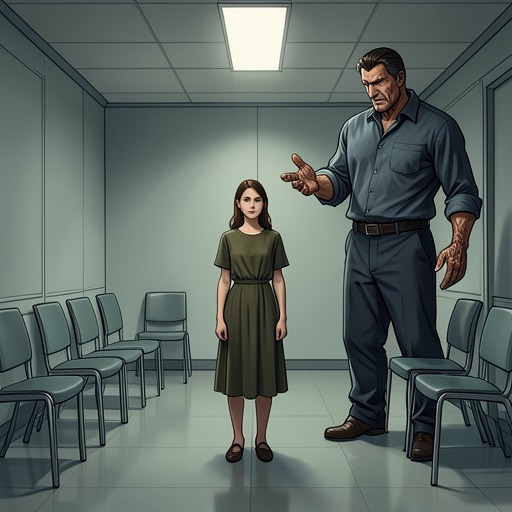
Myfanwy paid little attention to the officials’ explanation because she could not stop staring at Farrier. The woman was very thin, with dark brown eyes and hair drawn back and up; she spoke calmly and did not flinch when Myfanwy dropped her teacup, shattering it and spilling tea across the floor. Wattleman reacted sharply, but Farrier did not even blink. To the child, Farrier’s composure mattered less as an official manner than as a clue: she seemed strangely familiar.
As her father finally accepted that he would leave without her, Myfanwy remembered where she had seen Farrier before. For two months, she had dreamed every night of sitting with the same woman in a black-and-white tiled room. In those dreams, Farrier was formal and stiff, yet Myfanwy had adored her because she listened patiently and drew out details of the child’s life, especially the hospital visit. The dreams had made Farrier an intimate presence before Myfanwy encountered her in waking life. At the moment of separation, this recognition displaced the child’s attention from her father’s departure: she submitted to his last kiss and hug, then stood wiping his tears from her cheek and staring at Farrier.
The account does not conceal the cost of that absorption. Myfanwy later wonders whether it makes her a terrible child that she scarcely attended to her father as he left. She recalls that she loved her family, including her little sister and older brother, and that in the days afterward she would weep at the thought of them. But in the drawing room, the mysterious familiarity of Farrier occupied her completely. The episode therefore holds two bonds in tension: the family being taken from her and the dream figure who seems, impossibly, to have arrived from the child’s private world.
Separation and the journey to the Estate
After Farrier told Myfanwy that she would come and live with them, the child began to cry. Farrier did not comfort her; she sipped her tea and ate crumpets while waiting for the sobbing to pass. Wattleman, who had shown compassion toward Myfanwy’s father, did not respond to the little girl’s distress either. When she recovered enough to look at the biscuit tray, Farrier nodded slightly, and Myfanwy reached for a chocolate biscuit. The small permission to take one comes at the end of a formal transaction in which the adults have already decided her future.
Once her father had been ushered out, Farrier and Wattleman spoke to Myfanwy about their importance, the need to do her best to make them proud and happy, and the fact that she would be going to a sort of boarding school. Still stunned by the preceding hour, she nodded and allowed herself to be led to a car. It drove for many miles, taking her away from London. Alone in the back of the limousine, she felt that everything she knew had vanished; after more crying, the driver took pity on her and brought her to the front. She fell asleep awkwardly across the gear stick, her head on his knee, her face marked by chocolate, drool, and a runny nose.
At the Estate, a large woman with a strange accent woke and greeted her, appalled by the conditions of the journey. After denouncing the carelessness of her superiors, she introduced herself as Frau Blümen, headmistress of Myfanwy’s new school. Blümen was jolly, gentle, and good with children, but the journey had already shaped the child’s response to adult care: the driver on whom she had slept left without saying goodbye. Myfanwy concluded that no one could be relied on or trusted, a belief she says remained with her for a very long time.
A life claimed and redirected
In her letter to her successor, Myfanwy identifies the recruitment as the beginning of her association with the Checquy Group. The organization wanted her for her ability, and she explains that training had eventually taught her to seize control of another person’s physical system with a touch: she could remove any or all senses, paralyze someone, or make that person feel what she chose. Her account makes the recruitment’s cause explicit in retrospect. The child carried away from the drawing room was not simply being sent to school; she was being acquired for a power the organization hoped to use.
The Checquy initially imagined that Myfanwy might become an exceptional spy, sent abroad to make people throw themselves in front of cars. She was not suited to that role: she was not aggressive, became violently ill on planes, and was very shy. The Court was disappointed, but her ability made her too valuable to discard. She instead became an in-house operative, using her power only rarely and proving exceptionally capable in administration, with a strong head for numbers.
That change of function did not prevent her rise. Myfanwy joined the Court through bureaucratic work rather than remarkable field accomplishments, becoming its youngest current member after ten years in administration. The next-youngest member had taken sixteen years of highly dangerous fieldwork to reach the Court. Her later position thus sharpens the significance of the childhood scene: the organization’s first act was to claim her because of what she could do, but her eventual authority rested on a different talent she developed within its system.
The episode in retrospect
The recruitment is narrated inside Myfanwy’s letter to the amnesiac woman who has inherited her life. This layered telling lets the scene work in two times at once: the child recognizes Farrier without understanding how the dreams connect to her, while the reader sees the adult writer explain the consequences of being taken into Checquy. In the present of the letter, the amnesiac Myfanwy pauses over the description; Farrier sounds like the woman from her own dream, the room matches, and the name Checquy raises the hairs on her arms. She wonders whether her memory is returning, even a little.
The decisive turn is not a battle or a voluntary calling but a transfer of custody carried out in a drawing room and followed by a long drive. Myfanwy loses her family’s everyday presence, enters an institution that treats her unusual capacity as an asset, and begins training before she can understand what that entails. Yet the same event contains the first sign of a private connection that exceeds the institution’s explanation: Farrier is both the official who calmly enforces Myfanwy’s removal and the listener who has appeared in her dreams. The letter preserves that contradiction as evidence of the old life and as a possible opening through which the new Myfanwy may recover it.