Rook Gestalt
The RookRook Gestalt is a Checquy officer whose four bodies share a single consciousness. That unusual condition is more than a spectacle: it shapes Gestalt’s identity, isolates it from other children, and ultimately gives it the reach of a self-contained field team. Its formidable record in Checquy service makes the contrast especially sharp when, confronted with evidence of an invasion, the normally composed officer responds with fear.
Identity and Early Life
Gestalt was born as four children in one birth: three boys and one girl, including a pair of identical boys. When all four opened their eyes, however, only one mind looked out through them. The account insists on this distinction because the separate bodies can so convincingly suggest separate people. Gestalt is one person distributed across four bodies, not four siblings sharing a life.
That distinction complicates even ordinary reference. People often avoid pronouns for Gestalt because the grammar feels uncertain; the first-person account uses it for convenience in description, while noting that the choice would be rude in conversation. The grammatical awkwardness reflects a deeper social one: Gestalt’s body is plural, but its consciousness is singular.
Training and Social Life at the Estate
The Checquy took Gestalt to the Estate, where it was educated and trained alongside other children with unusual abilities. Its upbringing is described as loving within the limits of such an institution, and the Estate as a place where unusual children could grow up among others who were different. That environment did not, however, make friendship easy for Gestalt.
Gestalt made few friends. Other children treated the four bodies as siblings and thought the Gestalt children were snobs, missing the fact that all four were one person. Their mistake was understandable: the bodies have different voices and distinct mannerisms, and Gestalt can make them move independently rather than in rigid unison. It can even stage an argument or conversation between its bodies so convincingly that an observer forgets a single mind is controlling them.
Myfanwy was at the Estate with Gestalt for one year, when she was a shy nine-year-old and Gestalt was nearing the end of its schooling. She had a crush on the brother who was not a twin and watched the four closely. To her, Gestalt was not simply four unusual children, but one extraordinary and powerful person. The observation links the social misreading of Gestalt to a more accurate perception: what looked like a group was a singular person performing multiplicity.
In its studies, Gestalt excelled. Its excellent memory, rapid thinking, and ability to draw on four brains helped it absorb ordinary instruction quickly; careful teaching also gave it brilliant control of its powers. Its physical arrangement supported feats that exceeded ordinary schedules and distances. By twelve, it had demonstrated continuous wakefulness for five months by having one body sleep while the others stayed awake. At fifteen, the bodies were placed at great distances around the globe to test their limits, and could be on opposite sides of the planet without ill effect.
Field Record and Operational Reach
After graduating from the Estate, Gestalt went directly into field work and earned Rook status through outstanding operations. With four bodies, it could constitute its own team. Across sixteen years in the field, it accomplished a sequence of seemingly impossible tasks, culminating in the destruction of a 488-year-old vampire who had secretly controlled the wheat industry for 252 years.
The account sets that feat against the effort required to kill a much younger vampire in 1980: forty-five soldiers were needed to kill one that was sixty-four years old. The comparison underscores the scale of Gestalt’s achievement without treating its many bodies as merely a numerical advantage. The same distributed consciousness that lets it operate across space also makes the four bodies function as coordinated parts of a single agent. Gestalt is described simply as tough, a compact judgment supported by an extraordinary record.
Coordination in the Present Crisis
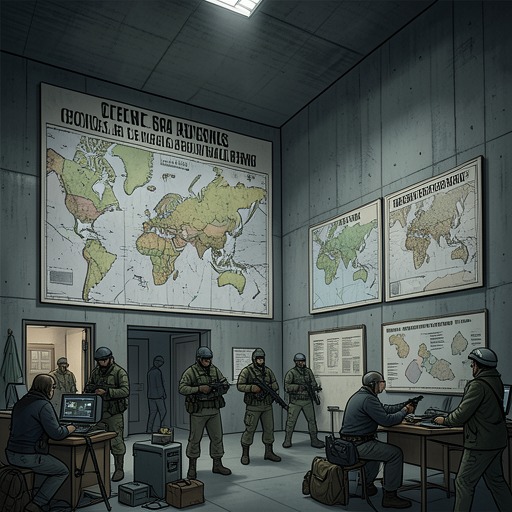
Gestalt’s distributed awareness is visible in a briefing to Myfanwy. Two of its bodies stare blankly into space before announcing together that they are about to enter the headquarters of a cult and asking whether Myfanwy wants commentary. She agrees. Gestalt explains that recording equipment is in place and relays the operation as it unfolds: the team is gathering at the door, Pawn Kirkman is looking through it, and three armed people are on the other side.
The report then becomes a live chain of command. Gestalt directs Cooper to launch stun grenades once Meaney brings down the door, and begins a countdown. As the operation proceeds, the twins’ voices rise and become intent; Myfanwy recognizes that the voice giving the orders is their sister’s. The twins’ left arms jerk slightly, apparently reflecting the movements of that distant body, more than two hundred miles away. Gestalt’s bodies thus serve not just as separate observers but as a means of relaying a remote colleague’s commands into the room where Myfanwy is listening.
That seamless coordination acquires a darker context after Peter Van Syoc’s death. Dr. Crisp’s technicians examine Van Syoc’s final shrieks, recognize that they contain coherent words, and send a message to Myfanwy. Gestalt had encountered the runner in the hallway and offers to share the dispatches. The translated final words identify Van Syoc as a scout for an invasion and threaten that the invaders will kill them all. The revelation changes the stakes of the briefing: Gestalt’s operational capacity now exists against the prospect of a force preparing to attack.
Fear, Judgment, and Narrative Role
Myfanwy reads the message and says that an invasion is coming. She initially sees the twins’ grimaces as displeasure, then realizes they are expressions of fear. That shift matters: Gestalt’s ability to stage exchanges among its bodies can make it difficult to read, but in this moment the shared response discloses genuine alarm rather than performance.
Gestalt agrees that more must be learned, while insisting that the Court be informed as soon as possible. It argues that the information is too sensitive to entrust to another messenger, and Myfanwy concurs. The choice shows the same practical judgment that defines Gestalt’s field work: its fear does not displace procedure, but sharpens the urgency of secure communication. The officer who can make four bodies act as an independent team recognizes when a threat exceeds what even that team can safely contain.
Gestalt’s role therefore joins several kinds of multiplicity without confusing them. It is one mind in four bodies, a social presence mistaken for a family of siblings, a field unit in its own right, and a communications link between distant participants in an operation. The novel makes those capacities concrete through separate voices, a five-month vigil, bodies tested across the globe, and a countdown relayed over more than two hundred miles. When Van Syoc’s final words reveal the invasion threat, the same extraordinary reach becomes a means of carrying warning to the Checquy’s leadership.