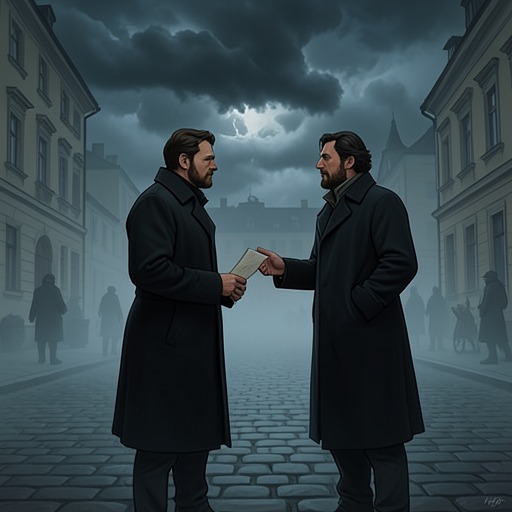
Shadrach
The RookShadrach, a former enslaved man and a Bishop of the Croatoan, serves as the organization’s representative to the fledgling United States. His arrival at George Washington’s home begins the negotiations that bring the Croatoan into the government: an institutional turning point that secures its work while establishing limits absent from the Checquy’s model.
Mission and selection
After the Treaty of Paris was signed and ratified on September 3, 1783, the Checquy faced the problem of how the Croatoan could continue its work in the newly independent country. Because the Checquy could not ask King George to fund its American counterpart, the Croatoan needed to approach the new government discreetly. Its emissary had to make a strong impression on the authorities and be capable of escaping if the reception turned dangerous. The chosen representative was Shadrach, whose supernatural abilities and position as a Bishop made him suited to the task.
Meeting with Martha Washington
Shadrach appeared at George Washington’s home in a cloud of moths, but Washington was away inspecting troops. Martha Washington received him instead. His entrance struck her as inexplicable, while his manners helped persuade her to let him wait for her husband. During the ensuing hours in the parlor, Shadrach explained the Croatoan’s purpose and its service to humanity. Martha recognized the potential value of the organization to the new nation, and the two began discussing the terms of its incorporation.
Terms of incorporation
Martha and Shadrach negotiated the arrangements over a cup of untaxed tea. The negotiations were complex, and the supernatural community continued to dispute which of the two was the more skillful negotiator. Whatever the balance of credit, the outcome was clear: when George Washington returned, the new government had acquired a covert supernatural agency. The Croatoan thereby secured an official place in the national structure rather than continuing as an unsupported counterpart to the Checquy.
The Croatoan’s distinct limits
The Croatoan received a substantial intelligence budget and retained a hierarchy resembling the Checquy’s, including a ruling Court, despite Martha’s concern that such a structure conflicted with the new nation’s ideals. Shadrach held firm on the hierarchy. On another point, however, the Croatoan’s arrangement differed sharply from the Checquy: it was not permitted to forcibly take powered children from their families. Martha had favored granting that authority, but the president rejected it. Croatoan members therefore had to attract operatives through appeals to duty and responsibility rather than compulsion. Its remit was also formally limited to supernatural affairs; like the Checquy, it was not to interfere in nonsupernatural matters.
Historical significance
Shadrach’s mission marks the Croatoan’s transition from an organization serving humanity to a covert agency incorporated into the United States government. The settlement preserved the Checquy-like structure and resources needed for its work, but it did not simply reproduce the Checquy’s authority. In particular, the prohibition on forced child recruitment established a consequential institutional difference. Shadrach’s negotiation thus helped shape both the Croatoan’s place in government and the boundaries within which it could operate.