The Barghests
The RookThe Barghests are the Checquy Group’s elite force of supernatural warriors, the living continuation of the organization’s origins as a fighting body. Their role is not to investigate, administer, police, or guard in the ordinary sense: they are deployed when the unknown becomes a battlefield, and their presence marks the point at which a crisis has exceeded local capabilities. The novel presents them both as a formidable instrument of collective protection and as a force whose training, expense, and vulnerability to infiltration carry serious consequences.
Origins and Purpose
The Checquy’s education prepares its members for violence, even when their eventual work lies elsewhere. Training in martial arts and weapons is built into life at the Estate, while those identified early as fighters receive instruction comparable to that of professional soldiers. They develop expertise across fighting styles and weapons, alongside survival, counterterrorism, and strategy skills; their supernatural abilities further distinguish them from conventional forces. The best of these fighters are selected for the Barghests.
The Barghests are described as the form from which the Checquy grew: an elite squad dispatched against its worst supernatural threats. The organization later expanded beyond its original fighting role, but the Barghests preserve that martial core. They are defined by what they do in the field, not by research, administration, record keeping, police work, or ceremonial protection. In this sense, they stand as the Checquy’s clearest expression of its founding purpose: confronting dangers that conventional institutions cannot safely address.
Organization and Command
The force consists of ten teams. Six operate internationally under the Chevaliers: two in Canada, one in New Zealand, two in India, and one in Australia. The other four are based in the United Kingdom and fall under the Rooks’ control, where they serve generally as heavy backup when local forces cannot handle a crisis. Their distribution gives the Checquy a standing military capability beyond Britain while reserving the domestic teams for urgent reinforcement.
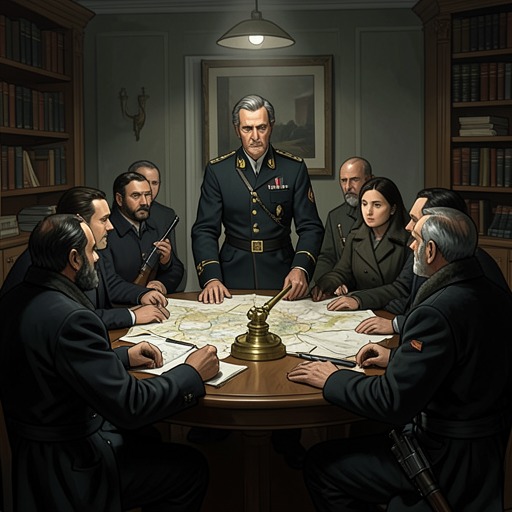
Myfanwy Alice Thomas has formal authority over the Barghests as a Rook, including approving entry into their ranks, reviewing their files, and overseeing their maintenance. But Rook Gestalt usually commands them on site, leaving her less familiar with the soldiers than her position might suggest. Every three months, she participates with Gestalt in a review of the troops, inspecting them as they stand in uniform. She is conscious of their capability and of her own reputation for weakness in martial and physical matters; some of the soldiers had known her at the Estate. Her command is therefore real, but it does not make her their field commander or erase the distance between office and operational expertise.
The Barghests’ practical importance is visible in their mobile command equipment. In Bath, Myfanwy and her party pass through an armored vehicle made of two joined trailers: its interior includes benches for soldiers, locked cages holding weapons or available as temporary restraints, a medical area, and a command suite staffed by Pawns monitoring screens and communications. The arrangement brings combat personnel, containment, medical support, and operational coordination into a single mobile base.
Deployments and Operational Role
A crisis in Bath demonstrates how escalation brings the Barghests into action. After an initial group of Pawns entered a dangerous site with cameras and continuous radio contact, both the camera feed and communications failed; screams followed while the threat continued. A second, larger Pawn team met the same failure. Only then did the Rookery dispatch a special Barghest team and notify Myfanwy. Her arrival at the operation site places the soldiers within a broader response that includes personnel, command facilities, and oversight by the Rook.
The Barghests are also mobilized during the Reading police-station crisis. Once the Checquy identifies the danger and establishes an operational response, the force is called automatically at a high crisis level. Myfanwy tells Pawn Cyrus West that the Barghests will be his to deploy, while she remains an observer and leaves him in command. That division distinguishes institutional authority from tactical control: the Rook authorizes the use of the force, but a local officer directs the operation.
Myfanwy’s experience in Reading also shapes how she uses that authority. After a previous manifestation had consumed three Checquy teams, including a Barghest team, and nearly caused her own mind to be destroyed, she orders that nobody approach the police station. The restriction is an explicit attempt to prevent further losses, not a judgment that the Barghests are incapable. Later, during the unfolding threat at Reading, she asks the Rookery for the status of teams not already engaged there. Team two is still occupied with the Reading operation, while team one is on standby at the Rookery. She activates team one under Chevalier Joshua Eckhart and stresses that the assault, to take place in a residential area, must be discreet.
That deployment links the Barghests to the renewed Grafter threat. When Myfanwy explains to Cyrus that the attackers are Grafters, she warns that the assault may be a warning rather than the beginning of another invasion, but insists the immediate danger must be subdued before the Grafters can exploit a moment of weakness. The Barghests are thus not simply a response to a present emergency: their readiness is also part of the Checquy’s ability to deter or contain a wider conflict.
Combat, Betrayal, and Consequences
The later account of Eckhart’s raid on the Grafter home base reveals both the Barghests’ combat effectiveness and a serious breach within their ranks. As pods opened and Grafter warriors emerged, the Barghests fought them off while Eckhart and Graaf Gerd de Leeuwen confronted the Grafter leader. Two Barghests turned against their comrades, exposed as traitors with Grafter enhancements. Those enhancements did not save them. The episode shows that even the Checquy’s most highly trained unit can be penetrated from within, and that biological modification offers no guarantee of loyalty or survival.
The action at the Grafter base forms part of a larger Checquy counterattack, not an isolated feat by the Barghests. Their role is to hold off emerging fighters while the central duel proceeds, allowing Eckhart and Graaf Gerd de Leeuwen to confront the leadership threat. In the aftermath, the details are delivered to the Court in a formal account that dwells on the operation’s violence and on the discovery of traitors in a unit thought to be exceptionally capable. The Barghests’ victory therefore comes with a strategic warning: elite training cannot by itself protect an organization that has been infiltrated.
Vulnerability, Loyalty, and Significance
The Barghests’ standing is built on intensive preparation and unusual capability, but the story does not treat them as invulnerable. Their repeated deployment in crises exposes them to threats that have already defeated other Checquy teams, and the Reading experience makes the costs of sending them into an unknown manifestation concrete. At the same time, their use in a discreet assault on a residential target shows that their power must be controlled by planning and attention to the surrounding public setting.
Their importance also extends beyond direct combat. The Checquy’s treatment of its people as members of a trained institutional force is most visible in the Barghests: they are recruited from those identified as exceptional while young, developed through long preparation, reviewed by senior officers, and maintained at considerable expense. Myfanwy’s responsibility for their ranks and upkeep coexists with her unease before them, while Gestalt’s field command supplies the operational authority she does not personally exercise. The contrast makes the Barghests at once a symbol of the Checquy’s martial heritage and a test of its ability to direct, protect, and trust the people on whom it depends.