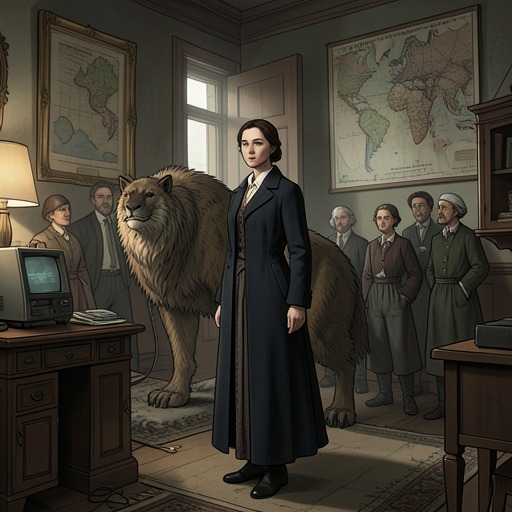
The Checquy Group and Britain
The RookThe Checquy Group’s relationship with Britain is one of concealed service and exceptional authority: the organization claims allegiance to the country rather than its rulers, and protects the public from threats the public cannot be told about. Its work is woven into British government and everyday life through information networks, discreet procedures, and the recruitment of people with unusual abilities. Yet its role as a national safeguard is inseparable from the power to claim citizens, bind members to secrecy, and keep the organization itself out of public view.
National Service Across Changing Rulers
The Checquy has existed for centuries, adapting to changes in the government rather than defining itself by loyalty to a particular monarch or administration. It worked closely with the House of York, largely ignored the Tudors, and endured the House of Stuart. Its claim to continuity is expressed as loyalty to Britain itself: an instrument of the nation that serves whoever holds power. When Oliver Cromwell became Lord Protector, the four leaders of the Checquy Brotherhood offered their services to him. A demonstration persuaded Cromwell to let the organization continue, despite the apparent contradiction between its supernatural character and his Puritan rule.
That history establishes the Checquy as neither an ordinary government department nor a private force acting in open opposition to the state. It bends to successive rulers and presents itself as an asset of the British Isles, a concealed arm capable of doing what ordinary institutions cannot. Its service is consequently both persistent and politically adaptable: governments change, while the organization’s stated national purpose remains.
Protection and the Intelligence Network
The Checquy’s protective function begins with a steady flow of information from the civil service. Supernatural incidents are not confined to places already associated with the uncanny; they can happen in ordinary settings, where their appearance is more likely to alarm people. The organization therefore collects a large volume of reports, figures, and files. Analysts sift this material for patterns, including signs that apparently routine economic activity may be affected by supernatural actors.
The organization also connects itself to officials through the Panic Lines. National and local figures across government and public life receive discreet briefings that communicate enough to prompt action without giving a complete account of the phenomena involved. The Checquy in turn receives calls from police chiefs, ministers, military officers, intelligence agents, churchmen, medical staff, and others, while people placed in important organizations report developments from within them. This network allows the organization to respond to threats without making its full knowledge or purpose public.
Secrecy is built into the infrastructure, not merely imposed after an incident. The Checquy’s name does not appear on documents outside the organization, and only a small number of outsiders know it exists. Information reaches it by indirect channels, and its computer network is separated from external systems. That arrangement helps the organization remain hidden while still receiving intelligence from across public institutions. The protection it offers depends on an asymmetry: it can find and act on information about threats while remaining difficult for the public to identify or locate.
Recruitment, Authority, and the People Who Serve
The Checquy’s relationship with the country includes exceptional authority to recruit citizens with powers. It may claim people it wants, and its methods include persuading or misleading parents, offering substantial payments, and attracting adults with promises of wealth, power, or national service. Membership is then secured through ancient oaths and modern contracts, under official and unofficial secrecy requirements. The resulting obligations make departure exceptionally difficult. Service to Britain is therefore not simply a voluntary public duty; the organization’s institutional reach extends into the lives of those it recruits and their families.
The Checquy organizes its workforce through a hierarchy that distinguishes members with powers from those without them. Powered members outside the Court are Pawns; members without powers are Retainers, who are barred by tradition and policy from the Court. Within the wider organization, however, rank does not map neatly onto that distinction: Pawns and Retainers can hold comparable authority, supervise sections, or be responsible for one another. The account also recognizes that prejudice persists, with Pawns generally more likely to be chosen when appointments are contested. The Court itself is the ruling circle, and its authority is described as answering only to the highest people in the land, and not invariably even to them.
The recruitment-and-training system treats ability and readiness as matters for organized assessment. At the Estate, pupils undergo extensive medical and personal examinations, and the tests are repeated monthly as staff try to understand the sources of supernatural abilities. The inquiry often fails to explain those abilities, but its records are retained in the hope that later workers may interpret them. The Checquy’s service to the nation thus includes the systematic study and preparation of people whose capacities it regards as relevant to national protection.
Secrecy, Procedure, and Public Consequences
Operational secrecy shapes how the Checquy handles events on the ground. When members of an initial response team were believed dead, the organization evacuated the street and coordinated with local police to keep the incident discreet. Officials were given a cover account involving a religious cult and gas mains; neighbors were told that a house had a gas leak and asbestos. These procedures show the organization working through ordinary authorities while carefully controlling what each group is told.
The same institutional logic appears in the Checquy’s response to suspected Grafter infiltration. After traitors at a reception were found to have Grafter implants, the organization planned intrusive examinations of every member. The process was designed to guard against tampering by examiners: groups of observers would attend examinations, and results would require agreement from the Checquy’s doctors and a randomly selected civilian practitioner. The screening would begin with the Court and extend to doctors around the world. This was a substantial administrative burden, but it demonstrates how a crisis of trust prompted the Checquy to turn scrutiny inward and construct procedures to test its own personnel.
The Checquy’s authority also reaches decisions with consequences for the country and for the people it has trained. In one emergency, Myfanwy Alice Thomas invoked an archaic formal declaration to call upon Harper Callahan, a ward of the Estate, for service. The language assigned responsibility to her and made the authorization legally effective. Only Rooks, Bishops, and the Lord and Lady of the Checquy could authorize deployment on British soil of an agent classified as a Force of Physical Obliteration; using such an agent also required notification of the Prime Minister, the Minister of Defense, the country’s ruler, and the Checquy Court. The ceremony joined inherited titles and formal wording to an exceptional exercise of national power.
Conflict, Restraint, and the Limits of Protection
The Checquy’s claim to protect Britain is tested most sharply by its history with the Grafters. In 1677, Grafter creations emerged from the sea and a supernatural war began on British soil. The Checquy deployed Pawns under the Rooks’ direct command. The fighting lasted three weeks, killed hundreds of civilians, and cost dozens of Checquy soldiers for each Grafter creation brought down. The crisis ended only after Crimson Rook John Perry linked his mind to that of the Grafter general and killed them both, leaving the Checquy’s forces and leadership badly diminished.
That weakness did not lead to an open invasion of Belgium. Although Charles II was said to favor one, the Checquy’s leaders pointed out that its forces had been decimated and its most capable generals were dead. The ruler accepted their argument, and negotiations followed. The Belgian ruler agreed to dissolve the Grafters, withdraw funding, end experiments, and confiscate their estates and property. The Checquy concealed how vulnerable it was, allowing the other side to believe that British forces remained capable of a devastating response. The settlement protected Britain, but it rested on a threat that the Checquy could not have carried out in its weakened condition.
The organization then treated the Grafters’ eradication as complete. Under Checquy supervision, leaders were executed, scientists were killed, facilities destroyed, and altered beings put to death; servants and officials were encouraged to forget their involvement. The destruction was intended to remove the threat so thoroughly that no unexplained absence or surviving member would call the result into question. Yet the Grafters endured, and their survival later made the Checquy’s old victory an unstable foundation for national security.
When Graaf Ernst von Suchtlen explained the later conflict, he rejected invasion as the Grafters’ purpose. He described the earlier assault as a feint and argued that, in a smaller and more connected world, conquering a country could not be kept secret. The Checquy, too, depended on secrecy; a public international war would imperil the conditions under which it protected Britain. Myfanwy recognized that a fight might be won only at the cost of making England—and the organization’s hidden world—unrecognizable. She framed the Checquy’s mandate as protection conducted in secret and concluded that von Suchtlen had come to negotiate an alliance rather than surrender.
Von Suchtlen’s account also complicates the Checquy’s image as a purely defensive institution. The Grafters had remembered it as the force that destroyed their work and homes, and their first aim after surviving was to conceal themselves and inflict pain. Over time, however, von Suchtlen said he came to regard the Checquy as a flawed but comparatively capable governing body with noble aims. His collaborators inside the organization were meant to make cooperation appear advantageous, not simply to prepare an attack. The possibility of alliance does not erase the history of violence or remove the Checquy’s need for secrecy; it reveals that protecting Britain has always involved managing threats whose intentions cannot be read from appearances alone.