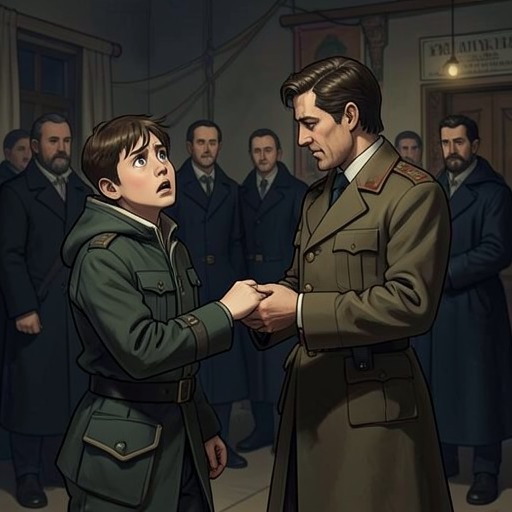
Treating People as Assets or Weapons
The RookTreating people as assets or weapons is a shared logic of the Checquy and the Grafters, though their methods and aims differ. The concept links the Checquy’s upbringing of children for service, the Grafters’ engineered soldiers and covert operations, and Myfanwy’s effort to see people as more than the functions assigned to them. Its sharpest contrast is between an organization’s language of usefulness and the human relationships that language cannot contain.
The Checquy’s instrumental upbringing
At a Court gathering, Myfanwy recognizes that she, Rook Gestalt, and Gubbins were raised at the Estate, while other Court members either predated that upbringing or came into their powers later in life. The three struggle to make ordinary conversation because their formative experience was to be treated as “assets first, warriors second, and people if there was ever some spare time.” In Myfanwy’s account, this ordering is not just a description of training: it has shaped what they can talk about and how they understand their place among colleagues.
The contrast with the Court members who knew what it was like to be a person before becoming a Checquy resource makes the institution’s practice visible. Myfanwy envies their greater freedom, and even envies ordinary people for being able to live without making the supernatural their responsibility. Her reflection joins the personal cost of being made useful to the more practical danger of Checquy work: its agents are sent to perilous assignments where they may die in fear and pain.
A team, not a family
Myfanwy refuses to let the organization’s claims of loyalty erase what it does to its members. She describes how the Checquy sends its people into danger and, when they die, may have their bodies examined, catalogued, and destroyed, leaving little memorial beyond a name in a file. The institution that calls people assets can thus reduce them to operational capacity in life and records after death.
Yet Myfanwy does not conclude that the Checquy should abandon all obligations between its members. She distinguishes family from team: family is an inadequate description of an organization willing to expose its people to such risks, but a team should still respect and remain loyal to its members. The promise associated with the Estate is that Checquy personnel can trust those around them. That ideal is not proof that the institution treats them as persons; it is a standard against which its conduct can be judged.
Camp Caius and engineered soldiers
The Grafters’ Camp Caius project makes the conversion of people into weapons literal in purpose, though its subjects are not simply described as voluntary recruits. Norman, whom Myfanwy encounters during the confrontation at Apex, is one product of the program. His body has been extensively modified to produce specialized capacities, and maintaining him requires continuous care, including seven intravenous drips supplying substances needed to keep his system balanced.
Norman’s usefulness is defined by what he can do to another person’s brain after establishing physical contact. He can interfere with basic functions, including putting people unconscious or preventing them from activating their powers; with closer contact, he can affect memories. The account of his capabilities places the human consequences beside the program’s military result: he is not merely trained for combat but made into a specialized instrument whose function operates on other people’s bodies and minds.
Myfanwy’s own encounter with Norman shows that this system does not guarantee control for its makers. During the attempt to hold her while Norman attended to her, she drew on a level of bodily-control power she had not shown at the Estate. She disabled one attacker’s sight and caused another to suffer a fatal consequence, before Norman could get hold of her. Later, she manages to take him out before he can tamper with her memories. The incident exposes the unstable boundary between weapon and agent: Myfanwy is herself a Checquy operative shaped by the Estate, yet she can turn her abilities against the people trying to use her.
The Grafters’ strategy and its fracture
A Grafter explains that he personally oversaw the establishment of Camp Caius, the recruitment and indoctrination of agents placed inside the Checquy, and the development and placement of a fungal weapon intended to affect large populations. These operations treat both people and biological force as instruments of a broader conflict. The covert agents are positioned to support a coup, while the weapon is designed to subdue people and spread across extensive areas once activated.
The strategy, however, becomes vulnerable when it is shaped by inherited grievance. The Grafter says Camp Caius subjects were selected because their ancestors had been Checquy soldiers at the Isle of Wight. He regards that choice as petty and operationally damaging: it made the project more exposed than it needed to be. His assessment marks a conflict within the instrumental logic itself. People selected as vehicles for revenge do not make a sounder operation; the personal history imposed on them can compromise the machinery built around them.
Reclaiming personhood from utility
Myfanwy’s response to Camp Caius reaches beyond defeating Norman. As the Barghests prepare an assault on the facility with orders to take as few lives as possible, she wonders how the children there can be rehabilitated and resolves to try. Her concern does not erase the danger they pose, and she cannot bring herself to pity Norman; nevertheless, she distinguishes the children from the program that made them useful as soldiers. Rehabilitation imagines a future not defined by what their makers have engineered them to do.
That intention also returns the concept to Myfanwy’s own history. The Estate taught her and others to understand service and combat as their first identities, while the institution’s promise of trust offered only a partial counterweight. Her effort to protect the Camp Caius children suggests a different measure of responsibility: not whether a person can be deployed effectively, but whether someone will help them live beyond the role imposed on them. The novel sets that possibility against both organizations’ habit of turning human lives into resources, and leaves the conflict between utility and personhood unresolved but unmistakable.