United States
The RookThe United States is both a setting and a problem of scale in the supernatural history recounted by the Checquy: a continent too large and sparsely staffed for its covert defenders to control by ordinary means, yet comparatively sheltered from paranormal manifestations. Its institutional history begins under colonial rule, continues through the Croatoan’s incorporation into the new government, and develops into a formal partnership with the Checquy. The account also attributes the relative safety of the continental United States to protections laid into the land by Native American peoples, a legacy that persists as their communities diminish.
Colonial beginnings and the Croatoan
The Checquy had a presence in the New World from the arrival of the English. One of the first people off the boat at Jamestown was an operative who witnessed the colonists’ conduct with dismay and watched them succumb to the subtle magical warfare of Native Americans. He returned to England unwilling to go back, but persuaded the Court that the continent’s supernatural potential required a better-funded investigation. The Checquy then sent agents across the ocean.
The most consequential early agent was Richard Swansea, assigned to covert paranormal work in Plymouth. A nonconformist among religious neighbors, he survived by performing the part of a devout, sober, civic-minded Puritan so convincingly that he became a local hero. The records concealed in his house could have got him hanged if discovered. His public position thus depended on concealing both his work and his actual beliefs.
Swansea’s loyalty to the Checquy kept him at his post, though the narrative makes clear how little affection he had for the colonists around him. On expeditions into the wilderness, he befriended Native Americans, warned them about the dangers posed by his countrymen, and urged them to move away. They listened kindly, showed him their land, and disregarded his warnings. He watched what followed with sadness, but without surprise.
Over the next 107 years, Swansea built a durable American operation that remained closely connected to its parent organization. Known as the Croatoan, it established offices in the colonies and undertook the enormous task of recording supernatural activity throughout the New World. When possible, its agents were to suppress threats and send living entities back to England for examination; when distance, manpower, or circumstances made that impractical, they sometimes had to kill them. The network was an archipelago of small outposts before an ocean of wilderness, not a force capable of exerting the Checquy’s reach.
Building a force across the frontier
The Croatoan could not draw on a large population of trained personnel. Its forces were assembled from a miscellaneous collection of powered people its members could recruit. Swansea approached Native American tribes because he observed a higher incidence of powered births among them, but they declined to enlist. Their experience, they explained, had already equipped them to face dangers in their homeland.
Recruitment among the English colonists presented a different obstacle. The colonies’ religious and independent character made it impossible for the Croatoan to rely on government authority to take powered children from their families, as the Checquy could in Britain. Colonists who resented taxes on tea were unlikely to surrender their children, while Swansea knew that drawing attention to supernatural matters among Puritans could invite thoughts of the noose. The Croatoan consequently had to find extraordinary ways to build a force capable of protecting the population without the Checquy’s coercive means.
The organization’s early vulnerability coincided with turmoil in England. In 1783, as the Treaty of Paris was signed and the Checquy Court was recovering from a supernatural crisis in Cornwall, letters from the Croatoan prompted an exasperated reaction from the Crimson Lord in church. The American operation needed support, but the Checquy could not ask King George to fund an agency serving the newly independent country. Its representatives therefore had to approach the new government discreetly, offering their services while keeping a low profile until acceptance was assured.
Government recognition and continental protections
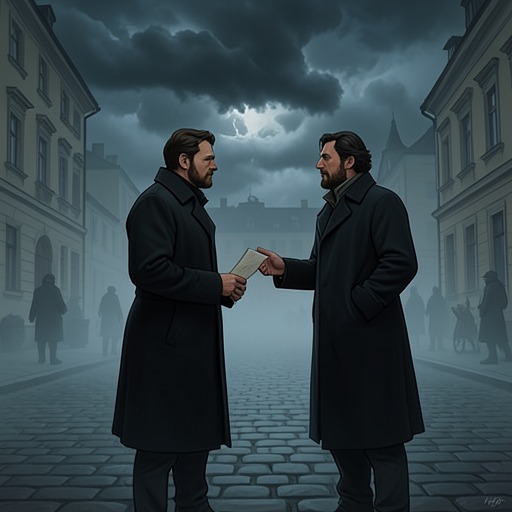
The Croatoan sent Shadrach, a Bishop and former slave, to make that approach. He entered George Washington’s home from a cloud of moths, but Washington was away inspecting troops. Martha Washington received Shadrach instead and heard his explanation of the Croatoan’s work. Over untaxed tea, the two negotiated the organization’s absorption into the government. When the president returned, the United States had acquired a covert supernatural agency.
Under its new arrangement, the Croatoan resembled the Checquy in its hierarchy and received a very large budget, although Martha Washington objected that a ruling Court sat uneasily with the nation’s new ideals. Shadrach insisted on retaining the structure. A more consequential difference was that the Croatoan was not permitted to seize powered children from their families. George Washington held firm against that practice, even though Martha supported it. Instead, Croatoan members recruited through appeals to duty and responsibility—an approach described as nearly as effective as compulsion, but not an open mockery of the Constitution. Like the Checquy, the organization was barred from interfering in non-supernatural affairs.
As the nation expanded, the Croatoan grew too, though not in proportion to the United States’ territory. Fewer powered children were born in the continental country than in Britain, but there were also fewer supernatural threats. The account names serious exceptions: mathematically created Irregularities distorted time and space while secretly manipulating the silent-film industry; the Cult of the Estrangement, the Horseman of Famine, and the Rattling God also emerged in America. Even so, the total burden of threats appeared comparatively limited.
Swansea, who eventually died after being repeatedly decapitated by a civilian lover he had spurned, had noticed this disparity. His diaries supplied a possible explanation. His close relationship with Native Americans had allowed him to observe their rites and practices, and he proposed that they had established protections woven into the fabric of the land. The protections, in this account, outlasted the communities whose work created them. The United States’ relative supernatural security is therefore not presented as proof that it lacked dangers, but as a condition maintained by an older and less visible defense.
Partnership across the Atlantic
Despite formal separation imposed by their respective governments, the Croatoan and the Checquy maintained close relations. They communicated regularly, and visits between their Courts were seldom separated by as much as a decade. In 1850, the Sororitas Pact turned that long friendship into a formal agreement. It established the List of each organization’s most serious threats, requiring immediate communication about developments involving any listed danger; it also provided for the extradition of transgressors and bound neither organization to take part in a war against the other’s country.
The pact did not prevent collaboration across national lines. During the American Civil War, gigantic mollusks rose again, apparently stirred by the violence, and stalked the land; the Croatoan called on the Checquy for reinforcements. In 1903, the Checquy appealed to its American allies when a portal opened in Hong Kong and demons began infiltrating the community. In 1989, the two organizations coordinated the suppression of animated dead in Hawaii, which did not share the continental United States’ mystic immunity. These operations strengthened a relationship built on shared work as well as treaty obligations.
In the account’s present, the Croatoan is described as the Checquy’s staunchest ally. Its members are fewer, but they police a territory many times larger than Britain’s and know secrets unknown even to their British counterparts. The United States thus occupies an unusual position in the book’s supernatural geography: difficult to monitor because of its scale, spared some manifestations by inherited protections, and defended through an American agency whose closest bond is with the organization that first dispatched it.