
A Crusade Imagined from Confinement
The RoomThis flow traces how the prisoner turns a letter about alleged police abuse into an imagined public campaign that casts him as an influential reformer.
increasing Bearing strength in each event
 decreasing
Bearing strength in each eventdecreasingThe Letter’s First Draft

The Letter’s First Draft
A grievance takes public form
The prisoner imagines writing to a newspaper editor about police power and the abundance of obscure laws. He revises his opening as he goes, searching for language that will make the issue sound urgent and persuasive. The letter gives his anger a formal shape and turns his private complaint into a proposed public accusation.
A system in his sights
He presents routine enforcement as part of a larger political danger, arguing that vague rules let police harass citizens at will. His imagined warning expands from an individual arrest to the prospect of a police state. The scale of the argument allows him to picture himself not only as a detained man but as someone who sees a danger others have missed.
Hope attached to publication
He expects the letter to awaken the public and force officials to act. In his fantasy, writing becomes more than a way to pass time: it is the first move in a campaign that can reach beyond the locked room. His confidence rests on the response he imagines rather than on any confirmed contact with the outside world.
Imagined Allies Arrive

Imagined Allies Arrive
A private audience becomes possible
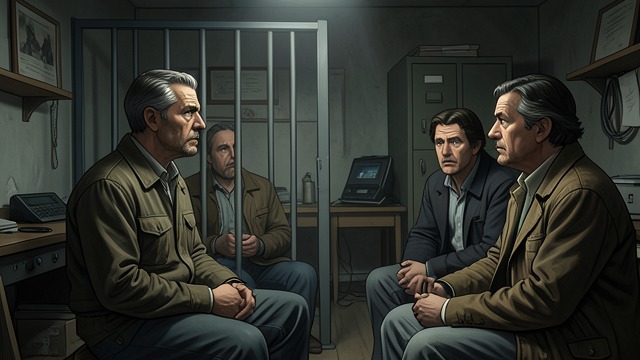
The prisoner imagines Donald Preston and Stacey Lowry visiting him after the letter reaches the paper. Their presence gives his complaint the institutional weight he cannot command from inside the cell. In this imagined meeting, he is treated as a credible witness and as a person whose experience matters.
Recognition and reassurance
He pictures the men praising his clarity and courage, while they describe his case as a chance to expose a wider pattern. Their agreement confirms the role he wants to occupy: not a confused detainee but an articulate advocate. The imagined visitors also supply powerful protection against his fear that jail authorities can silence him.
A coalition built from desire
The conversation quickly grows into plans for editorials, speeches, and public attention. The allies’ enthusiasm mirrors the prisoner’s own need to believe that his account will be heard. Because the scene is produced in his mind, it reveals how intensely he longs for recognition while leaving the promised intervention unverified.
The Statewide Campaign
The Statewide Campaign
From case to cause
The imagined alliance develops into a coordinated campaign against abuses of authority. Donald Preston is to use newspaper coverage, while Stacey Lowry speaks to civic and professional groups. The prisoner proposes widening the cause beyond police conduct to other powerful institutions.
Public attention as leverage
In the fantasy, articles, interviews, appearances, and pamphlets keep the issue in public view until political leaders respond. The campaign’s intended mechanism is not simply moral persuasion: public attention is supposed to give officials an incentive to investigate. The prisoner sees himself as the living example that makes a general allegation emotionally persuasive.
Personal vindication within reform
He describes the campaign as a service to other vulnerable people, yet the imagined success also promises to vindicate his own arrest and punish those who wronged him. The two motives are difficult to separate. His cause grows more expansive as his imagined standing grows, making reform and self-importance parts of one fantasy.
The Hearing Before the Senators

The Hearing Before the Senators
A witness at the center
The prisoner imagines entering a packed hearing room with Donald Preston and Stacey Lowry. He sees cameras, reporters, and members of the public focused on him, and imagines himself as the central witness whose presence makes the case real. His earlier fear of institutional power is recast as confidence before a national audience.
A prepared public identity
In the imagined proceedings, the lawyers present documentary material while the prisoner delivers a solemn account of systemic injustice. Senators thank him and praise his courage. The scene grants him the respect, composure, and influence that his actual confinement denies him.
A fantasy of consequence
The hearing is not presented as a verified event outside his mind. It is an elaborate imagined culmination of the campaign, complete with public acclaim and official promises. Its grandeur shows how far his wish for justice has developed into a fantasy of being recognized as the person who can make history move.
The Campaign’s Imagined Afterlife

The Campaign’s Imagined Afterlife
Work without an endpoint
The prisoner imagines that success will lead to offices, records, consultation, and investigations across the country. The campaign becomes a lifetime vocation rather than a single response to his arrest. He believes that future requests for help will confirm the importance of the work and his central place within it.
Justice and personal revenge
Even as he speaks of public protection, he imagines ensuring that his adversaries remain disgraced and confined. His reform project therefore carries a punitive underside: he wants to impose on others the helplessness and suffering he associates with his own confinement. The public mission offers a respectable language for an intensely personal appetite for retaliation.
A future that cannot leave the cell
The fantasy gives him purpose, status, and a future with clearly defined goals. Yet its apparent forward motion does not carry him beyond the closed room in which it originates. The campaign’s triumph is imagined rather than achieved, and the gap between the scale of the future and the limits of his present makes the fantasy’s fragility visible.
Early in the detention, during a night spent alone in the cell
Soon after the imagined letter is completed, in a fantasy of a visit to the jail
In the imagined period after his supposed release from detention
Later in the imagined campaign, during a major hearing in the capital
Near the end of the campaign fantasy, after the imagined testimony
