
From Rage to Psychological Collapse
The RoomThis flow follows how bodily discomfort, sexual fixation, self-justifying anger, and impossible demands for escape culminate in a crisis that leaves the prisoner withdrawn and unresponsive.
increasing Bearing strength in each event
 decreasing
Bearing strength in each eventdecreasingThe Blemish Becomes a Fixation

The Blemish Becomes a Fixation
A small irritation in the cell
The prisoner repeatedly examines a blemish on his cheek, touching it cautiously and judging whether it has changed. The cell offers few new objects of attention, so the sore becomes an unusually intimate measure of time and change. Its apparent growth gives a fixed focus to his otherwise scattered awareness.
Pain as provocation
As the blemish becomes more tender, he presses and squeezes it, then reacts to the pain with disproportionate anger. He repeatedly treats the bodily irritation as evidence that something is being done to him or that the world is interfering with him. The physical sensation and his sense of persecution reinforce each other.
A delayed bodily resolution
Much later, he imagines or experiences forcing out a long, hard core and identifies an ingrown hair as the cause. The episode briefly gives him a concrete problem with a concrete end. Yet even after the blemish is emptied, the pattern of fixation remains: relief from one irritation does not undo the anger that has gathered around it.
The Unnamed Sexual Craving

The Unnamed Sexual Craving
A remembered Saturday
The prisoner recalls repeated encounters with Mary and the secrecy surrounding their meetings, especially his efforts to conceal their activities from his mother. Saturday becomes a planned interval of anticipation, while the following day brings a familiar heaviness that he cannot explain. Pleasure is remembered as an event that fails to settle the deeper unease.
More without a name
When he tries to understand what he wants, he returns to the phrase more and what, as if intensity itself might answer the question. The memories emphasize repeated sexual activity and the need to continue, but do not provide a lasting sense of satisfaction. His desire is therefore presented as a cycle rather than a movement toward intimacy or completion.
Desire joins the prison routine
In the cell, recollection and fantasy repeatedly mingle with pacing, sleeplessness, and scrutiny of his body. The old scenes offer stimulation and temporary distraction, but his thoughts return to the same sense that something is missing. The unresolved craving becomes one part of the larger pattern in which momentary release gives way to renewed emptiness.
Excuses Against Responsibility

Excuses Against Responsibility
A world that keeps interfering
The prisoner recalls teachers, strangers, police, and other people as figures who frustrate or humiliate him. Small disappointments become evidence for a general conviction that others continually spoil whatever he tries to do. This pattern turns distinct experiences into a single, all-purpose explanation for his anger.
Apology without acceptance
He insists that he has been sorry for harms he caused, while minimizing the injuries and embarrassment attached to them. When confronted by memories of his own cruelty, he compares himself with worse offenders or describes the incident as accidental. His self-defense reveals a continuing awareness that other people have suffered, but that awareness does not develop into sustained responsibility.
A grievance that cannot be satisfied
He wants people to leave him alone, yet repeatedly imagines punishing those who have crossed him. The demand for peace coexists with an appetite for revenge, so the conflicts in his account can never be resolved by others simply granting his wish. His victim identity protects him from looking steadily at the harm he has inflicted.
The Ordeal of Exposure
The Ordeal of Exposure
Movement under pressure
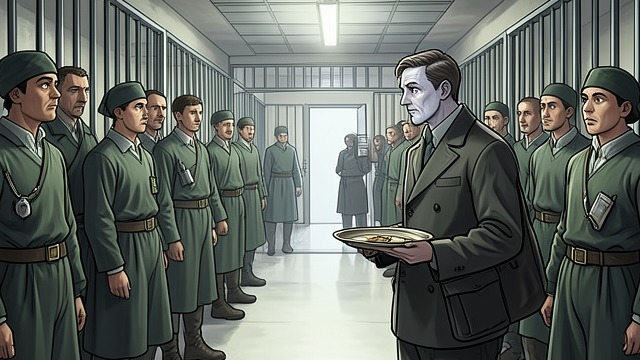
After the court fantasies and personal memories, the prisoner is called to eat while physically and emotionally depleted. He struggles to rise and focus on what his body is doing. The ordinary demand to walk and carry a tray becomes a task he experiences as nearly impossible.
Light and watching eyes
The corridor’s brightness and the presence of other prisoners intensify his sense of exposure. He is convinced that eyes are on him as he stands with his tray, and he can barely move forward without being prompted. The public space contrasts with the imagined audiences who admire him: here, he feels seen without recognition or control.
Retreat to the locked room
He manages to return to the cell and presses himself against the bed, concentrating on breath, warmth, and the door. The locked room offers shelter from the mess hall’s scrutiny, but the retreat also marks a severe narrowing of his capacity to engage with others. His safety depends on withdrawal, not on relief from the underlying crisis.
Vomiting and Surrender
Vomiting and Surrender
The body takes command
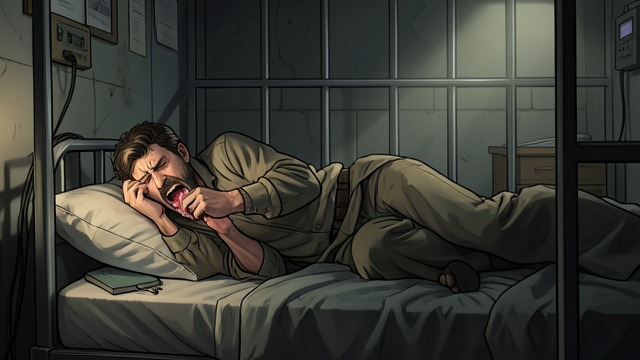
On the bed, the prisoner struggles with nausea, weakness, and the fear that he cannot reach the commode. His attempts to control the situation fail, and he vomits into his hands before making his way to the bowl. Physical distress replaces the courtroom and revenge fantasies as the immediate fact of experience.
A slow return to movement
He remains on his knees, then struggles to wash and reach the bed. Each transition requires effort, and he pauses to ask whether movement has any purpose when every position leads only to another demand. The episode makes the novel’s recurring struggle with time and repetition bodily and immediate.
Sickness as company
As he settles, he no longer treats sickness only as an enemy; he imagines it as a constant friend that will remain when other forms of connection fail. He curls around this familiar sensation and gives up on the promise that leaving it behind will solve anything. When court time is called, he stays in bed, and the novel ends with withdrawal rather than recovery.
From the opening night onward, whenever he returns to the cell mirror
During recurring memories of adolescence and repeated nights in the cell
In the later cell passages, as memories of childhood and adulthood recur
Near the ending, when he must go from his cell to the mess hall after a breakdown
Near the novel’s end, during the prolonged crisis after the meal call
