
The Pimple and Its Core
The RoomThis thread traces the protagonist’s fixation on a small blemish from tentative inspection to painful extraction, showing how a minor bodily irritation becomes a concentrated struggle for control.
increasing Bearing strength in each event
 decreasing
Bearing strength in each eventdecreasingThe First Inspection

A Red Spot in the Mirror
A Minor Blemish
In the dimly lit cell, the prisoner studies his face in the mirror and notices a small red spot on his cheek. He considers squeezing it, then decides that it is not ready and may disappear on its own.
The blemish is slight, but it gives him a tangible subject to examine in a room otherwise defined by fixed surfaces. He can touch it, assess it, and imagine a future moment when its condition will change.
Attention Settles on the Body
He returns to the spot as the surrounding room offers little variation. This first inspection is still restrained: he recognizes that pressing too soon may bruise the skin and chooses to wait.
The restraint will not last. The blemish becomes a recurring object onto which he can focus irritation that has no clear external outlet.
A Tenderer Spot
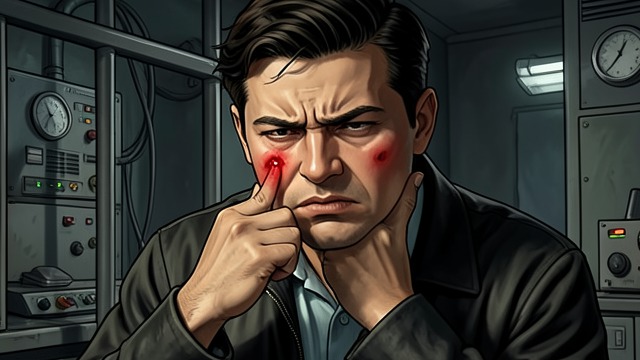
The Blemish Changes
Repeated Checking
After waking, the protagonist looks again at the cheek and finds the spot more tender and red. He touches it experimentally, increasing the pressure until a sharp pain tells him it is still inflamed.
The examination gives his restless attention a task with an immediate physical response. Unlike the wider injustices he imagines, the spot seems close enough to test with his own hands.
No Clear Progress
He cannot determine whether the blemish is improving or worsening in a meaningful way. He returns to the bunk with the irritation unresolved, and the uncertainty sends his attention back toward the same small patch of skin.
The pattern is established: inspection promises information, but the information does not bring relief. Each check renews his awareness of the spot rather than ending it.
The Painful Squeeze

Pain as a Focal Point
Pressure Builds
After a burst of imagined pleasure and anger, the protagonist returns to the mirror and examines the blemish again. He presses and prods it, and the resulting pain sharpens his attention until his body stiffens.
The cell seems to offer no effective action against the people he resents. The blemish, by contrast, is physically reachable, so he directs force toward it even though the attempt produces little relief.
Anger Finds a Target
When nothing substantial emerges, he turns from the mirror toward the cell and rages at the people he believes have wronged him. The pimple does not cause that grievance, but its persistence helps give the anger a concrete focus.
The scene links bodily irritation to the larger pattern of frustration: he attacks a small, accessible target while feeling powerless against the confinement and authority that surround him.
The Swollen Lump

A Blemish Becomes a Crisis
Pain Without Touch
Much later, the protagonist believes the spot has swollen dramatically. He imagines a wire twisting inside it and feels compelled to inspect and squeeze it, while even the thought of touching the skin produces sharp pain.
He tries hot water and different finger positions, searching for a way to control the pressure. The careful adjustments do not calm him; they make the task more consuming as he prepares to force the lump to open.
A Small Object, Total Attention
The cell and the rest of his life recede behind the immediate demand to remove the blemish. He wants a pin or needle but has no suitable tool, so he continues with his fingers despite the pain.
This concentrated bodily struggle echoes the novel’s larger cycles of fixation. The promised result is simple, yet obtaining it demands escalating effort and provides no assurance of lasting peace.
The Ingrown Hair
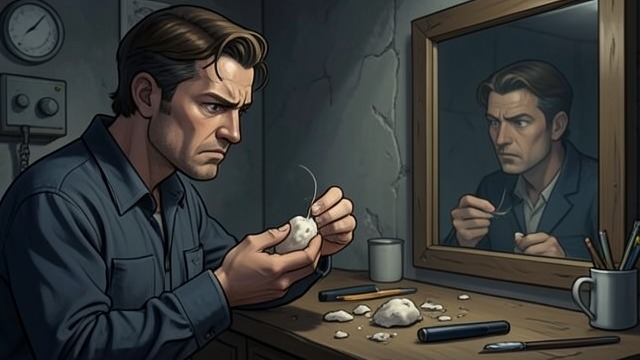
The Core on the Mirror
Extraction and Inspection
The protagonist finally squeezes until the lump breaks open and its pale contents emerge. He studies what comes out and finds a tiny hair embedded in the mass, interpreting it as the cause of the ordeal.
He removes more material, inspecting each piece and continuing until he believes the infected area is clear. The process converts a painful bodily disturbance into something he can see, handle, and ultimately flush away.
Relief Without Release
He briefly savors the result, then returns to the mirror and notices that a blemish remains for another time. The immediate target has been dealt with, but the habit of watching and anticipating the next one persists.
The episode offers a narrow victory rather than a transformation. Control is achieved locally and temporarily, while the cell’s confinement and the protagonist’s wider distress remain unchanged.
early in the first night in the cell
later in the first days of confinement, after a period of sleep
later in confinement, after the prisoner imagines the officers’ humiliation
near the end of the novel, after the protagonist’s imagined public campaign
near the novel’s ending, during the long-awaited eruption of the cheek lump
