Breakdown and Vomiting Episode in the Cell
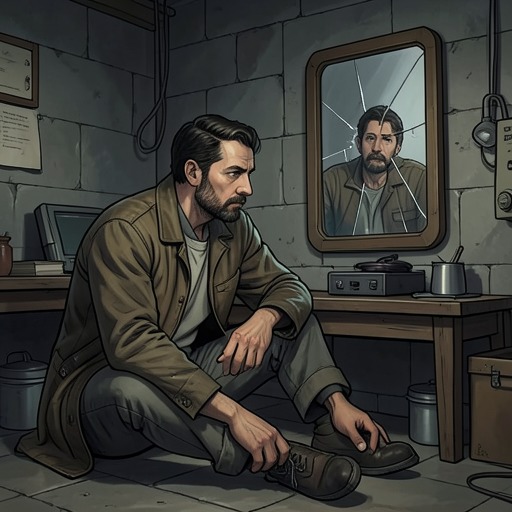
The RoomThe Breakdown and Vomiting Episode in the Cell is a prolonged crisis in which the unnamed protagonist’s bodily distress and psychological withdrawal reinforce one another. After crying into his pillow, he loses his bearings in a nearly motionless grayness; later, an order to report for chow forces him into a public routine he can scarcely manage. Back in his cell, he vomits, struggles to recover, and attends anxiously to the space around him. The episode ends not with a clear return to ordinary functioning but with a drift toward the familiar refuge he associates with a friend.
Collapse and grayness
At the outset, the unnamed protagonist presses his face into a pillow wet with tears. When he can go no farther, he turns his head so that his cheek rests on the damp fabric, keeping his eyes shut. The light and motion he had been experiencing give way to an almost stationary gray, described as barely definable. This shift marks a narrowing of his awareness: instead of looking outward, he remains enclosed against the pillow, with even the distinction between seeing and not seeing reduced to a dim field.
The physical stillness breaks into a small, repetitive movement. He draws his knees toward his chest, curls inward, and rocks while sobbing. The movement is laborious, and the passage emphasizes its gradual rhythm rather than any sudden release. Tears fall onto his cheek and into his mouth as the rocking continues; the gray darkens until he can sink into sleep. The scene connects exhaustion to retreat: sleep follows not a resolution of the crisis, but the shutting out of light and the exhaustion of crying.
Chow and the demands of routine
The cell door opens to the call for chow, and the interruption is the first indication that time has moved. On waking, he initially cannot identify what he sees. Only after staring does he recognize a narrow strip of wall and the dim shape of the pillow. He then realizes that his face is almost buried in it and that the pillow is wet from his tears. Even the command to go to chow reaches him before he can readily respond to it.
Outside the cell, ordinary actions become a sequence he must consciously complete despite nausea and pain. He understands that he has to accept a tray, sit at a table for a sufficient interval, dispose of the food, return the tray, and make his way back to the cell. The passage presents these steps as obligations that have to be carried out while he feels unwell, not as a meal he is able to enjoy. His fear of collapsing on the mess hall floor competes with his wish to be back in the cell, curled up and hidden from himself.
He makes his way through the routine by keeping his body turned toward the wall. After the man across from him stands and takes up his tray, the protagonist follows the flow toward the garbage can and tray cart, then proceeds along the mess hall and corridor. His attention stays on maintaining that turned posture and avoiding a fall. The gray of his cell door becomes a point of return, but he does not simply run toward it: getting back safely depends on preserving the careful movement he has adopted.
The vomiting episode and its aftermath
Back in the cell, his distress escalates into an episode of vomiting that he is unable to prevent. He tries to suppress it, but repeated retching and spasms overwhelm his effort. The narrative conveys the loss of control without turning the incident into an explanation or a recovery. When the episode subsides enough for him to move, he slides from the bed with his hands held close to his chest and makes his way to the commode. He watches the water and the movement on its surface, focusing on what happens there rather than on any larger interpretation of the crisis.
He next tries to wash. Supporting himself against the wall, he turns on the basin and lets water run over his hands. He attempts to bring water to his face, but it runs up his arms before he can manage it. The effort is modest and unsuccessful; the scene does not suggest that washing restores him. Instead, it records how difficult even this basic act has become and how his attention remains fixed on the immediate task in front of him.
Later, he checks the commode area with deliberate care. He examines the wall, floor, and porcelain from different angles, uses toilet paper to wipe places that seem wet, and flushes the paper away. He watches the bowl for several minutes to make sure nothing returns, checks the corner again, and then struggles to get beneath the blanket on his bed. This sequence introduces a precise, repetitive order after the earlier bodily loss of control. It offers no evidence that the checking is required by another person; it is presented as an action the protagonist undertakes himself, carefully and at length.
Retreat and the returning refuge
The episode’s final movement takes the protagonist away from the immediate surroundings and back toward an inward, familiar state. He becomes aware of his body again, while the gray grows darker and more comforting. The narration describes this return through the image of a friend: wherever he travels in his inward experience, he comes back to the same place. His journeys have, it seems, become shorter and more frightening, and he has less desire to leave the security he finds there.
That return complicates any reading of the scene as a straightforward recovery. The protagonist does not emerge newly ready to face the world beyond the cell; even a step or two away from the refuge feels not worth the effort, and he stops trying to leave it. His diminished willingness to venture outward follows the earlier struggle to attend chow, the careful passage along the wall, and the difficulty of washing and returning to bed. The crisis therefore joins a bodily episode to an increasingly narrow sense of safety: the familiar gray is soothing precisely as the possibility of movement and engagement recedes. In the episode’s closing image, the refuge is not a solution but a place to which he feels he always returns.