Constitutional Rights Protections
The RoomConstitutional Rights Protections are a contested standard in the book: police witnesses invoke them as proof of lawful conduct, but the Unnamed protagonist experiences policing and courtroom procedure as systems that leave him exposed and unheard. The contrast does not settle the legal merits of his case; it shows how official assurances and his deep distrust of the justice system occupy the same narrative space.
Rights and the Police State
In the Unnamed protagonist’s address to the public, rights are threatened not only by conspicuous violence but by the everyday reach of police authority. He describes the state as a Police state in which people are watched wherever they go, and argues that obscure laws make harassment easy: even a person trying to obey the law, he claims, cannot walk the streets for five minutes without breaking one. He points to spitting on the sidewalk as an example of a law that could furnish police with a pretext.
His argument turns on the difference between a law’s existence and its enforcement. He rejects the assurance that archaic statutes will never be used, asserting that a vindictive officer can invoke authority to settle a real or imagined grievance. Parking a few inches from the curb or dropping a cigarette butt becomes, in his account, a possible occasion for retaliation. These are his accusations and generalizations, not independent findings about the officers in his case; their force in the narrative comes from the way they frame his expectation that legal protections may be selectively applied.
The Preliminary Hearing
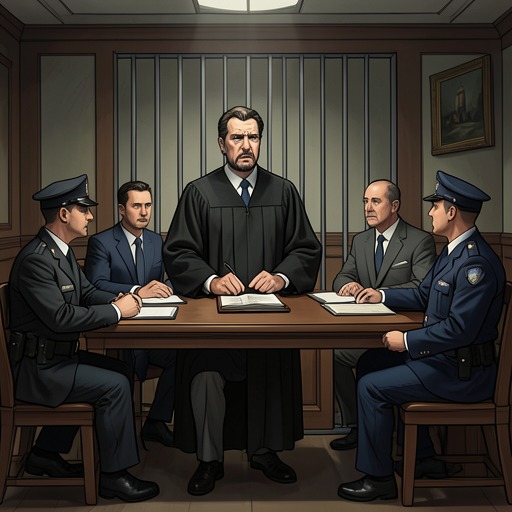
The preliminary hearing gives that distrust a personal setting. As the charges are read, the Unnamed protagonist recognizes only scattered words and registers the proceeding more as sound than as an explanation. He pleads not guilty. A public defender beside him gives him paper and a pencil and asks him to write questions rather than speak while witnesses testify. The protagonist does not know the lawyer’s name, reads his attention to papers and conversation with the prosecutor as evidence that he has already been abandoned, and begins by hoping to identify discrepancies himself.
That effort falters as the arresting officers testify. He struggles to put his objections into words, while stipulations and waivers accumulate in the record. The public defender then seeks dismissal on several grounds, and the prosecutor argues against it; after reviewing the attorneys’ citations, the judge denies the motion. The protagonist experiences what follows as more unanswered questions and a lawyer who lets matters pass without helping him. His account makes a crucial distinction visible: formal participation by counsel and a motion on the defendant’s behalf do not, in his perception, amount to meaningful protection when he cannot understand or influence the process.
Conflicting Accounts at Trial
At trial, the constitutional question is stated more directly through police testimony. One officer agrees that neither he nor his partner had drawn a gun or touched the defendant, and concludes that there was no violation of constitutional rights. Later, in an exchange over what happened during the arrest, an officer denies that the police shoved the defendant down, twisted his hands behind his back, handcuffed him, and kicked him. He maintains that they observed the defendant’s rights and did everything legally. The questioning immediately challenges that assurance, accusing the officers of having torn those rights to shreds.
The exchange puts competing claims on the record without resolving them in the supplied passage. The officers’ language presents constitutional observance as an established fact; the questioning presents the alleged force as its contradiction. The proceeding’s laughter, interruptions, and demands for order also make the courtroom a public contest over who can define what happened, though they do not by themselves establish which account is true.
Self-Representation and the Limits of Procedure
The trial further complicates the meaning of procedural protection because the Unnamed protagonist is acting as his own counsel. When the court says that the line of questioning is unreasonable and unnecessary, it reminds him that he insisted on representing himself despite the court’s contrary advice and the availability of a public defender. Asked whether he wants counsel for the remainder of the trial, he declines; the court warns that proper procedure must be followed or he may be held in contempt. The scene records both his choice and the institutional limits placed on how he may defend himself.
His ensuing outburst widens the complaint from his own case to unequal access to justice. He contrasts people without money for lawyers, whom he imagines left to languish in jail, with wealthy defendants who can obtain extensive legal representation. He also insists that the system will not let an accused person defend himself effectively, then treats its procedural rules as barriers raised whenever he gets the authorities on the ropes. These claims express his understanding of the system rather than neutral findings about every case or lawyer. Together with the earlier hearing and the officers’ denials, they make constitutional protection in the book less a settled guarantee than a point of conflict: rights are repeatedly named, while the protagonist doubts that naming them gives him power to make them effective.