Cross-Examination of Police Testimony in the Jewelry Store Case
The RoomThe Cross-Examination of Police Testimony in the Jewelry Store Case is a courtroom confrontation in which the Unnamed protagonist tries to dismantle a police account of a suspicious figure outside Kramers Jewelry Store. Rather than treating the officers’ testimony as settled fact, he presses on how they could have made and maintained their identification under the conditions they describe. The questioning then reaches beyond the jewelry-store allegation: the protagonist connects one witness to Mrs. Haagstromm’s assault, and the witness’s composure gives way. The scene makes cross-examination both a legal tactic and the protagonist’s imagined means of forcing official violence into public view.
Setting and Narrative Frame
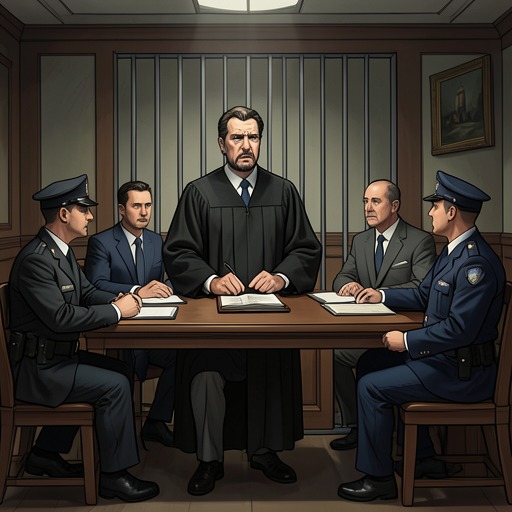
The scene is presented as courtroom questioning, but it belongs to the Unnamed protagonist’s imagined campaign against police corruption rather than standing as an independently verified account of a completed trial. Elsewhere in the narrative, he is shown at a hearing, disoriented as charges are read and distrustful of the defense counsel seated beside him. He answers not guilty, then concentrates on listening for discrepancies that he believes his attorney might miss. The imagined cross-examination reverses that position: instead of sitting silently while legal professionals control the proceeding, he takes charge of the questioning and directs attention to gaps in the officers’ account.
The imagined courtroom is part of a larger effort to expose what the protagonist calls a police state. In his account, old and minor laws give officers opportunities to harass ordinary people, while official authority can be used to settle real or imagined grievances. His expansive claims are the protagonist’s own, not neutral findings established by the cross-examination. Within that frame, however, the jewelry-store testimony supplies a specific target: a police narrative whose details, he argues, do not fit together.
Testing the Officers’ Account
The questioning begins with a witness’s account of driving north on Hill Street and seeing a person in the doorway of Kramers Jewelry Store, on the north side of the 2200 block of Hill Avenue. The witness confirms the location. The protagonist then focuses on the conditions under which the officer claims to have noticed and identified the person. If the officer was monitoring speed, traffic lights, and vehicles in the street, the protagonist asks, how could he also pick out a figure hundreds of feet away in a dark doorway, regard the figure as suspicious, and study him closely enough to identify him positively? The witness rejects the implication that these demands conflict, but does not resolve the underlying question to the protagonist’s satisfaction.
The challenge grows more elaborate when the protagonist revisits the officer’s claimed view during the car’s movement across an intersection. He asks the court to accept that the officer could keep the defendant in sight despite bright light in his eyes, shadows around the defendant, and parked cars obstructing the view—and could also know that no other person was present or had fled. The same officer, the protagonist argues, supposedly recognized a hardened criminal in darkness yet stood under a streetlight and requested identification without drawing a weapon or searching the man. The passage piles one asserted certainty on another, making the officer’s calm approach appear difficult to reconcile with the danger the officer supposedly perceived.
A second contradiction concerns the arrest itself. The protagonist contrasts the allegation that the defendant had tried to run over two trained officers with the claim that, after a light tap with a gun, he became submissive and walked to the patrol car. He proposes a different explanation: that the man was already incapacitated after being beaten, dragged, and thrown into the vehicle. The witness confirms that the defendant was handcuffed after being put on the floor of the back seat. The questioning thus shifts from what the officers could see to what happened between the alleged encounter and the arrest, using the sequence of restraint to challenge the official description of the defendant’s behavior.
The Accusation Concerning Mrs. Haagstromm
The cross-examination takes a more consequential turn when the protagonist brings Mrs. Haagstromm into the questioning. The witness initially denies having spoken to Harry about perfume in the back of the car or having mentioned Mrs. Haagstromm. Later, the protagonist returns to the subject, asking whether the woman smelled like a rose when she was put in the car. The witness interrupts the question to deny having thrown her in, a response that the protagonist treats as a revealing deviation from the denial about recognizing her.
The protagonist then asks whether Mrs. Haagstromm identified the officer by his name tag. The witness answers that she could not, says he took it off, and insists that he does not know her and has never seen her. The exchange is not presented as a calm clarification. The witness repeatedly denies the accusation, and the protagonist follows with a question about how she could identify one of the officers who attacked her. In the context of the protagonist’s larger imagined testimony, the name-tag question joins the witness’s reaction to the photographs of two officers: Mrs. Haagstromm had screamed and covered her eyes when shown the pictures, while the officers remained in service because, as the protagonist had argued, there was no admissible evidence. The cross-examination dramatizes the gap between an accusation that appears compelling to the protagonist and what he believes the justice system can formally establish.
Breakdown and Significance
When the protagonist refers to laboratory tests as proof, the witness leaps from the stand and tries to seize him by the throat, shouting threats. Court officers remove the witness from the courtroom. The prosecutor had earlier requested a recess because the witness had been badgered; the protagonist’s counsel objected to that characterization and described the questioning as an effort to find the truth amid confusing and contradictory testimony. These interruptions mark a contest over both the evidence and the legitimacy of the examination: the prosecutor seeks a pause, the protagonist presses forward, and the witness’s physical outburst brings the proceeding to a halt.
The scene’s force depends on the contrast between legal procedure and the protagonist’s sweeping distrust of it. In his broader account, poor defendants can be left in jail while wealthier accused people can afford experienced lawyers; appointed defense, technical rules, and evidentiary limits appear to him as barriers that prevent an ordinary person from proving official wrongdoing. The cross-examination gives that grievance a dramatic form. Questions about distance, lighting, handcuffs, perfume, and identification become successive tests of whether police authority is credible. Yet because the courtroom sequence belongs to the protagonist’s imagined campaign, its dramatic exposure of the witness cannot by itself be treated as an independently verified verdict. The scene presents his desire to make contradictions count, while keeping in view the distinction between accusation, testimony, and admissible proof.