Distrust of the Justice System
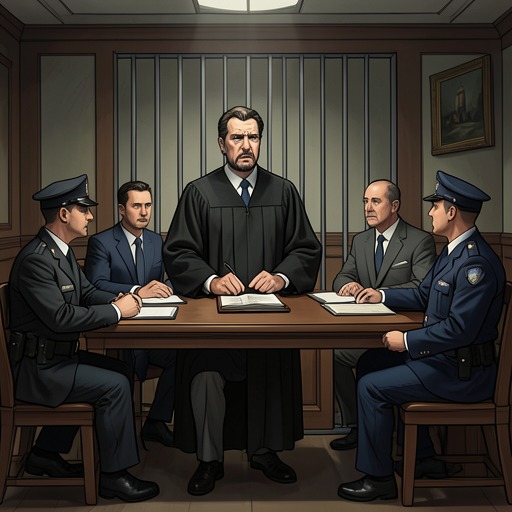
The RoomDistrust of the Justice System is not confined to the Unnamed protagonist’s objection to a particular ruling; it becomes his framework for understanding policing, legal procedure, and the unequal ability to defend oneself. The narrative gives that distrust concrete institutional settings, from a preliminary hearing where he cannot follow the proceedings to a later trial where his efforts to question witnesses are checked by the court. It also sets his claims beside his public account of Mrs. Haagstromm, whose identification of two officers, as he describes it, fails to produce admissible evidence against them. At the same time, the story does not make the protagonist’s interpretation identical to an objective finding: conviction, genuine procedural constraints, and imagined persecution remain in tension.
Origins and Scope
In an address to the United States Senate Special Investigating Committee, the Unnamed protagonist casts policing as the everyday reach of a Police state. His argument is that citizens cannot know every law, including old and seemingly trivial regulations, yet police can use those laws selectively to harass people or settle real or imagined grievances. He contends that an ordinary person could break a law without realizing it within minutes of walking outside. The point is larger than any one arrest: when rules are numerous and enforcement discretionary, he sees ordinary legal exposure as a means of control.
This argument turns legal authority into a source of permanent vulnerability. In his account, the citizen may be law-abiding in intention and still be subject to punishment because the law is too extensive to know and police discretion too difficult to predict. The claim supplies a political frame for his personal experience, but it is presented as his argument rather than as an independently established description of every police encounter. His rhetoric repeatedly moves from particular examples to a general conclusion about state power, making individual grievances evidence, for him, of a wider system.
The Preliminary Hearing
The hearing provides an immediate personal source of his distrust. When the charges are read, he recognizes only a few words; legal language registers as sound rather than meaning. He pleads not guilty, but does not know the public defender beside him and interprets the lawyer’s attention to papers and conversations with the prosecutor as proof that he has already been abandoned. Given a sheet of paper and a pencil so he can record questions without interrupting testimony, he initially intends to identify inconsistencies and supply his lawyer with ways to challenge the prosecution.
As the arresting officers testify, however, he cannot find words for what he wants to note. The hearing proceeds through stipulations and waivers, followed by arguments on the defense motion to dismiss. The judge cites authorities and denies the motion. For the Unnamed protagonist, this sequence does not feel like a meaningful contest in which his defense has been heard: he sees his lawyer letting the case pass without doing enough for him. The court’s ruling and his impression of counsel’s inaction merge into a single experience of powerlessness, even though the reported proceedings also include arguments by both attorneys and a judicial decision based on their citations.
The hearing leaves him unable to give a stable account of its duration. He recalls being awakened around 5:30 and returning to his cell after 7:30, an absence of about fourteen hours, yet the day seems both endless as it happens and brief when he reviews it. Waiting in successive holding areas, being chained for transport, traveling by bus, and appearing in court become a sequence that he can recount in minutes but that occupied most of the day. Back in his cell, time seems interchangeable, measured by meals and occasional showers rather than by daylight. That disorientation matters to his distrust: procedure reaches him as an exhausting chain of movements and delays, while its formal language and decisions remain difficult for him to grasp.
Public Testimony and the Problem of Evidence
The protagonist’s public indictment of the system draws on the case of Mrs. Haagstromm. He says that she was twenty-three when two police officers stopped her on the way to collect her young daughter, claiming her car matched the description of a stolen vehicle. According to his account, the officers took her to an isolated area and assaulted her. She was later admitted to General Hospital with severe injuries, and her physical and psychological condition left her unable to give a coherent account for an extended period. The protagonist says that doctors reconstructed the events from what she could communicate during lucid moments and under hypnosis; he also describes her subsequent institutionalization and repeated treatment. These details are presented within his speech, not as a judicial finding in the evidence supplied here.
The case becomes an example of the gap between an allegation and what the legal system can act upon. The protagonist reports that the police commissioner supplied photographs of officers who had been on duty in the area. When Mrs. Haagstromm was shown images that included two of them, he says, her reaction was immediate and consistent. Yet, in his account, there was no admissible evidence sufficient to charge the officers, who continued to serve as police. The contrast is central to his argument: a woman’s apparent recognition and the lasting consequences he describes do not, in his telling, translate into legal accountability.
His testimony makes that case stand for more than one victim. He presents it as a warning that the person exposed to abuse could be anyone’s wife, daughter, or mother, and argues that even a single injustice threatens the public as a whole. The widening move gives his speech urgency, but it also shows how he uses a specific account to support a sweeping claim about authority. The reader is asked to register the evidentiary failure he describes while keeping in view that the account reaches the committee through the protagonist’s advocacy and through information he attributes to doctors and others.
Self-Representation and Procedural Conflict
At trial, distrust becomes a conflict over who may control the defense and what counts as a proper question. The Unnamed protagonist insists on acting as his own counsel despite the court’s contrary advice and the availability of a public defender. During questioning, the prosecutor objects that certain facts have already been established by expert testimony, including testimony from the Department of Water and Power, an alarm company, and the United States Weather Bureau. The court agrees that the line of questioning is unreasonable and unnecessary, sustains the objection, and warns him that proper procedure must be followed. It also offers him another opportunity to accept representation; he declines.
The exchange shows a real procedural limit as well as the protagonist’s hostile interpretation of it. The court does not simply allow him to question witnesses without restriction, but the evidence does not establish that every restriction is a plot against him. He experiences the court’s intervention as another instance of being denied a chance to prove the authorities wrong. His self-representation is therefore both an attempt to recover agency and a setting in which his lack of control becomes more visible: he wants to expose contradictions, but the judge and prosecutor determine which questions may continue.
His private strategy reveals how carefully he thinks about the possible legal outcome, even as he describes the system as deceitful. He wants the case to proceed to a jury verdict of not guilty rather than be dismissed, because he fears dismissal could allow the charges to be brought again. He invokes the principle of double jeopardy as the protection he hopes to secure by insisting on a verdict. This is his expressed reasoning, not a ruling that the court has agreed with him. The contrast is telling: he rejects legal procedure as rigged while trying to use a specific legal safeguard to prevent what he regards as a second attempt to prosecute him.
Inequality, Self-Exculpation, and Narrative Tension
The protagonist’s distrust also has an economic dimension. He contrasts people with little money, whom he imagines left with inadequate representation and prolonged detention, with wealthy defendants who can obtain a roomful of skilled lawyers. He invokes Stacey Lowry as an example of the prominent attorney he assumes would consider defending someone like him beneath his dignity. That is the protagonist’s conjecture, not evidence that Stacey Lowry actually refused such a case. In his view, access to legal defense follows wealth, while formal rules are deployed against people who cannot afford to challenge them effectively.
His account repeatedly describes effort thwarted by rules, objections, or other people’s decisions. He believes he could unsettle the prosecution if the judge would let him proceed, and he attributes his failures to a system that will not leave him alone or allow him to do things his own way. The recurring movement from attempted control to a sense that everything ends in nothing connects his legal grievance to the book’s wider portrayal of frustration and surrender. His complaint is not only that the system may punish him; it is that every route he tries appears to be controlled by someone else.
That insistence is complicated by the narrative form. The trial transcript, courtroom interventions, and the protagonist’s extended interior accusations do not always keep imagined action and actual proceedings clearly separated. His confidence that he can defeat the prosecution coexists with the earlier hearing’s confusion and with fantasies of courtroom domination that are not themselves successful legal actions. The text therefore sustains two propositions without resolving them into one: institutional power can deny a defendant meaningful participation, and the Unnamed protagonist’s account of that denial is shaped by rage, suspicion, and self-exculpation. Distrust of the Justice System is both a critique of the distance between legal rights and lived procedure and a revealing portrait of a mind that increasingly reads every limit as proof of betrayal.