Imprisonment
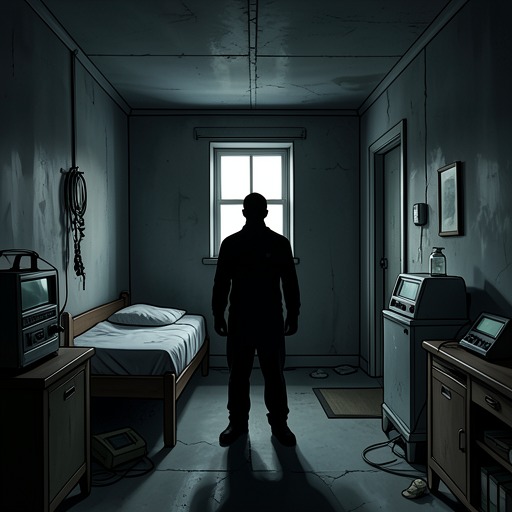
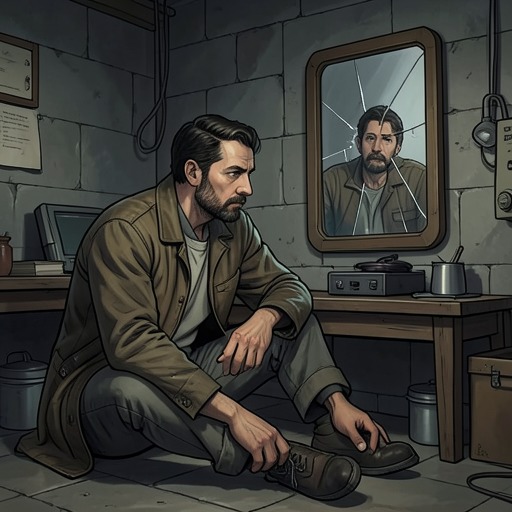
The RoomImprisonment is the Unnamed protagonist’s continuing condition in The prison, not simply the setting around him: locked doors, fixed routines, and restricted movement shape what he can do and how he experiences time, light, and his own surroundings. Its central contradiction is that confinement is both coercive and, at moments of acute distress, the boundary he experiences as safety.
Space and Routine
In the cell, the Unnamed protagonist studies the corridor through a small window, reading labels over baskets of prison laundry. The corridor is seven feet wide, and he has to press close to the glass and shift position to make out the last signs. The repeated act of reading and reciting the labels gives him a narrowly bounded task within a space he cannot freely enter.
The cell’s lighting changes according to the prison’s schedule, but familiarity unsettles the distinction between dimness and brightness. Night light can come to seem as bright as daylight; when the overhead lights change, his eyes must adjust again. With no book to occupy him and no meaningful distinction between sleeping at night or during the day, he concludes that each day and night must still account for the same twenty-four hours. Sleep can make the time pass faster, but he cannot reliably command it.
The institution’s daily pattern is reduced to meals, an occasional shower, and changes in noise and lighting. After waking, the Unnamed protagonist is unsure whether he has slept or how long he has been awake; the time of day has become meaningless to him. A court trip makes the mismatch between measured and felt time especially clear: he remembers being awakened at about 5:30 and returning after 7:30, a fourteen-hour absence that, in retrospect, he can review in minutes. Its sequence of waiting areas, restraints, bus travel, and further waiting gives the hours their institutional shape, while his memory compresses them.
The Cell as Shelter and Limit
During a severe period of distress, the Unnamed protagonist struggles to respond to the call to go to the mess hall. Even the ordinary steps of getting up, walking in line, collecting food, and returning to his cell appear as a compulsory sequence that he must carry out despite wishing to remain in bed. The routine persists when his capacity to meet it has sharply diminished.
The corridor intensifies that strain. Its brightness, length, and apparent instability make walking feel difficult, and he is acutely aware of the people, doorways, signs, and lights around him. When he eventually returns to his cell and the steel door closes, the locked barrier gives him a sense of safety. He looks toward the thick gray door and its small wire-mesh window, registering the outside rooms and corridors as being on the other side of something impenetrable. The same lock that enforces confinement also separates him, temporarily, from the surrounding world.
Confinement and the Court
Imprisonment does not suspend the court proceedings that structure the Unnamed protagonist’s days. At trial, the court reminds him that he insisted on acting as his own counsel despite advice to the contrary and the availability of a public defender. Offered another opportunity to accept representation, he declines. The judge warns that proper trial procedure must be followed and that contempt may result otherwise. The exchange shows the court asserting procedural control while the defendant retains, at least in that decision, a limited choice.
The court schedule continues to reach into the cell. At the novel’s close, a guard’s voice calls court time and a set of prison clothes is tossed onto the bed. The Unnamed protagonist does not move. The open doorway and the summons announce the next institutional demand, but the scene ends with him remaining where he is, making the routine’s claim on his body visible without showing whether he will comply.
Time, Perception, and the Meaning of Confinement
The prison’s routines give time a measurable framework—meals, showers, court trips, changes in noise—while the Unnamed protagonist experiences it as alternately endless and compressed. Fourteen hours of transit and waiting can seem interminable as they happen and shrink to a few minutes in recollection. The repeated adjustment between night lighting and full illumination produces a similar instability: conditions change, perception adapts, and what had seemed fixed becomes another temporary normality.
These contrasts make imprisonment both a material restriction and a shaping force in the narrative. The protagonist cannot choose when a court call comes, how the prison day is organized, or whether he must leave the cell for routine activities. Yet the locked room can also become the place he identifies with safety when the corridor and its demands feel unbearable. The closing summons preserves the tension rather than resolving it: institutional time moves on, while his response remains suspended.