Light and the Feeling of Being Watched
The RoomLight and the Feeling of Being Watched turns ordinary illumination and the presence of other people into a pressure that governs Unnamed protagonist’s experience of prison. Light is not merely something he sees: he feels it, along with the eyes he imagines or perceives around him. In the corridor and mess hall, this awareness makes simple movement and routine tasks difficult; behind the locked cell door, enclosure offers a brief counterweight to exposure.
Sensation and Exposure
The motif is presented through Unnamed protagonist’s immediate bodily experience rather than as a detached account of prison lighting. He encounters a corridor that seems too long and too wide, with a floor that feels unsafe to cross. He wants to close his eyes, flatten himself against a wall, or find some way of moving without being exposed to the space. When he tries to shut his eyes, his balance falters and they open again. The corridor’s details then crowd into view: marks and cracks on the surfaces, signs, doorways, moving bodies, and lights.
Seeing does not make the space feel more manageable. It sharpens his awareness of being visible within it. The narration makes a distinction between the physical light and the gaze associated with it: he can see the corridor, but he also feels the light and the eyes. That shift from visual description to felt pressure gives the motif its particular force. The threat is not established as an objective act of surveillance by every person nearby; rather, the passage stays close to his experience of exposure, in which the presence of others seems impossible to escape.
The Corridor and the Mess Hall
The pressure intensifies as Unnamed protagonist follows the line toward the mess hall. Its end seems close but remains out of reach until the line stops, prolonging the approach. He tries to fold himself against a wall, treating it as a partial barrier between his body and the surrounding space. Inside, the noise and activity of trays, cups, and voices recede in importance beside his awareness of light and eyes. Closing his eyes brings some dimness, but it does not remove the sensation of being watched.
The meal requires a sequence of actions that would ordinarily be routine: accept a tray, reach a seat, remain there, dispose of the food, and return to the cell. Here each step becomes a problem of visibility and control. He is weak and nauseated, fears falling, and tries to keep close to the wall. Carrying the tray requires him to turn slowly while watching the food and searching for a way to move without losing his balance. When he reaches the end of the counter, he recognizes that he is standing in view of the room. He freezes rather than choose a seat, and another prisoner’s prompt to move pushes the line forward.
At the table, he keeps his attention on the food and tries to make himself less noticeable. He moves a spoon without meaningfully eating, while weighing how long to stay and how to leave without drawing attention. The imagined risks of standing, slipping, or spilling the tray add to the difficulty. Light and eyes thus govern not only what he perceives but the choices he can make: remaining still prolongs his exposure, while moving risks a fall or a conspicuous mistake. The scene makes routine participation feel like a public test that he cannot comfortably refuse or complete.
The Cell as a Counterspace
The route back repeats the same tension in reverse. When another prisoner gets up and leaves, Unnamed protagonist follows his example, keeping close to the wall and turning his body toward it as he crosses the mess hall and corridor. He wants to reach the cell quickly, but concentrates instead on moving without falling. The return is not described as an immediate escape from the sensation of being watched; he continues to feel the light and eyes as he makes his way along the corridor.
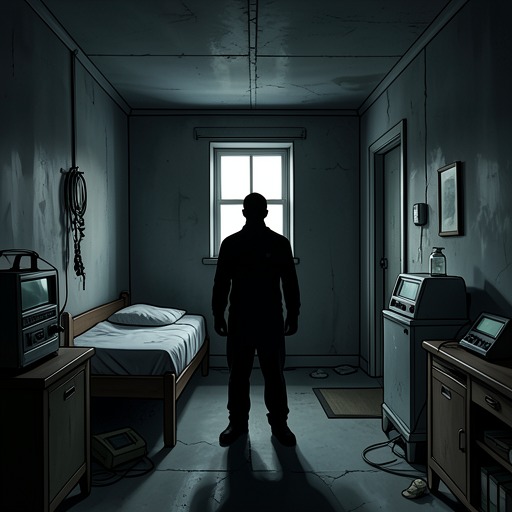
The cell door changes the terms of the scene. Once inside, he settles against the mattress and listens to his own breathing. The door clangs shut, and the sound registers as confirmation that he is safe. He looks at the heavy gray steel door and its small window of thick, wire-mesh glass; beyond it are the prison’s people, lights, rooms, and passages. The door separates him from that exposed world. Its bolt and solid surface matter not simply as furnishings but as the boundaries that make retreat possible. He begins to move more freely only after the door has closed, a contrast that links safety to separation and enclosure.
The apparent refuge is limited. The cell does not resolve his distress, and the account does not show the feeling of exposure disappearing permanently. Rather, the locked door provides a local, conditional relief: he can orient himself toward its solidity and attend to his body in the relative privacy of the room. Elsewhere, he longs to hide under a pillow or find cover, but his fear and immobility obstruct that impulse. The cell makes hiding materially possible in a way the corridor and mess hall do not.
Light, Time, and Confinement
The motif connects with the book’s wider portrayal of time as oppressive and difficult to measure. In Unnamed protagonist’s account, time can seem to drag, while the same day-to-day cycle returns him to the same place. Later, he experiences time as stationary even as its pressure remains present. He cannot find visible evidence that an interval has passed: on waking, the room would appear and feel unchanged. Light and the environment therefore offer little reliable indication that he has moved forward in time. A space that stays perceptually constant can make confinement feel continuous rather than divided into meaningful intervals.
The attempt to close his eyes offers a small adjustment, not an exit. In the mess hall, shutting them gives him some dimness and reduces what he has to see, but the surrounding gaze remains perceptible. In the cell, closing his eyes later produces a gray without images or threatening corners, a deliberately partial withdrawal rather than complete darkness. The distinction matters: darkness itself is not presented as uncomplicated comfort. What he seeks is a manageable reduction of exposure, while the prison’s spaces and routines repeatedly return him to light, movement, and other people.
Narrative Significance
Light and the Feeling of Being Watched makes confinement legible through a conflict between exposure and shelter. The ordinary architecture of corridors, tables, walls, and a cell door becomes significant because Unnamed protagonist experiences each space according to how much it permits concealment or demands participation in public view. The narrative remains closely aligned with his perceptions, so the sense of watching is conveyed as part of his distress without claiming that every perceived gaze is objectively hostile.
The recurrence also links bodily vulnerability to the structure of prison routine. He cannot simply opt out of the meal line or move at his own pace; he must accept the tray, find a seat, wait, and return, all while trying to control how visible he is. His wish for a wall, a closed eye, a pillow, or a locked door repeatedly meets the requirements of the institution and the presence of others. The steel door offers a moment of relief, but only within confinement itself. The motif’s central contrast is therefore not between light and darkness alone, but between exposure and the fragile, temporary security of having a boundary around him.