Nothingness and Surrender
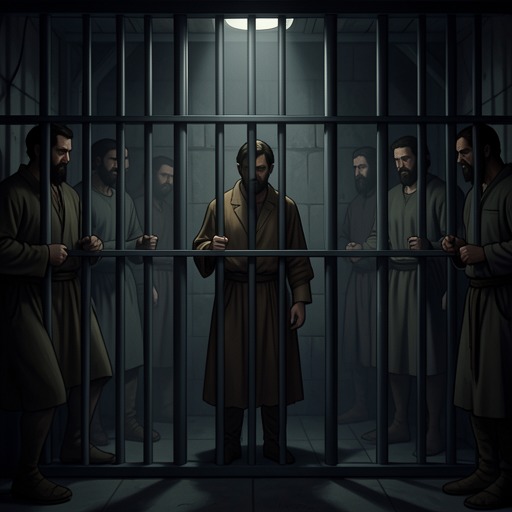
The RoomNothingness and Surrender is the Unnamed protagonist’s recurring desire to escape not only pain but the conditions that make experience possible: time, sensation, movement, need, and desire. In the cell, this imagined absence promises relief from pressure; yet every attempt to reach it gives way to continued awareness, bodily distress, and the routines he believes lead nowhere. The concept therefore holds two states in tension: a wish for complete nonexistence and a reduced, exhausted form of survival in which even illness can seem dependable.
The Desired State of Nothing
In a shallow, exhausted sleep, the Unnamed protagonist imagines finding a small zone between opposing pressures, a place without light, time, need, desire, or even the blackness that might ordinarily stand for emptiness. The imagined destination is not simply darkness or unconsciousness. It is an absence so complete that there would be no void to perceive and no self left to feel the strain of opposing forces. This extreme definition makes nothingness a form of refuge from consciousness rather than a peaceful condition he can actually attain.
The refuge recedes as he struggles toward it. The harder he tries to escape the pressures, the more tightly he feels caught between them; the more he fights for movement, the more stationary he becomes. The contradiction makes surrender less a chosen release than the result of being unable to move beyond the conditions that torment him. Nothingness is desired as an end to struggle, but the effort to reach it renews the struggle.
Time Without Evidence of Passage
Time is one of the pressures from which he wants release. Elsewhere, he thinks of it as something that can drag, weigh on a person, or pass almost unnoticed, and he longs to sleep through the hours. The comparison with waiting for Christmas morning recalls how difficult sleep can be even when waking promises a clear change. In the cell, however, waking offers no such assurance: a dark sleep brings dreams of being awake and trying to sleep, while the room provides no reliable sign that minutes or hours have passed.
He can imagine that visible movement would make time bearable, because it would show that he was approaching or leaving something. Instead, the room and his own body seem unchanged. The clanging of the cell door and a shouted call for chow finally establish that time has advanced, but even then the change is slight: he first registers more light and only gradually recognizes the wall and pillow beside his face. The passage from unbearable stillness to a small, external marker of routine does not restore a sense of progress. It shows how little change is needed to confirm the passage of time, and how little that confirmation alters his condition.
The thought that every effort ends where it began extends the cell’s stagnant present into a wider judgment on life. He recalls people spending their lives studying the stars to calculate where planets will be in the distant future, only to end in the same repetitive condition. The cell makes this return literal: after sleep, he expects to wait again for sleep, sitting on a bunk and facing a wall under a blinking night-light. Time passes, but passage itself does not guarantee movement toward a different life.
Immobility and the Refusal of Effort
The longing for nothingness also appears in small decisions that have become difficult to make. Standing by the sink, he looks at a bed only a few feet away and considers the ordinary sequence of crossing to it, lying down, and covering himself. He cannot find a reason to undertake it. Leaning against the wall, lying on the bed, or remaining in one place seem interchangeable because each position leads back to waiting and eventual effort again. The bed is close, but the short distance becomes a measure of how thoroughly purpose has drained from action.
His body nevertheless moves in stages. A foot advances, his hands reach the bed, and he pulls himself onto the mattress before resting with his face against the blanket. The movement is practical rather than hopeful: it does not answer his question about why anything should be done. He delays getting under the covers, then closes his eyes to replace the walls with a dim grayness that has no images or threatening corners. This limited retreat differs from the absolute nothing he sought in sleep. He shuts out some light, not all of it, and remains aware of what his body feels.
Illness as a Dependable Companion
That awareness gathers around persistent nausea. The Unnamed protagonist describes sickness not as a passing episode but as something that remains with him, even when he is not on the verge of vomiting. Earlier vomiting episodes may return, but in the present moment the sickness is not about to break through; it is a constant sensation he can anticipate. He comes to regard it as more friend than foe, a companion that will stay regardless of where he goes or what happens around him.
This attachment makes surrender more complicated than a simple wish to disappear. The illness offers continuity in a world where rest, time, and the prospect of improvement cannot be trusted. He curls around it as a way to endure loneliness and the knowledge of tears he may have caused. The companionship is not presented as comfort without cost: he connects it to pain and sorrow, yet its constancy gives him something to rely on. In that paradox, the body’s discomfort becomes a substitute for the vanished expectation that life will change.
Repetition and the Ending
The language of return links his inward crisis to ordinary cycles of eating, drinking, sleeping, and waking. He expects every action to lead back to the same place and every attempt to improve matters to end in failure. His account of a childhood wish for a new overcoat carries the same resignation into memory: he insists that he did not understand the family’s financial circumstances then, says he has apologized, and pleads to be left alone. The recollection does not resolve responsibility or undo the past; it folds into his broader conviction that he is always judged wrong and cannot make things turn out differently.
The song fragment about being far from home reinforces the sense that no change of place would provide escape. He concludes that it makes little difference where he goes or what he does, while the familiar sickness continues to tug at his throat and accompany him. When the cell door opens again and a voice calls court time, he does not move. His legs continue to swing slowly at the edge of the bed as he remains with his companion. The ending gives surrender a concrete form: an immediate summons and an open doorway do not overcome his conviction that movement leads only back to the same condition. Nothingness remains unattainable, but withdrawal from action has become possible.