Paranoia
The RoomParanoia is the protagonist’s evolving explanation for his sudden imprisonment and the force that helps turn his grievance into an imagined public campaign. It begins as uncertainty about why he has been arrested, hardens into a conviction that authorities act arbitrarily, and expands into a theory of institutional power. The novel does not simply present this outlook as either proven insight or baseless suspicion: it shows how recognition from allies strengthens it, and how the imagined justice it promises can eclipse the physical confinement from which it arises.
From Confusion to a Theory of Authority
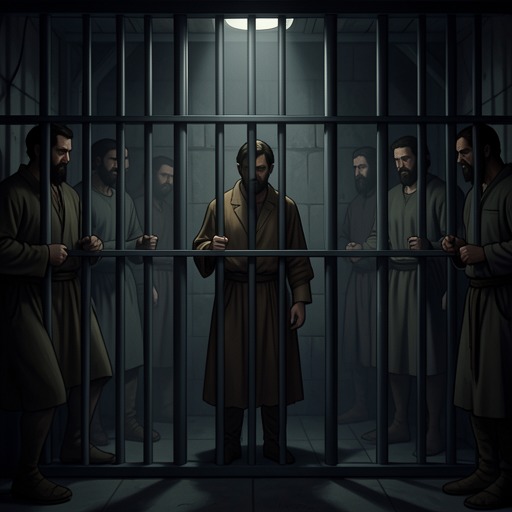
The protagonist recalls the abruptness of his change in status: one moment he was free, and the next he was incarcerated. After interrogation and booking, he first considers mistaken identity. That explanation gives way to a more disturbing one: he thinks he has been subjected to indignities simply because he happened to be there. The mountain-climber analogy makes the encounter sound arbitrary, as if the authorities’ power requires no personal reason or specific accusation beyond the opportunity to exercise it.
His account changes again after he speaks with other inmates and observes what is happening around him. He interprets the brutality not as a collection of isolated errors or the corruption of a few officers, but as the visible action of a higher, unseen authority, expressed through its lower ranks. This is a crucial enlargement of his suspicion: what began as a question about his own arrest becomes a theory about the structure behind police abuse. He presents his confinement as part of a broader pattern affecting people who have been, are, or may be harmed unless that authority is checked.
The novel preserves the distinction between the protagonist’s conviction and independent confirmation of his explanation. The account records what he believes he has recognized; it does not establish the unseen authority as an objectively demonstrated fact. His language moves from bewilderment to a comprehensive explanation, and the movement itself matters: paranoia offers coherence where the arrest initially seemed incomprehensible, while also extending the scale of the threat beyond his individual case.
Recognition and Reinforcement
In the imagined conversation with the publisher, Donald Preston, and Stacey Lowry, the protagonist feels that the two men understand him as a wronged man rather than dismissing him as a crank or as merely paranoid. He sees their recognition as extending beyond his personal demand for vindication. In his view, they understand that his struggle also concerns others subject to the same authority. Their acceptance gives his interpretation a social audience, and his sense of being understood becomes part of the imagined campaign’s foundation.
Preston remarks on the apparent incongruity between the protagonist’s cultured manner and his being behind bars. The protagonist answers that he, too, is mystified by his situation and does not fully understand the authorities’ motivation. He recalls becoming paranoid after the interrogation and booking, but then describes his later observations as the basis for his broader interpretation. Preston and Lowry respond that they have been trying to expose the real causes of police brutality for years. Their agreement appears to confirm the protagonist’s account within the scene, joining his personal experience to their established campaign against what they describe as systemic abuse.
The scene also reveals the instability beneath that confirmation. The protagonist is grateful and overwhelmed when the two men’s support seems to become actual, yet the narrative shows him with his eyes closed, reviewing the exchange and finding nothing to revise. His certainty that he will show his opponents and shake them is part of the same inwardly composed scene. The support is emotionally powerful, but the framing makes clear that its triumphant consequences are being rehearsed in imagination rather than reported as events that have occurred outside the cell.
The Senate Hearing as an Inner Scene
The imagined campaign reaches its fullest form in a Senate committee hearing. The protagonist pictures himself beside Preston and Lowry as senators enter and take their places; he sits straighter, feels singled out by their attention, and experiences growing excitement without tension. The scene’s precision gives the fantasy unusual force. He sees his blue suit, white collar, tie clip, polished shoes, the committee’s papers on a huge oak table, and the television cameras behind him. It is not a vague hope of vindication but a staged public proceeding, furnished with clothing, gestures, objects, and an audience.
His imagined hearing supplies a public framework for the account he has privately formed of authority. The chairman promises a search for truth rather than a whitewash or partisan indictment. Lowry reads a prepared statement that the protagonist understands as a manifesto for their campaign, and praises him as its brave and honest third member. These details transform his sense of persecution into a story in which he is not only the injured party but a recognized witness helping to expose a wrong. The imagined committee does not merely hear his grievance; it gives that grievance institutional stature.
The most revealing feature is how the scene overtakes the cell. It remains static for what feels like minutes or hours, while images and smells accumulate. The protagonist fears that opening his eyes will destroy it. He experiences the hearing as more real than the bunk he cannot feel and the cell in which he is locked, which, within the fantasy, seems not to exist. The contrast does not show that the hearing has taken place; it shows the intensity with which imagined recognition displaces present confinement. His paranoia and his fantasy of redress converge in a scene where the institution that has excluded him is replaced by another institution imagined to hear and vindicate him.
Return to Confinement
The imagined triumph culminates in photographs, handshakes, praise from the committee, and police officers asking for help and forgiveness. The protagonist lets the scene carry him into sleep. When a door clangs open and he wakes, the corridor sounds are muffled and gentle; he feels light, detached, and strong. The narrative thus gives the fantasy a bodily aftermath without converting its events into fact. What persists is not a real committee’s judgment but a changed feeling on waking.
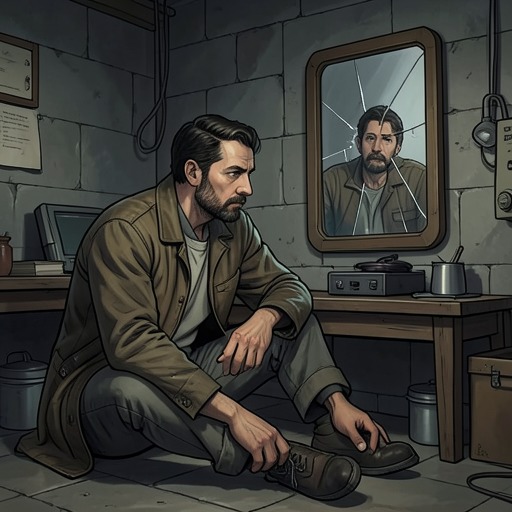
He washes, touches his pimple briefly, and then studies his face from several angles, attending to his jaw, cheeks, forehead, and eyes. He finds the expression in his eyes unchanged, a reflection of secretive knowledge. This closing scrutiny brings the account back from public vindication to solitary self-observation. Paranoia has offered him a structure in which arbitrary humiliation becomes evidence of a larger system and a future campaign promises recognition; the ending leaves him alone in the cell, examining the face that carries his certainty.