Police Abuse of Power and Law-Enforcement Violence
The RoomPolice Abuse of Power and Law-Enforcement Violence is a central concern in the novel and the force behind the protagonist’s movement from personal grievance to imagined public crusade. The text connects minor legal infractions, suspicion-based detention, and unequal courtroom treatment with the possibility of serious abuse by officers. Yet it does not present the protagonist’s account as a stable record of verified events: scenes of police violence are interwoven with fantasies of exposure and revenge, making the struggle over truth part of the subject itself.
A police state as the protagonist’s diagnosis
The protagonist imagines a society in which police surveillance reaches into ordinary life and the many obscure laws on the books give officers discretionary means to harass people. In his account, citizens cannot reasonably know every law, including old and seemingly trivial prohibitions, and may unknowingly break one during an ordinary walk. He argues that this makes legal authority available for selective enforcement: an officer who bears a grudge can turn a minor act into a pretext for punishment. These claims express his diagnosis of an expanding police state, rather than a detached survey of law or policing.
The concern is grounded in episodes of detention that the protagonist recounts. In one account, he loses his bearings while walking in an unfamiliar part of a city. A patrol car stops, and officers arrest him for suspicion without, as he understands it, specifying what he is suspected of doing. He says that he tries to explain his situation and presents his driver’s license and other identification, but is taken into custody anyway. The sequence gives the theme a concrete point of departure: ordinary disorientation is recast as suspicious conduct, and identification does not secure immediate release.
He describes the ensuing processing as a blur of rooms, fingerprinting, photographs, and repeated questions. He does not report being beaten or directly threatened with bodily harm in that episode. Instead, he recalls feeling endangered by officers’ manner and looks, and by the knowledge that he could be alone with them in a locked room. The distinction matters: the novel presents both a specific account of custody and the persistent apprehension that institutional power can make a detainee vulnerable even without an explicit threat.
A separate memory reaches back to the protagonist’s adolescence in Providence, when he had run away from home and was working on an oil barge. After he and another deckhand spend an evening with a girl, two men claiming to be police officers stop them and say that they want to check on her because she may be a runaway. At the station, the group is separated, their belongings are taken, and the protagonist is questioned about where he came from and what he was doing with the girl. The memory extends the motif beyond his adult detention: police authority enters the lives of young people who do not understand the situation or control what follows.
Police power in the courtroom
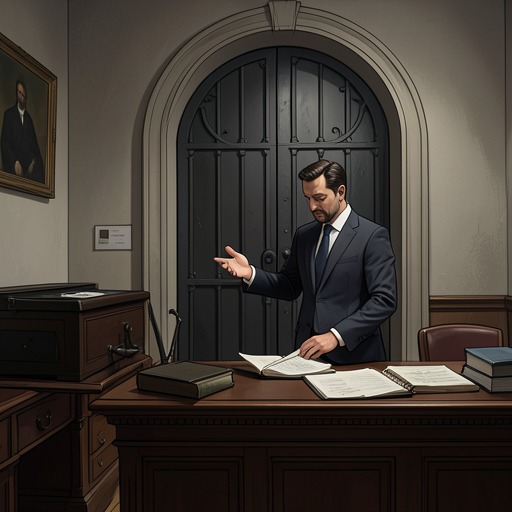
The courtroom brings the conflict between formal process and the protagonist’s sense of powerlessness into the open. When charges are read, he recognizes only a few words and experiences the proceedings as sound without intelligible meaning. He pleads not guilty, but does not feel that this establishes a meaningful connection with the appointed defender beside him. The defender gives him paper and a pencil and tells him not to speak while witnesses testify; the protagonist interprets the arrangement as evidence that he has already been abandoned. He responds by watching testimony and gestures, ready to record discrepancies that his lawyer may miss.
That response makes the trial a contest over access to legal knowledge as well as over the charge. The protagonist believes that a defendant without money cannot obtain the same resources as a wealthy accused person, and imagines that an influential lawyer such as Stacey Lowry would not stoop to represent him. He also suspects that courts use procedural rules to prevent defendants from making an effective case for themselves. These judgments are voiced through his anger and are not established as neutral descriptions of every legal actor; their importance lies in how the protagonist experiences legal procedure as something imposed on him rather than a system in which he can participate on equal terms.
His anger repeatedly turns the officers and legal authorities into targets of imagined retaliation. After a courtroom exchange, he pictures himself humiliating or physically defeating an officer who has taken the witness stand. Elsewhere he imagines reducing police to trained Dogs, subject to commands and public degradation. These scenes invert the hierarchy of uniform, force, and control that he resents. They also complicate the novel’s critique: his fantasies expose the appeal of reversing an abusive power relation, while reproducing its use of domination and bodily coercion.
The imagined case of Mrs. Haagstromm
The most sustained account of police violence is presented through the protagonist’s imagined public testimony about Mrs. Haagstromm. In a scene of fantasy, he constructs a stop on the pretext that her car resembles one reported stolen. The officers tell her they need to check her registration, then drive away from populated streets rather than taking her to a station. The shift from an apparently routine stop to an isolated setting makes the danger in the account depend on the officers’ control over both the explanation and the destination.
The imagined scene depicts Harry and Fred exploiting their authority to sexually assault and terrorize Mrs. Haagstromm. Its essential narrative facts are the officers’ deception, their control of her movement, and their use of force against a woman who believes she is being taken for an official check. The account does not establish, independently of the protagonist’s fantasy, that these events occurred as described. That uncertainty is crucial: the novel places a forceful accusation inside a narrative already shaped by the protagonist’s rage, rather than allowing the imagined testimony to function as a simple documentary record.
In his imagined address to the United States Senate Special Investigating Committee, the protagonist presents the woman’s case as an account assembled from medical treatment and periods of lucidity. He describes her as a young wife and mother whose life changes after the alleged assault, and says that she is left with severe injuries and lasting psychological impairment. He further claims that she identifies two officers from photographs during lucid intervals, but that the identification cannot be used as admissible evidence and the officers remain on duty. Within the speech, this gap between recognition and proof becomes the central institutional failure: the alleged victims’ suffering is vivid, but the legal system cannot, or will not, translate it into accountability.
The testimony expands one woman’s supposed experience into a warning about vulnerability more broadly. The protagonist argues that the victim could be anyone’s wife, daughter, or mother, and connects conspicuous violence to less dramatic abuses such as traffic tickets and gratuities. In his reasoning, tolerated misconduct accumulates; allowing small abuses to pass helps preserve conditions in which grave ones can go unpunished. The Senate scene consequently gives his private grievance the scale of a national appeal, though that political transformation belongs to the imagined campaign rather than to a verified public investigation.
Exposure, retaliation, and narrative instability
The imagined committee hearing supplies the protagonist with an audience his ordinary life denies him. He pictures himself speaking under cameras and lights, conscious of threats but calm because he believes that exposing injustice is a duty. The committee chair, in turn, thanks him for providing evidence and praises his example of defending truth. The exchange stages recognition and institutional support as the answer to his earlier isolation in custody and court. Because the speech and the chairman’s response are part of the protagonist’s fantasy, however, the apparent success does not confirm that his claims have been investigated or accepted in the world of the narrative.
The envisioned aftermath converts exposure into punishment. The protagonist imagines psychiatrists describing Harry and Fred as emotionally unstable, hostile, and sadistic, followed by a judge committing them to a state mental institution. He imagines monitoring their confinement and preventing their release for years. This is not a documented outcome for the officers; it is the protagonist’s projected settlement of the case. His fantasy replaces the impunity he fears with a system of confinement and surveillance directed at the accused, making revenge resemble the coercive authority that the imagined campaign claims to oppose.
The novel also gives this reversal a recurring bodily image in the protagonist’s fantasy of training Dogs. He imagines commanding them to remain still, run, and submit to discipline. The scene translates his resentment of police power into a role reversal in which he controls the officers’ bodies and humiliates them. Its significance is not that it records an actual police-training practice, but that it shows how thoroughly his imagined justice is organized around command and punishment. The fantasy offers temporary mastery while revealing how easily opposition to domination can adopt domination’s methods.
Across arrest memories, courtroom proceedings, and invented testimony, the novel leaves readers to distinguish institutional facts from the protagonist’s interpretations and imagined outcomes. The arrest for suspicion and the incomprehensible charge-reading scene establish his felt exclusion from legal process; the elaborated case of Mrs. Haagstromm turns that grievance into an accusation of unchecked police violence; the imagined Senate hearing gives the accusation public authority; and the dreamed punishment of Harry and Fred reveals the retaliatory structure beneath his crusade. Police abuse is therefore both a subject of social criticism and a pressure shaping the protagonist’s unreliable sense of justice. The text can condemn the vulnerability created by unchecked authority without treating his fantasies of exposure and revenge as proof that the imagined events or their promised resolutions are real.