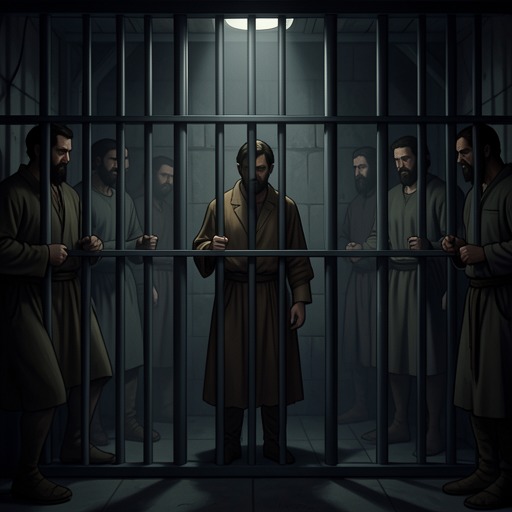
Police abuse of authority and impunity
The RoomPolice abuse of authority and impunity is presented as more than individual misconduct: it is a condition in which police powers can be used against ordinary people, while legal and institutional barriers leave victims without redress. The novel develops this idea through the Unnamed protagonist’s claims about arbitrary enforcement, the account of Mrs. Haagstromm’s assault and its aftermath, and his imagined campaign for investigation. It also complicates that indictment by setting his public rhetoric beside his private anger and fantasies of retaliation.
The claim of a Police state
The Unnamed protagonist frames the problem as a Police state: he imagines the police as the visible agents of a state that watches people wherever they go. His argument begins with the distance between the law as written and the law as lived. Ordinary citizens, he contends, cannot know every law on the books, including obsolete or petty regulations, and therefore cannot reliably avoid violating one. In his account, the existence of such rules gives police a pretext to harass people at their discretion.
He further rejects the reassurance that archaic laws are harmless because they are rarely enforced. A person who has incurred an officer’s resentment, he argues, may be punished over a minor matter such as parking slightly too far from the curb or dropping a cigarette butt. The examples connect everyday encounters to a larger concern: enforcement is not necessarily even-handed when an officer can use legal authority to settle a personal grievance. The resulting fear comes not only from severe violence but also from the uncertainty of being subject to rules that can be selectively applied.
Mrs. Haagstromm and the cost of unchecked authority
The novel gives this argument a specific human consequence through Mrs. Haagstromm. In the account presented during the protagonist’s imagined campaign, she is a young wife and mother with no prior history of trouble. On April 2, while returning to collect her young daughter, she is stopped by two officers who claim that her car resembles one reported stolen. Instead of resolving the supposed discrepancy at a station, they take her to an isolated area and assault her. The narrative makes clear that their police authority is what enables the deception: the ordinary appearance of a traffic stop conceals the coercion that follows.
The consequences continue long after the encounter. Mrs. Haagstromm is found the next morning and taken to General Hospital in a critical condition. Her injuries require extensive treatment, and she loses her right foot. The account also describes severe psychological collapse: after months of treatment she remains unable to care for herself and is confined to a mental institution. The novel stresses the contrast between her former life as a daughter, wife, and mother and the lasting dependence that follows the assault. Her young child and the rest of her family are part of the harm, not incidental details.
The account’s pursuit of accountability reaches a dead end. During lucid intervals, Mrs. Haagstromm recognizes two officers in photographs shown to her, but the speaker says that the identification cannot be used as admissible evidence. The men remain on the force. The crucial contrast is between the certainty the account attributes to the victim and the inability of the legal system to act on it. Her suffering is described at length, yet the institution that could punish the perpetrators is presented as unable to translate that knowledge into a case.
Everyday misconduct and cumulative harm
The novel links this extreme case to lesser abuses rather than treating it as an isolated horror. In the protagonist’s argument, traffic tickets and gratuities may look trivial on their own; tolerated one by one, however, such acts help normalize discretionary authority. The progression from minor enforcement to grave abuse is part of his causal claim: when small abuses are ignored, officers learn that they can act without consequence, and the public has less reason to trust that power will be restrained.
The imagined account also depicts officers using a purported stolen-car check to approach a woman driver, making sexualized comments about her and misleading her about where they are taking her. This episode shows how official procedure can provide cover for predatory conduct. The badge and the claim of an investigation are not neutral details in the scene; they are the means by which the officers control the encounter and make resistance more difficult. The narrative thereby connects public authority to control over an individual’s movement and bodily autonomy without suggesting that every police interaction has the same outcome.
The protagonist’s response and its contradictions
The Unnamed protagonist’s response combines a demand for public scrutiny with fantasies of revenge. In his imagined campaign, he proposes a thorough review of how police officers are selected, arguing that preventing future incidents requires examining the procedures that give men guns and authority. He extends the consequences beyond the direct victim to her family, the officers’ families, and the public whose confidence in social institutions may be altered by such events. The proposed review is framed as a way to prevent repetition, not merely to punish after the fact.
Elsewhere, his anger takes a less reformist form. He imagines humiliating and physically defeating Fred in court, and he pictures police dogs subjected to a cruel training regime in a reversal of the power officers exercise over others. These scenes are fantasies, not accounts of actions he carries out. Their significance lies in the way they turn the structure of domination around: the person who feels powerless imagines himself commanding, punishing, and publicly exposing those who have authority. That reversal expresses the intensity of his grievance, but it also shows how readily his proposed answer reproduces coercion.
Law, procedure, and impunity
The novel sets the protagonist’s sweeping claims beside his own actual experience of court procedure. When charges are read, he recognizes little of the legal language and pleads not guilty. His appointed counsel gives him paper and a pencil for questions, but he immediately suspects that the lawyer has already betrayed him. As witnesses are called, he resolves to watch for inconsistencies and supply his own defense with evidence. The scene conveys his distrust as an experience of alienation from proceedings whose language and roles he does not control; it does not, by itself, establish every allegation he makes about the justice system.
His later reflections widen that mistrust into a claim that punishment depends on money and access to legal representation. He contrasts people who receive substantial sentences for small thefts or remain jailed while awaiting trial with wealthy defendants who can hire lawyers and secure more favorable treatment. He also believes that procedural rules prevent a defendant from defending himself effectively. Read alongside the account of Mrs. Haagstromm, this conviction produces a bleak institutional pattern: legal rules may seem rigid when applied to defendants with little power, yet insufficient when a victim seeks action against officers. The subject’s force comes from that disparity, and from the unresolved question of whether exposure and proposed reform can overcome a system the protagonist experiences as closed to those without authority or money.