Pretrial detention
The RoomPretrial detention is the unnamed defendant’s enforced waiting between arrest and the resolution of his case, lived in locked cells and punctuated by a long trip to the Courtroom. It is not merely a legal interval: the account makes confinement a bodily and perceptual condition, in which routine becomes indistinguishable time, minor details command attention, and helplessness gives rise to fantasies of action that the prisoner cannot carry out.
The Cell and the Work of Waiting
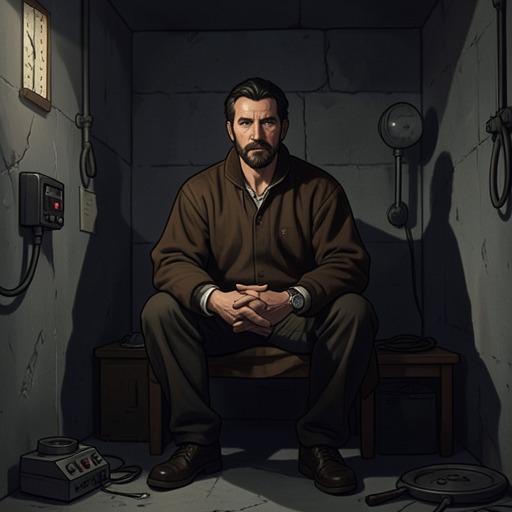
In his cell, the defendant fixes on a small window and the dim corridor beyond it. Though he knows there is nothing to see, he studies the reflected image of his face and the wall opposite, only seven feet away. He reads labels over the dirty-linen baskets—shirts, pants, blankets, and towels—repeating them and shifting position to make out the last signs. This careful inventory gives the hours a task, but no larger purpose: he does not even need to check whether he has remembered the words correctly.
The mirror offers another small object for sustained scrutiny: a red blemish on his cheek that may be a developing pimple. He considers squeezing it, stops because that could bruise the skin, and returns to touching and examining it. The episode narrows attention to what can be seen and felt within reach. Even the cell’s lighting becomes uncertain. Although the room is dimmer than during the day, he experiences it as bright as a sunny beach, then questions whether that impression makes it so. Confinement unsettles the distinction between a condition and the mind’s experience of it.
The cell also produces anger through its ordinary failures. Smoke from a cigarette hangs in the room rather than disappearing into the ventilation vents, which he believes do not work. He reads the failed ventilation as part of a larger refusal to care for prisoners, imagining that he will expose the police department and jail system. He throws the cigarette into the commode, arranges his pillow against the wall, and lies down. The movement from grievance to imagined public retaliation, then back to the bunk, makes the limits of his immediate power visible: the cell contains both his protest and his body.
Court Proceedings and Distrust
When the charges are read, he recognizes only some of the words. Legal language reaches him more as sound than as meaning; he knows he is standing in the Courtroom and that the proceeding is real, but feels otherwise uncertain about what is happening. Asked for his plea, he answers not guilty. His defense counsel gives him paper and a pencil and instructs him to write down questions rather than interrupt testimony. The defendant accepts them without protest, but regards the unfamiliar lawyer as someone who has already betrayed him.
He tries to make the paper into a means of defense. He intends to listen closely, record inconsistencies, and supply his counsel with points that could undermine the prosecution’s case. But he experiences the lawyer as failing to notice discrepancies and allowing the proceeding to pass without action. After the judge denies a motion to dismiss, the defendant interprets the remaining questions and answers as further evidence that his lawyer is doing nothing for him. His distrust thus shapes not only his view of counsel but also his experience of the hearing: a procedure meant to test the case appears to him as a succession of missed opportunities.
The hearing ends, and he is led back to his cell, but the account gives little sense of a completed legal resolution. Instead, it measures the proceeding by its cost in time and sensation. The day has seemed endless while he waits, yet, once back in the cell, its events seem compressed and difficult to recall. His eyes burn and ache under the light; his body feels ready to move, as if it needs to direct its energy against someone, while the heavy feeling in his eyes pulls him toward the bunk.
Confinement, Violence, and Distorted Time
Lying down, he imagines that he should have seized a guard, broken his neck, opened the cells, and set the prisoners loose against uniformed officers. In the fantasy, however, his arms move with an impossible slowness, remaining far from the guard while he watches and urges them onward. The imagined violence does not become an escape or an action: the sequence gives way to the physical sensation of his hand falling asleep. He wakes, rubs his face, splashes cold water on it, and returns to examining the blemish. The contrast joins a sweeping fantasy of revolt to the small bodily discomforts that actually govern his movements.
Time in custody has no stable measure for him. He says that meals, occasional showers, and lights that remain on make the time of day meaningless; the greater noise during the day is one of the few distinctions left. He recalls being awakened for Courtroom proceedings at about 5:30 and returning after 7:30, fourteen hours later. Yet he can review the day in minutes. In between are repeated stages of waiting: on a bench, in holding tanks, for clothes, to be chained, on a bus, and again in the courthouse and jail. The precise itinerary explains how a day can feel endless in the moment and nearly vanish in retrospect.
A separate account of custody clarifies that not every period of isolation was officially treated as Solitary confinement. Discussing a spot found on his lung, which he believed was an old scar from pleurisy, the defendant recalls being placed in a nine-by-six-foot cell in the jail’s tuberculosis-suspect section. He says he had not known that his shrug in response to the medical examination would lead to that placement. Although he distinguishes this cell from what other prisoners called the hole, he describes being locked alone in even a small room as a powerful experience. The qualification matters: the account marks a difference in the jail’s terminology without making the confinement feel minor.
Significance
Across these episodes, Pretrial detention is rendered through a friction between institutional procedure and private experience. Charges are read, motions are decided, and prisoners are transported through a sequence of controlled spaces; for the defendant, those processes become hard to absorb and impossible to measure. His efforts to watch, remember, and prepare notes coexist with suspicion that counsel has abandoned him, while imagined retaliation coexists with a body confined to a bunk and a cell. The account’s repeated attention to labels, lighting, smoke, a blemish, and waiting shows how confinement reorganizes attention around what is near and repetitive. The proceeding moves forward, but the prisoner’s immediate world remains locked, difficult to interpret, and marked by time that both drags and disappears.